




Volume 197 - Issue 2
Survival guide on child health
Author: Julian J Kelly
Med J Aust 2012; 197 (2): 120. || doi: 10.5694/mja12.10547
Published online: 16 July 2012
Published online: 16 July 2012
IT WAS always going to be a difficult task to summarise all possible paediatric presentations into a single book to help junior medical staff “on call”, so the authors of this effort are to be commended.This is an Australian adaptation of the popular American handbook, and all three Australian authors - Browne, McCaskill and Cheng - are senior staff in the emergency department at the ...
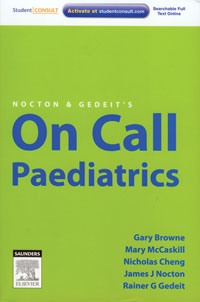
Nocton & Gedeit’s on call paediatrics.
Gary Browne, Mary McCaskill, Nicholas Cheng, James J Nocton, Rainer G Gedeit. Sydney: Saunders, 2011 (xiii + 505 pp, $74.95). ISBN 9780729539128.
IT WAS always going to be a difficult task to summarise all possible paediatric presentations into a single book to help junior medical staff “on call”, so the authors of this effort are to be commended.
This is an Australian adaptation of the popular American handbook, and all three Australian authors — Browne, McCaskill and Cheng — are senior staff in the emergency department at the Children’s Hospital at Westmead, University of Sydney.
The book tries to simplify the task of making a sensible assessment of the symptom or condition presented, and then moving on to managing the problem or asking for help. Chapter 4 is titled “a survival guide” but, surely, the book itself is a survival guide.
The major problems with the book are in the detail. It is difficult to create guidelines for all paediatric centres but the ones presented often revert to emergency care rather than general hospitalist-based practice. Also, some of the guidelines seem outdated and parochial, and not really evidence-based.
In other sections, there is a wealth of detail, much more than required for a handbook — for example, the coagulation cascade tables and vasopressor effect tables for different inotropes.
Another problem is that the terminology used is inconsistent. For example, the very ill patient is described as “critical (about to die)” in one chapter, and “lethargic (critical)” in another. Management of the deteriorating patient is crucial and should be made as simple and iterative as possible.
There are a number of issues with perspective as well — rare conditions that seem to stick in paediatricians’ minds, such as C1 esterase deficiency, are given prominence. Yet there are obvious omissions of more common conditions such as juvenile idiopathic arthritis.
On a positive note, the appendices and index are excellent and would be very useful to anyone on call. On the whole, however, this book requires major restructuring to be a useful guide for junior doctors with the task of looking after sick children and adolescents in the hospital setting.
Barriers and Facilitators to Timely Detection and Optimal Management of Chronic Wet Cough in Aboriginal Children Across Australia From the Perspectives of Carers of Aboriginal Children: A Qualitative Study
Gloria T. Y. Lau, Pam Laird, Robyn Aitken, Melanie Barwick, Liam Bedford, Emily R. Bowden, Jamie Everingham, Angela Fuery, Reece Griffin, Neha Jain, Mina Kinghorn, Renae Knapp, Gabrielle B. McCallum, Peter Morris, Richard Norman, Peter C. Richmond, Aarti Saiganesh, Slade Sibosado, Cameron Taylor, Maree Toombs, Roz Walker, Joan Wilson, Anne B. Chang, André Schultz
Barriers and Facilitators to Timely Detection and Optimal Management of Chronic Wet Cough in Aboriginal Children Across Australia From the Perspective of Health Care Providers: A Qualitative Study
Gloria T. Y. Lau, Pamela Laird, Robyn Aitken, Melanie Barwick, Liam Bedford, Emily R. Bowden, Corey Dalton, Jamie Everingham, Angela Fuery, Reece Griffin, Neha Jain, Mina Kinghorn, Renae Knapp, Gabrielle B. McCallum, Peter Morris, Richard Norman, Peter C. Richmond, Aarti Saiganesh, Slade Sibosado, Maree Toombs, Roz Walker, Joan Wilson, Anne B. Chang, André Schultz
Short-Term Safety of Concomitant Meningococcal B and National Immunisation Program Vaccines in Infants Aged < 15 Months: A Survey-Based Surveillance Study
Thuy Nguyen, Evelyn C. S. Tay, Michael Dymock, Thomas L. Snelling, Lucy Dawes, Julie Marsh, Yue Wu, Alan Leeb, Nicholas Wood, Lucy Deng
The GenV Biobank: Enabling Biological Research in a Large Longitudinal Population-Representative Cohort of Australian Newborns and Their Parents
Katherine Lange, Kim L. Powell, Yeukai Mangwiro, Tony Frugier, Donna T. Geddes, Melissa Wake, Richard Saffery
Watchful Waiting Compared With Immediate Antibiotics for Urban Aboriginal and Torres Strait Islander Children With Uncomplicated Acute Otitis Media (WATCH): A Non-Inferiority Randomised Controlled Trial
Jennifer S. Reath, Hasantha Gunasekera, Sanja Lujic, Amanda J. Leach, Letitia Campbell, Robyn Walsh, Tim Usherwood, Geoffrey K. Spurling, Claudette A. Tyson, Deborah A. Askew, Kelvin Kong, Chelsea J. Watego, Peter Morris, Wendy Hu, Penelope A. Abbott
A Rare Case of Storage Mite Anaphylaxis in Infancy
Eliza Kluckow, Katie Frith