




Volume 197 - Issue 11
Heartwarming, heartbreaking memoir
Author: Natalie J Gray
Med J Aust 2012; 197 (11): 662. || doi: 10.5694/mja12.11404
Published online: 10 December 2012
Published online: 10 December 2012
FOR MOST AUSTRALIAN DOCTORS, a child dying from malnutrition, malaria or tuberculosis is something you read about in textbooks, not see in your day-to-day practice. Yet for doctors like Damien Brown, a volunteer with humanitarian organisation Médecins sans Frontières (MSF), it is an all too regular reminder of the impact that conflict, weak governance, and a lack of essential services have on the health of ...
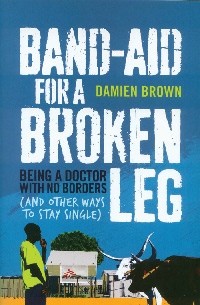
Band-aid for a broken leg: being a doctor with no borders (and other ways to stay single).
Damien Brown. Sydney: Allen and Unwin, 2012 (xiv + 360 pp, $25.99). ISBN 9781743310212.
FOR MOST AUSTRALIAN DOCTORS, a child dying from malnutrition, malaria or tuberculosis is something you read about in textbooks, not see in your day-to-day practice. Yet for doctors like Damien Brown, a volunteer with humanitarian organisation Médecins sans Frontières (MSF), it is an all too regular reminder of the impact that conflict, weak governance, and a lack of essential services have on the health of the communities they serve.
Band-aid for a broken leg details Dr Brown’s experiences on his first mission in Mavinga, Angola, and his later missions in Mozambique and Nasir (in what is now South Sudan). Accounts of his often challenging, yet ultimately rewarding, cross-cultural interactions with local health workers are skilfully intermingled with the stories of specific patients and the surreal happenings of the world in which he finds himself — a leopard attack, a plane door flinging open mid-flight and a traditional Angolan wedding celebration being notable examples.
Throughout his journey, Dr Brown’s skills as a clinician, a linguist, a compassionate development practitioner and a colleague are all tested; and he emerges a better doctor for it. Not one to downplay either his own limitations or his questioning of development approaches, Band-aid for a broken leg is an honest and moving tribute to the patients seeking MSF’s care, the volunteers who sometimes risk their lives to provide it, and the local staff who work with pride and determination to serve their people, all the while tolerating the enthusiastic young doctors, nurses and midwives who rush in to try to make a difference.
Heartwarming and heartbreaking in equal parts, Band-aid for a broken leg will appeal to those who have worked in resource-poor and insecure settings, as well as to anyone who wonders what it would be like.
Capturing the Benefits of Clinical Quality Registries
Taryn Bessen, Stephen McDonald
Medical Colleges Have an Obligation to Ensure Full Participation in Clinical Quality Registries
Thomas J. Hugh
Getting on the Same Page: Why Australia Needs a National Maternity Early Warning System (MEWS) Chart
Briony A. Cutts, Lucy Bowyer, Nisha Khot, Sandra Lowe, Stefan C. Kane
Data for Equity: Can Linked Administrative Data Inform Pathways to More Equitable Child Health?
Sarah Gray, Shuaijun Guo, Meredith O'Connor, Elodie O'Connor, Katrina Williams, Hannah Badland, Susan Woolfenden, Josie Dickerson, Gerry Redmond, Marnie Downes, Sharon R. Goldfeld
Specialty College Selection: Why Change is Critical to Support a Future Rural Workforce
Matthew R. McGrail, Jenny May AM, Katherine Logan
Differentiated and simplified oral HIV pre‐exposure prophylaxis (PrEP) models hold the key to virtually eliminating HIV transmission in Australia by 2030
Tyson Arapali, Sarah Warzywoda, Anthony K J Smith, Curtis Chan, Timothy R Broady, Erin Sullivan, Catherine MacPhail, Mohamed A Hammoud, Alexander Dowell‐Day, Benjamin R Bavinton