




Volume 193 - Issue 11
Straight from the crocodile’s mouth
Authors: Samuel J Fitzpatrick and Amanda L Thomas
Med J Aust 2010; 193 (11): 717. || doi: 10.5694/j.1326-5377.2010.tb04119.x
Published online: 6 December 2010
Published online: 6 December 2010
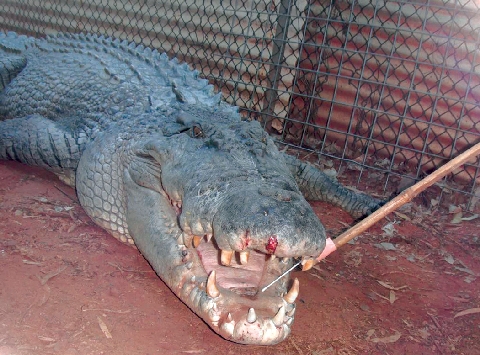
We present a case of an older patient who sustained dental trauma during a break-and-enter and assault at his home in Broome, Western Australia. Cruelly nicknamed “Fatso” from a young age, our patient was an 80-year-old gentleman who lived on his own in a care facility, in close proximity to individuals in similar circumstances. Despite weighing 800 kg and being 5 metres tall, the patient was able to mobilise on all four limbs, and was self-caring apart from receiving a daily meal service similar to that of “Meals on Wheels”.1
The assailant sat on top of the patient, who bravely fought back by biting the assailant’s knee. This caused damage to the patient’s teeth. He was unable to mount a more vigorous response, as it was a cool night, which rendered him more lethargic than usual.
The patient was a vague historian, but there were no noticeable complaints of pain or any behavioural change. Blood tests were not performed because of the difficulty of penetrating the patient’s extremely tough skin.
The patient made a remarkably swift and uncomplicated recovery, restarting his normal high-protein (mostly whole-chicken) diet after a brief period of observation.
This was in stark contrast to what followed for his assailant, whose history we also briefly present.2 He was taken into clinical custody, where it was discovered that the patient’s tooth had penetrated his knee joint capsule, as well as causing several deep irregular lacerations. The assailant required a prolonged hospital admission after developing fever and septic arthritis.
Despite repeated attempts to culture the assailant’s blood and joint aspirates, the cultures did not grow any organisms. To assist in his treatment, the hospital’s Infectious Diseases Department requested swabs from Fatso’s mouth, teeth and tongue to attempt to identify the likely cause of the infection. This was achieved during a home visit, with specially modified swabs (see Box) and a degree of trepidation. The mouth swabs grew Aeromonas hydrophila and Trichosporon asahii, consistent with the predominantly gram-negative and fungal microorganisms expected. The organisms were found to be sensitive to meropenem, vancomycin and ciprofloxacin. These findings were used to tailor the antibiotic therapy for the assailant.
The assailant made a slow and difficult recovery, with ongoing fever and joint inflammation. He was transferred to a metropolitan hospital for further treatment.
References
- Meals on Wheels Australia [website]. http://www.mealsonwheels.org.au/Home.aspx (accessed Oct 2010).
- Broome tourist survives tussle with 5m saltwater crocodile. Perth Now 2010; 13 Jul. http://www.perthnow.com.au/news/broome-man-survives-tussle-with-5m-saltwater-crocodile/story-e6frg12c-1225891029000 (accessed Oct 2010).
Costs of Delivering the Hep B PAST Model of Care in Remote Australia: A Retrospective Pre–Post Study
Hoa Nguyen, Anh Le Tuan Nguyen, Paula Binks, Melita McKinnon, Emily Vintour-Cesar, Karen Wills, Nicola Stephens, Benjamin Cowie, Joshua S. Davis, Yuejen Zhao, Peter Nihill, Julie A. Campbell, Andrew J. Palmer, Jane Davies, Barbara de Graaff
Buruli Ulcer Acquired From Ringtail Possum Rescue
Daniel P. O'Brien, Naomi Clarke, Sara Bonnici, Mohammad A. Hussain
Q Fever Visceral Abscesses After Contact With Native Australian Marsupials
Samantha J. Laws, Enzo Binotto, James Stewart, Jennifer Ho, Trent Yarwood, Josh Hanson, Simon Smith
Hospital-Admitted Injection-Related Infections Among Incarcerated People Who Inject Drugs in Australia: A Retrospective Cohort Study
Andrew Palmer, Matthew Carter, Jeremy Yeo, Cecilia Shim, Jason Connor, Jeremy Hayllar, Gerald Holtmann, Naomi Moy, Elliott G. Playford, Naomi Runnegar, Paul J. Clark
The Live Attenuated Influenza Vaccine in Australia: An Additional Tool for Influenza Prevention
Cyra Patel, Alexis Pillsbury, Tran Nguyen, Xia Wang, Helen E. Quinn, Clayton K. Chiu, Allen C. Cheng, Katie L. Flanagan, Zhicheng Wang
Reflex Testing for Hepatitis D Infection: A Unique Opportunity to Reduce Hepatitis D-Related Chronic Liver Disease Deaths in Australia
Jessica Howell, Lauren Andersson, Miriam T. Levy, James O'Beirne, Leon Adams, Katharine Irvine, Avik Majumdar, Golo Ahlenstiel, Kathy Jackson, Krispin Hajkowicz, Joseph Doyle, Jane Davies, Sarah Cherian, Wayne Dimech, Alexander J. Thompson