




Volume 192 - Issue 12
Being “a little bit pregnant”
Author: Lisa H Amir
Med J Aust 2010; 192 (12): 718. || doi: 10.5694/j.1326-5377.2010.tb03712.x
Published online: 21 June 2010
Published online: 21 June 2010
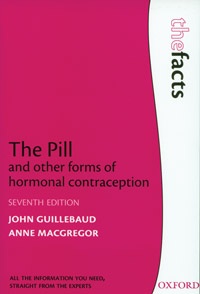
The pill and other forms of hormonal contraception. The facts. 7th ed.
John Guillebaud, Anne MacGregor. Oxford: Oxford University Press, 2009 (xix + 193 pp). ISBN 9780199565764.
Does life begin at fertilisation or implantation?
At times, the sticky question about whether certain types of contraception are actually causing an abortion arises with patients or colleagues. This book helps by providing a discussion of some ethical aspects of contraception in one of the appendices, where the authors argue that one can write an equation for the definition of conception as follows:
CONCEPTION = FERTILIZATION + IMPLANTATION
(being with child) (crucial) (also crucial)
This equation makes it possible to argue that methods of contraception which may block implantation are contraceptives, and not abortifacients.
John Guillebaud is Emeritus Professor of Family Planning and Reproductive Health at University College London, and a guru in family planning. He first wrote this guidebook in 1980 as he is passionate about sharing his knowledge with women: “here are the facts, now you decide”. Anne MacGregor is an Instructing Doctor in Sexual and Reproductive Healthcare at the Royal College of Obstetricians and Gynaecologists, London.
This “book about the Pill for a general readership” is a user-friendly explanation of the contraceptive pill and other hormonal contraceptive methods. There are plenty of diagrams, tables and flowcharts to assist the reader’s understanding of reproductive physiology, choice of pill and what to do about breakthrough bleeding and other management issues. Tables present the risks and side effects, but also the benefits of taking the Pill.
Although many people regard the Pill as “unnatural”, one could argue that having regular menstrual cycles is an unnatural condition. Before contraception was available, women would have been pregnant or breastfeeding for most of their reproductive lives. Although the Pill is not suitable for all women, many women find that taking the Pill and being “a little bit pregnant” works well at one or more stages of their life, or “contraceptive ages” as this book puts it.
Forty Years in the Making: Reporting on the Co-Creation of a National Roadmap for Birthing on Country Services for the Best Start to Life
Res McCalman, Anneka J. Bowman, Roianne West, Kristie Watego, Jyai Allen, Claire Clack, Sue Kildea, Sue Kruske, Melanie Briggs, Cleone Wellington, Rebecca Coddington, Yu Gao, Isabella Garti, Sascha Kowalenko, Sarah Ireland, Catherine Austin, John D. Boffa, Marah Prior, Kelsie Kahl, Bettina Chaseling, Sarah Khaw, Emily Armstrong, Donna Hartz, Yvette Roe
Temporal Trends in Preterm Birth Associated With Hypertensive Disorders of Pregnancy in Victoria, Australia: A Population-Based Interrupted Time-Series Study
Melvin Marzan, Heng Jiang, Daniel Lorber Rolnik, Joanne M. Said, Lisa Hui
Linguistic Manoeuvres: Obstetric Violence Camouflages Harm and Loss of Consent From Birth
Liz Sutton, Harsha Ananthram, Rebecca Matthews
Linguistic Manoeuvres: Obstetric Violence Camouflages Harm and Loss of Consent From Birth
Bashi Kumar-Hazard, Andrew M. Bisits, Sharon L. Settecasse, Jenny Gamble, Hazel Keedle, Hannah G. Dahlen
Linguistic Manoeuvres: Obstetric Violence Camouflages Harm and Loss of Consent From Birth
Wendy Pollock, Alissa Fleming, Ensieh Fooladi, Joy Kloester, Anne Tremayne, Yasmin Zisin, Bethany Carr, Kym Davey, Suzanne Willey, Jenny Gamble
Getting on the Same Page: Why Australia Needs a National Maternity Early Warning System (MEWS) Chart
Briony A. Cutts, Lucy Bowyer, Nisha Khot, Sandra Lowe, Stefan C. Kane