




Volume 191 - Issue 1
Childhood obesity in Australia remains a widespread health concern that warrants population-wide prevention programs
Authors: Rae-Chi Huang, Fiona J Stanley and Lawrence J Beilin
Med J Aust 2009; 191 (1): 45-47. || doi: 10.5694/j.1326-5377.2009.tb02681.x
Published online: 6 July 2009
Published online: 6 July 2009
To the Editor: We concur wholeheartedly with Gill and colleagues1 in support of recognising obesity as a public health issue, and we dispute claims that the current problem of obesity is being exaggerated.
Gill and colleagues point out that obesity trends have climbed over decades, and state that 6%–8% of Australian school children are affected.1 While this is a substantial burden of over a quarter of a million children, we also consider that restricting definitions of obese to arbitrary cutoff points may underestimate the problem, given that the entire distribution of childhood weight is increasing, not just the extreme group classified as obese. Adiposity is related to cardiovascular outcomes such as myocardial infarction and stroke in a (curvi)linear fashion. Defining obesity by arbitrary cutoff points is vulnerable to differences between sexes, ethnicity and age, and limits our understanding of obesity-related diseases.
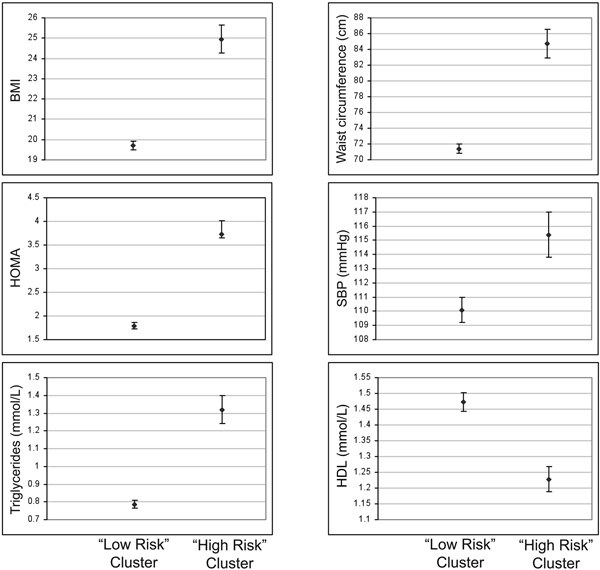
It is well known that cardiovascular risk factors cluster, particularly the adiposity-driven components of the so-called metabolic syndrome. In the Western Australian Pregnancy Cohort (Raine) Study, we have used cluster analysis to identify a group of children at risk of future cardiovascular disease with features of the metabolic syndrome.2 The differences in characteristics are shown in the Box. The “high risk” and “low risk” cluster groups differ widely in terms of not only body mass index, the most widely used measure of obesity, but also waist circumference (a measure of central adiposity), insulin resistance, blood pressure, and levels of triglycerides, high-density lipoprotein cholesterol, total cholesterol (data not shown) and low-density lipoprotein cholesterol (data not shown). Not only the conventionally used 95% confidence intervals, but also the 99% confidence intervals do not overlap for any of these intermediate cardiovascular risk factors. We found that 29% of children were in the high-risk cluster at the age of 14 years2 and a similar analysis suggested that even at age 8 years, 25% of children were at increased risk of future obesity, cardiovascular disease and diabetes.3 C-reactive protein (CRP) level is known to be associated with future cardiovascular diseases in adults,4 and with an adverse metabolic profile in children.5 The “high risk” children had significantly higher CRP levels at the age of 14 years than their low-risk counterparts.
Certainly, the magnitude of this problem, affecting up to a third of our youth, needs to be addressed by government and health-planning bodies. We suggest our approach of cluster analysis will help identify earlier those children at substantially increased risk of cardiovascular and other adiposity-related disorders in Australia.
Features of the cluster groups with respect to components of the metabolic syndrome, showing 99% CIs*
 | |||||||||||||||
|
BMI = body mass index. HOMA = homeostatic model assessment (for quantifying insulin resistance). SBP = systolic blood pressure. HDL = high-density lipoprotein cholesterol. * From Huang et al.2 Reprinted with permission from the American Diabetes Association. | |||||||||||||||
Acknowledgements
We are extremely grateful to all the families who took part in this study and to the Raine Study team. We acknowledge the support of the Raine Medical Research Foundation, Healthway, Western Australia and the Telethon Institute for Child Health Research (University of Western Australia) and the National Health and Medical Research Council (NHMRC). Rae-Chi Huang is supported by the NHMRC Postgraduate Research, NHMRC Centre for Clinical Research Excellence (Royal Perth Hospital) and Athelstan and Amy Saw Research scholarships.
References
- Gill TP, Baur LA, Bauman AE, et al. Childhood obesity in Australia remains a widespread health concern that warrants population-wide prevention programs. Med J Aust 2009; 190: 146-148. 0_CBBDGFFI
- Huang RC, Mori TA, Burke V, et al. Synergy between adiposity, insulin resistance, metabolic risk factors, and inflammation in adolescents. Diabetes Care 2009; 32: 695-701. 0_CHDDBJCF
- Huang RC, Burke V, Newnham JP, et al. Perinatal and childhood origins of cardiovascular disease. Int J Obes (Lond) 2007; 31: 236-244. 0_CHDFEIDB
- Ridker PM, Hennekens CH, Buring JE, Rifai N. C-reactive protein and other markers of inflammation in the prediction of cardiovascular disease in women. N Engl J Med 2000; 342: 836-843. 0_CHDEHJII
- Ford ES, Ajani UA, Mokdad AH. The metabolic syndrome and concentrations of C-reactive protein among US youth. Diabetes Care 2005; 28: 878-881. 0_CBBFBDFE
Fatty Liver Disease in Australia: A Narrative Review on the Epidemiology, Natural History, Prognostication and Management in People With Metabolic Dysfunction
Karl Vaz, Daniel Clayton-Chubb, William W. Kemp, Stuart K. Roberts, Ammar Majeed
Sex Differences in Management and Outcomes of People With ST-Elevation Myocardial Infarction, New South Wales, 2011–2020: A Retrospective Cohort Study
Adam C. Livori, Jedidiah I. Morton, Dianna J. Magliano, Jonathan E. Shaw
Rethinking Rheumatic Fever Diagnosis: Progress, Pitfalls and the Path Towards a Definitive Test
Anna P. Ralph, Rachel Webb, Tom Parks, Nicole J. Moreland, Asha C. Bowen, Benjamin Jones, Emma Ndagire, Andrea Z. Beaton
Sex Differences in Management and Outcomes of People With ST-Elevation Myocardial Infarction, New South Wales, 2011–2020: A Retrospective Cohort Study
Samia Kazi, Simone Marschner, Clara K. Chow
Distribution of Cardiovascular Disease Risk Based on the Updated 2023 Guideline-Recommended Australian Cardiovascular Disease Risk Algorithm and Comparison With the 2012 Algorithm: An Observational Study
Nina Lazarevic, Meghana Bhat, Grace Joshy, Danielle C. Butler, Mark Woodward, Anushka Patel, Rod T. Jackson, Garry Jennings, Rosemary Wyber, Ellie Paige, Emily Banks
They Brought the Hospital to Me
Hugh N. Burrill