




Volume 190 - Issue 2
Amphetamines, from there to here
Author: Danny H Sullivan
Med J Aust 2009; 190 (2): 73. || doi: 10.5694/j.1326-5377.2009.tb02280.x
Published online: 19 January 2009
Published online: 19 January 2009
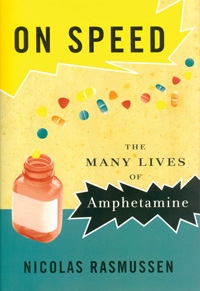
On speed: the many lives of amphetamine.
Nicolas Rasmussen. New York: New York University Press, 2008 (ix + 351 pp). ISBN 978 0 8147 7601 8.
Amphetamines are highly topical in the Journal — recent articles have discussed the controversies of prescribing them for attention deficit hyperactivity disorder, and their associations with violence in emergency departments and criminal offending. This book situates current concerns about stimulant use in a historical context and, in doing so, crosses swords with the pharmaceutical industry. But Rasmussen also has insights into the past roles of military medicine and social concerns that might be exploited to increase market share for drugs that are sold for “aspirational” goals.
The author’s background is in history and philosophy of science. His book is at times irritating, particularly with repeated and unconvincing efforts to calculate past consumption of stimulants in the United States. These quibbles are minor, however, for the scope of his work is provocative and applicable to other areas in which social mores and medicine interact. His premise — that amphetamines have been marketed and remarketed for dubious indications and social woes, rather than for medical problems — is appealing and his research painstaking. However, most intriguing is the discussion of marketing, of efforts to rebrand addiction as habituation, and of the evolution of life problems seen as warranting psychopharmacological intervention. Rasmussen makes a good case that patent medicines and their promises have been supplanted by amphetamines and related drugs.
This is a well referenced and easily read book, which reminds the reader that uncritical acceptance of drug marketing is unwise. The book is not as tendentious as the works of David Healy or Peter Breggin, and for that is all the more compelling. Nevertheless, any doctor will be challenged by the ease with which novel drug indications are accepted and by the shifts in prescribing patterns, which remain so similar. Moral panics about drugs are reinvented by every generation, and Rasmussen admirably provides the historical setting for current anxieties about stimulants.
Gabapentinoid Poisoning Presentations to Victorian Emergency Departments: A 15-Year Trend Analysis
Bishaal Tej Gurung, Amy McNeilage, Angus Skeen, Tina Lam, Joanna F. Dipnall, Jane Hayman, Suzanne Nielsen, Ting Xia
Hospital-Admitted Injection-Related Infections Among Incarcerated People Who Inject Drugs in Australia: A Retrospective Cohort Study
Andrew Palmer, Matthew Carter, Jeremy Yeo, Cecilia Shim, Jason Connor, Jeremy Hayllar, Gerald Holtmann, Naomi Moy, Elliott G. Playford, Naomi Runnegar, Paul J. Clark
The Management of Withdrawal From Alcohol and Other Drugs in Australian Custodial Settings: A Consensus Statement
Grace FitzGerald, Jocelyn Chan, Jon Cook, Mark Stoove, Michael Curtis, Suzanne Nielsen, Rebecca J. Winter, Thileepan Naren
Impact of Prescription Drug Monitoring Program Implementation on Rates and Characteristics of People Seeing Multiple Prescribers in Primary Care: A Controlled Interrupted Time-Series Analysis
Louisa Picco, Monica Jung, Grant Russell, Samanta Lalic, Mahbod A. Fini, Dan I. Lubman, Rachelle Buchbinder, Ting Xia, Suzanne Nielsen
Early Cessation of Acetylcysteine Treatment After Paracetamol Overdose (NACSTOP 2): A Non-Inferiority Randomised Controlled Trial
Anselm Wong, Richard McNulty, Sarah E. Hodgson, Naren Gunja, Andis Graudins
The risk of death after hospitalisation following intentional self‐poisoning: a retrospective observational study (PAVLOVA‐2)
Firouzeh Noghrehchi, Nicholas A Buckley, Rose Cairns