




Volume 190 - Issue 11
Primary osteosarcoma of the sternum after coronary artery bypass grafting
Authors: Laurence Weinberg and Joseph Mathew
Med J Aust 2009; 190 (11): 649. || doi: 10.5694/j.1326-5377.2009.tb02599.x
Published online: 1 June 2009
Published online: 1 June 2009
To the Editor: A 71-year-old man presented with a firm erythematous painful swelling over the sternoclavicular region. He had undergone coronary artery bypass grafting (CABG) 18 months earlier.
A chest x-ray showed the presence of sternal wires and mediastinal clips from the surgery, and pleural thickening in the right costophrenic angle. There were no focal abnormalities seen on the x-ray when compared with pre-CABG radiographs.
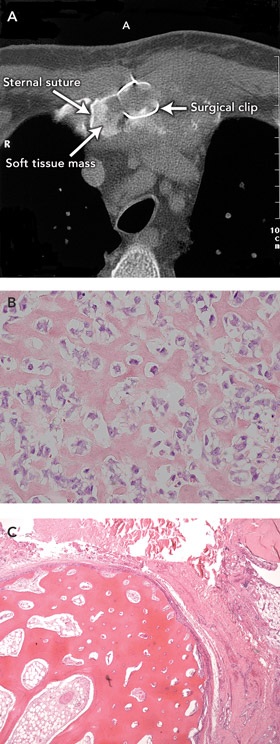
A computed tomography scan of the chest showed a destructive lesion of the manubrium, with an associated soft tissue mass extending into the pectoralis muscle and anterior mediastinum. A sternal suture was noted within the lesion, and a separate surgical clip was identified in the suprasternal notch region (Box, A). Surgical exploration of the sternotomy wound revealed tumour in the muscle around the proximal sternum, with bone destruction. Histopathological examination of the tumour confirmed the presence of an osteosarcoma (Box, B). (A section of normal trabecular bone [Box, C] is shown for comparison.)
There have been few reported cases of primary sternal tumours. To our knowledge, primary osteosarcoma arising contiguous to a surgical suture has never been reported. It is unknown why the osteosarcoma originated in the part of the sternum that contained the sternal suture rather than originating de novo in another part of the bony skeleton. Chronic localised sternal inflammation or mechanical irritation of the proximal sternum by the suture may have been contributory factors in triggering carcinogenesis in this uncharacteristic site.1 However, the effect of trauma and mechanical stimulation on development of primary cancers and their metastases has never been proven. Patients who present with bony tumours frequently have a history of previous trauma to the area where the tumour develops. While there have been numerous reports suggesting some relationship between trauma/chronic inflammation and oncogenesis,1-5 there is no evidence that a single incident of trauma can cause cancer. The combination of trauma, in-situ metal and malignancy after CABG is rare, and there are currently no grounds for suspecting a direct relationship between them.
References
- Weiss L. Some effects of mechanical trauma on the development of primary cancers and their metastases. J Forensic Sci 1990; 35: 614-627.
- Kuhlmann RF, Lavell TE. Juxtacortical osteogenic sarcoma following trauma: a case report. Ann Surg 1965; 62: 1087-1090. 0_pgfId-1735928
- Monkman GR, Orwoll G, Ivins JC. Trauma and oncogenesis. Mayo Clin Proc 1974; 49: 157-163. 0_pgfId-1735935
- Cohen AD, Shoenfeld Y. [Mechanical trauma as a cause of cancer — a continuing dispute] [Hebrew]. Harefuah 1995; 128: 715-718. 0_pgfId-1735943
- Chapman AJ, Race GJ. Trauma and cancer: a survey of recent literature. J Forensic Sci 1969; 14: 167-176. 0_i1091857
Fatty Liver Disease in Australia: A Narrative Review on the Epidemiology, Natural History, Prognostication and Management in People With Metabolic Dysfunction
Karl Vaz, Daniel Clayton-Chubb, William W. Kemp, Stuart K. Roberts, Ammar Majeed
Sex Differences in Management and Outcomes of People With ST-Elevation Myocardial Infarction, New South Wales, 2011–2020: A Retrospective Cohort Study
Adam C. Livori, Jedidiah I. Morton, Dianna J. Magliano, Jonathan E. Shaw
Rethinking Rheumatic Fever Diagnosis: Progress, Pitfalls and the Path Towards a Definitive Test
Anna P. Ralph, Rachel Webb, Tom Parks, Nicole J. Moreland, Asha C. Bowen, Benjamin Jones, Emma Ndagire, Andrea Z. Beaton
Sex Differences in Management and Outcomes of People With ST-Elevation Myocardial Infarction, New South Wales, 2011–2020: A Retrospective Cohort Study
Samia Kazi, Simone Marschner, Clara K. Chow
Distribution of Cardiovascular Disease Risk Based on the Updated 2023 Guideline-Recommended Australian Cardiovascular Disease Risk Algorithm and Comparison With the 2012 Algorithm: An Observational Study
Nina Lazarevic, Meghana Bhat, Grace Joshy, Danielle C. Butler, Mark Woodward, Anushka Patel, Rod T. Jackson, Garry Jennings, Rosemary Wyber, Ellie Paige, Emily Banks
They Brought the Hospital to Me
Hugh N. Burrill