




Volume 182 - Issue 2
Postpartum toxic shock syndrome associated with multiple splenic infarcts
Author: Adrienne Torda
Med J Aust 2005; 182 (2): 93. || doi: 10.5694/j.1326-5377.2005.tb06588.x
Published online: 17 January 2005
Published online: 17 January 2005
To the Editor: I report a patient with splenic infarction associated with group A streptococcal sepsis that occurred post partum. Although spontaneous splenic infarcts have been associated with many types of infections, to my knowledge this is the first published report of an association with this organism.
A 29-year-old woman had an unremarkable term labour and vaginal delivery of her third child. On Day 2, she felt feverish, but no abnormalities were detected on clinical examination or pelvic ultrasound examination.
Over the next 24 hours, she developed abdominal pain and sweats, and appeared flushed. On Day 3, her temperature was 37.6°C, and she developed nausea and diarrhoea. Empirical treatment was begun with intravenous ampicillin and metronidazole. She developed hypotension (blood pressure, 90/60 mmHg) and an erythematous rash of the legs and diffuse erythema of the trunk, anterior thighs and face. Relevant results of laboratory investigations are summarised in Box 1.
On Day 4, a vaginal swab was taken, and antibiotic therapy changed to ticarcillin–clavulanate and clindamycin on the basis of presumed toxic shock syndrome. The next day, the patient developed oedema of the hands and feet, a sore throat and sore ankles. Group A streptococcus grew from the vaginal swab. Blood cultures showed no growth, but the samples had been taken after antibiotic therapy was begun.
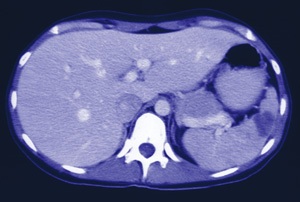
Over the next few days, the patient’s condition improved, but on Day 9 again deteriorated, with recurrence of low-grade fever and the development of sharp, retrosternal chest pain. Computed tomography (CT) of the chest with a pulmonary angiogram revealed a small right lower-lobe opacity, suggestive of a pulmonary infarct. The CT scan also revealed multiple splenic infarcts (Box 2). Screening for thrombophilia gave normal results. She was treated initially with intravenous heparin, followed by oral warfarin for 3 months. Her clinical recovery was slow but complete.
This patient had probable toxic shock syndrome caused by group A streptococcus.1 She had the non-specific features of toxic shock syndrome2 (fever, nausea, diarrhoea, rash, abnormal hepatic and renal function) and disproportionate abdominal pain as the initial symptom. The only criterion lacking for “definite” toxic shock syndrome was the isolation of group A streptococcus from a normally sterile site (it was isolated only from the vagina). Puerperal toxic shock syndrome caused by group A streptococcus is well reported,1,2 with mortality of 25%–50%.2
The patient’s clinical course was complicated by multiple splenic infarcts and a possible pulmonary infarct, thought to have developed in situ with no identifiable prothrombotic diathesis. Splenic infarction is not common and is usually associated with a haematological or rheumatological disorder.3,4 Spontaneous splenic infarcts have been associated with infections, but there is only one report of these infarcts in association with toxic shock syndrome, in that case caused by Staphylococcus aureus.5 The infarcts have been postulated to be caused by circulating endotoxin.5
1 Abnormal laboratory results
Investigation |
Result |
RR |
|||||||||||||
White cell count (x 109/L) |
11.07* |
3.50–11.00 |
|||||||||||||
Platelet count (cells x 109/L) |
63 |
150–450 |
|||||||||||||
Prothrombin time (s) |
15.3 |
12–5 |
|||||||||||||
ESR (mm/h) |
22 |
0–12 |
|||||||||||||
C-reactive protein (mg/L) |
56 |
< 3 |
|||||||||||||
INR |
1.2 |
0.8–1.1 |
|||||||||||||
Alkaline phosphatase (U/L) |
298 |
38–126 |
|||||||||||||
γ-Glutamyltransferase (U/L) |
95 |
0–30 |
|||||||||||||
Albumin (g/L) |
18 |
33–48 |
|||||||||||||
Creatinine (μmol/L) |
111 |
60–110 |
|||||||||||||
* 63% band forms. ESR = erythrocyte sedimentation rate. INR = international normalised ratio. RR = reference range. |
|||||||||||||||
References
- Bisno AL, Stevens DV. Streptococcal infections of skin and soft tissues. N Engl J Med 1996; 334: 240-246.
- Noronha S, Yeu CT, Sekosan M. Puerperal group A beta-hemolytic streptococcal toxic shock-like syndrome. Obstet Gynecol 1996; 88 (4 Pt2): 728. i1085757
- Toth PP, Reuter RK, MacDonald J. Spontaneous splenic infarction secondary to diabetes-induced microvascular disease. Arch Fam Med 2000; 9: 195-197. i1085759
- Nores M, Phillips EH, Morgenstern L, Hiatt JR. The clinical spectrum of splenic infarction. Am Surg 1998; 64: 182-188. i1085761
- Cassar SL, Wong AL, Jadavji T, Leung AK. Multiple splenic infarcts associated with toxic shock syndrome. Pediatr Emerg Care 2002; 18: 31-32. i1085763
Costs of Delivering the Hep B PAST Model of Care in Remote Australia: A Retrospective Pre–Post Study
Hoa Nguyen, Anh Le Tuan Nguyen, Paula Binks, Melita McKinnon, Emily Vintour-Cesar, Karen Wills, Nicola Stephens, Benjamin Cowie, Joshua S. Davis, Yuejen Zhao, Peter Nihill, Julie A. Campbell, Andrew J. Palmer, Jane Davies, Barbara de Graaff
Buruli Ulcer Acquired From Ringtail Possum Rescue
Daniel P. O'Brien, Naomi Clarke, Sara Bonnici, Mohammad A. Hussain
Q Fever Visceral Abscesses After Contact With Native Australian Marsupials
Samantha J. Laws, Enzo Binotto, James Stewart, Jennifer Ho, Trent Yarwood, Josh Hanson, Simon Smith
Hospital-Admitted Injection-Related Infections Among Incarcerated People Who Inject Drugs in Australia: A Retrospective Cohort Study
Andrew Palmer, Matthew Carter, Jeremy Yeo, Cecilia Shim, Jason Connor, Jeremy Hayllar, Gerald Holtmann, Naomi Moy, Elliott G. Playford, Naomi Runnegar, Paul J. Clark
The Live Attenuated Influenza Vaccine in Australia: An Additional Tool for Influenza Prevention
Cyra Patel, Alexis Pillsbury, Tran Nguyen, Xia Wang, Helen E. Quinn, Clayton K. Chiu, Allen C. Cheng, Katie L. Flanagan, Zhicheng Wang
Reflex Testing for Hepatitis D Infection: A Unique Opportunity to Reduce Hepatitis D-Related Chronic Liver Disease Deaths in Australia
Jessica Howell, Lauren Andersson, Miriam T. Levy, James O'Beirne, Leon Adams, Katharine Irvine, Avik Majumdar, Golo Ahlenstiel, Kathy Jackson, Krispin Hajkowicz, Joseph Doyle, Jane Davies, Sarah Cherian, Wayne Dimech, Alexander J. Thompson