




Volume 181 - Issue 8
Organising projects a medicos guide
Author: Christopher B Del Mar
Med J Aust 2004 || doi: 10.5694/j.1326-5377.2004.tb06356.x
Published online: 28 April 2004
Published online: 28 April 2004
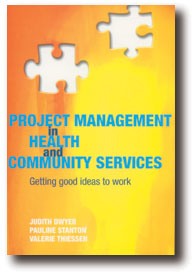
Project management in health and community services
Judith M Dwyer, Pauline Stanton, Valerie Thiessen. Sydney: Allen and Unwin, 2004 (xxi + 200 pp) ISBN 1 74114 055 2.
One of the frequent deficits of doctors when they assume levels of seniority is a thorough incompetence at management. We are trained with quite different skills in mind, like caring for individual people. Project management is not always well done, even for medicos involved in research projects often fizzle out not because of problems with design, or messing up the sample, but because of pragmatic failings. So this book might have relevance to all of us involved with projects, and look! written for us health folk, and by true-blue Aussies.
The book comes in two parts: some of the research and thinking behind projects, and where they fit in organisations and their strategies. There is quite a bit of theory, but few pragmatic data on what works. The theory is littered with technical stuff: it was good to get my head around things I had come across but wasnt really sure about, like PERT (Project Evaluation and Review Technique), Gantt Charts, WBS (Work Breakdown Structure) and PMBOK (Project Management Body of Knowledge). There isnt anything here that is intellectually tricky. Dont worry, they say, about all the technical stuff. Forget the acronyms, all you really need is buckets of common sense. We are introduced to tools (mostly software) that help manage projects, but the finger is wagged in our faces about not relying on them, and the plans they generate. Project management is an art not an algorithm (p63). So does any this stuff work? Empirical research is weak, but suggests the usual suspects for failure: insufficient planning, buy-ins from the organisation, planning and so on
The second part of the book is more of a workshop manual. What to do, and, more pertinently, what not to forget. It suggests telltale signs of things going wrong; how to spot the folk who might cause you problems (like the white-ant); and what to do about them. This is the sort of book in which you might pause, smile in recognition, and read on again. There are examples some real from Australian hospitals, community health settings, and also Divisions of General Practice. A good book. I am the better for having read it. I think.
Christopher B Del MarDean Health Science and Medicine Bond University Gold Coast, QLD
Medical Colleges Have an Obligation to Ensure Full Participation in Clinical Quality Registries
Thomas J. Hugh
Getting on the Same Page: Why Australia Needs a National Maternity Early Warning System (MEWS) Chart
Briony A. Cutts, Lucy Bowyer, Nisha Khot, Sandra Lowe, Stefan C. Kane
Data for Equity: Can Linked Administrative Data Inform Pathways to More Equitable Child Health?
Sarah Gray, Shuaijun Guo, Meredith O'Connor, Elodie O'Connor, Katrina Williams, Hannah Badland, Susan Woolfenden, Josie Dickerson, Gerry Redmond, Marnie Downes, Sharon R. Goldfeld
Specialty College Selection: Why Change is Critical to Support a Future Rural Workforce
Matthew R. McGrail, Jenny May AM, Katherine Logan
Differentiated and simplified oral HIV pre‐exposure prophylaxis (PrEP) models hold the key to virtually eliminating HIV transmission in Australia by 2030
Tyson Arapali, Sarah Warzywoda, Anthony K J Smith, Curtis Chan, Timothy R Broady, Erin Sullivan, Catherine MacPhail, Mohamed A Hammoud, Alexander Dowell‐Day, Benjamin R Bavinton
The number of cancer‐related deaths that could be attributable to spatial disparities in survival in Australia, 2010–2019: a retrospective population‐based cohort study
Charlotte K Bainomugisa, Jessica Cameron, Paramita Dasgupta, Peter Baade