




Volume 181 - Issue 5
Reducing drug-related harm: Australia leads the way
Authors: Alison J Ritter, Alex D Wodak and J Nick Crofts
Med J Aust 2004; 181 (5): 242-243. || doi: 10.5694/j.1326-5377.2004.tb06260.x
Published online: 6 September 2004
Published online: 6 September 2004
Harm-reduction approaches are more easily embedded in policy when drugs are legally regulated
“Harm reduction” in relation to drugs refers to policies and practices intended primarily to reduce the health, social and economic costs of mood-altering drugs without necessarily restricting their consumption. The recognition of AIDS in 1981, and the subsequent realisation of the magnitude of the threat of HIV spread among and from injecting drug users, has given increasing prominence to harm-reduction approaches. The 15th International Conference on the Reduction of Drug Related Harm was held in Melbourne from 20 to 24 April 2004. This is the third time this conference has been held in Australia, an indication of Australia’s leadership position in this field for nearly two decades. The goal of the conference is to bring together people representing the diverse aspects of harm reduction, and the conference’s theme was “Minimising the harm: maximising the impact”.
As a reflection of the growing strength of the harm-reduction movement worldwide, the conference attracted over 1100 delegates from more than 40 countries. Delegates included researchers, clinicians, policy makers, law-enforcement officers, politicians, past and present drug users and private industry representatives. Cross-sectoral and interdisciplinary discussions and networking were a major feature of the conference.
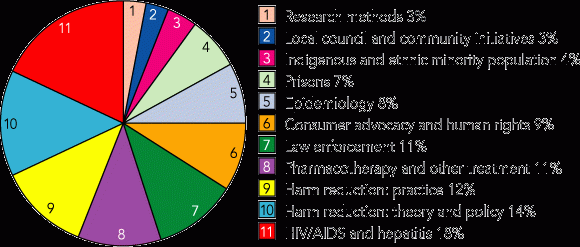
The 875 papers presented (including 450 posters) covered a diverse range of topics (see Box) and encompassed a wide range of approaches, including sophisticated science, complex policy analysis and activism. Research methods varied from quantitative epidemiology, qualitative ethnography, randomised clinical trials to economic analyses. Round-table discussion and other interactive forums were common, and the conference included the first international festival of films about drugs and harm reduction.
Legal drugs (alcohol and tobacco), which account for 4% of the global burden of illness, were the subject of only 10% of papers, compared with illicit drugs, which account for 0.8% of the global burden of illness, but to which almost 90% of papers were devoted. This reflects the reality that harm-reduction approaches are much more easily embedded in policy when drugs are legally regulated.
Public health and human rights
Public health was the major framework for many conference speakers, who saw harm-reduction approaches as essential for improving the health status of drug users and their communities. Other speakers emphasised the important links between human rights and public health. This aspect dominated many discussions of HIV prevention among injecting drug users in countries where this population is savagely discriminated against and driven underground, reducing substantially the effectiveness of health and social interventions.
Harm-reduction tensions
A fertile debate centred on the relationship between harm reduction and demand reduction. For some speakers, preventing drug use sat uncomfortably with harm reduction, while many others saw no conflict in simultaneous efforts to reduce both demand and harm. The observation that “what works in drug policy is unpopular and what’s popular doesn’t work” struck a chord with delegates from many countries familiar with official denigration of evidence-based interventions, such as needle and syringe and methadone programs, and the zealous promotion of law-enforcement efforts to restrict drug supply, notwithstanding limited evidence of benefit.
A second area of controversy is in the relationship between harm-reduction and law-enforcement approaches. An important paper by Peter Reuter (School of Public Affairs and Department of Criminology, University of Maryland, USA), a world expert on organised crime and the impact of drug policy, concluded that there was “no evidence to support law enforcement efforts” to curtail the availability of illicit drugs.
Two senior Russian law-enforcement representatives demonstrated for delegates — somewhat unintentionally — the conflict around harm reduction within conservative law-enforcement ranks in Russia, and the difficulties of establishing effective drug policy and HIV prevention in environments where authorities rely almost entirely on harsh law-enforcement measures to control illicit drugs. The first representative called for tougher measures against drug traffickers, and said that, although Russia needed harm reduction, its introduction was impossible because it was illegal. His colleague counselled “methadone is a therapy of despair . . . like a death sentence”. Attending delegates strongly refuted the claims, with representatives from the Central Eastern European harm-reduction network pointing to the lawful establishment of needle and syringe programs in Russia. Other papers emphasised the now extensive research evidence supporting methadone maintenance and needle and syringe programs as highly effective harm-reduction strategies. For example, new data were presented at the conference based on evidence that needle and syringe programs in Australia had meant 25 000 fewer cases of HIV and saved up to $7 billion.1
Collateral damage
Collateral damage from the “War against drugs” was a popular theme, with numerous illustrations of the severe counterproductive effects of current prohibition policies. Some speakers provided ample grounds for pessimism:
thousands of drug users and traffickers mysteriously murdered in Thailand in recent years after a government-inspired campaign;
five million new cases of HIV infection globally in 2003;
widespread and active discrimination against illicit drug users;
entrenched negative attitudes opposing harm reduction among some UN organisations and in some countries and regions; and
an epidemic of incarceration of drug users in many countries.
Ernie Drucker (Director, Division of Public Health and Policy Research, Montefiore Medical Center, Albert Einstein College of Medicine, New York City, USA) estimated that the introduction of the draconian Rockefeller drug laws in New York State in 1973, requiring harsh prison terms for the possession or sale of relatively small quantities of drugs, had resulted in more years of life lost than had the 2900 deaths in the attack on the World Trade Center on 11 September 2001.
Positive progress
Some speakers saw abundant grounds for optimism:
the growing strength of the evidence base for harm reduction and rational drug policy;
revolutionary recent shifts in attitudes in Central and Eastern Europe;
the success of the recent decriminalisation of use and possession of all drugs in Portugal;
the remarkable adoption and implementation of harm reduction in Iran; and
the active involvement of law-enforcement participants in the conference, and their growing involvement in harm reduction worldwide.
The scientific and policy aspects of the conference were balanced by more personal views: some speakers referred to immense personal loss from drugs, while others argued from their individual perspective for more humane attitudes towards drug users.
Conference highlights
The 2004 Annual National Rolleston Award is granted at each conference to an individual from the host country who has contributed outstandingly to harm reduction. The award perpetuates the memory of an influential English physician who, in 1926, supported the lawful provision of morphine or heroin to selected drug-dependent people if this would assist their leading “a fairly normal and useful life”. It was awarded to Mr Tony Trimingham, founder and coordinator of Family Drug Support, Sydney, for his work in support of families and friends of those affected by heroin-related deaths.
There was a strong presence of Indigenous Australians and Indigenous culture throughout the conference. This reflected the enormous toll, initially from licit and more recently also from illicit, drugs on the health and wellbeing of Indigenous Australians. A presentation by Tony McCartney (Chair of the National Aboriginal Community Controlled Health Organisation) highlighted the ineffectiveness of policy, attracting considerable attention and concern from national and international delegates. However, numerous delegates praised many other aspects of Australia’s response to illicit drugs in recent decades.
Another of the conference highlights was the annual Rolleston Oration. Former Australian Minister for Health, Neal Blewett (currently President of the Alcohol and Other Drugs Council of Australia), delivered the 2004 Oration. He presented a magisterial review of the almost two decades since he, as the responsible minister, oversaw the introduction of harm reduction in Australia in 1985. This shifted the emphasis of drug policy from intent to consequences, enabling the rapid introduction and vigorous expansion of measures that successfully controlled HIV infection among injecting drug users, and allowed policy makers to encompass legal as well as illegal drugs in a pragmatic policy framework.
The current Indonesian Minister for Health, Dr Achmad Sujudi, made a strong call for the wide-scale introduction of harm-reduction measures in his country to stem the tide of HIV infection. Ms Marina Mahathir, President of the Malaysian AIDS Council, echoed this call, urging the adoption of effective and pragmatic, human-rights-based measures to combat AIDS in Asia.
Conclusion
Judging by the breadth and confidence of the discussions and presentations at the conference, harm reduction now seems to be leaving behind a phase of marginalisation and conflict and entering an era of mainstream acceptance and understanding. The conference disseminated new evidence of the effectiveness of harm-reduction approaches to drug problems, stimulated collaboration between participants from diverse backgrounds, gave new energy and confidence to harm-reduction practitioners from far and wide, and helped focus attention on how much more needs to be accomplished, especially in the global battle to contain the AIDS epidemic.

References
- Health Outcomes International; The National Centre for HIV Epidemiology and Clinical Research; Centre of Health Economics, York University (Drummond M). Return on investment in needle and syringe programs in Australia. Australian Government Department of Health and Ageing, October 2002. Available at: www.health.gov.au/pubhlth/publicat/document/metadata/roireport.htm (accessed Aug 2004).
Capturing the Benefits of Clinical Quality Registries
Taryn Bessen, Stephen McDonald
Medical Colleges Have an Obligation to Ensure Full Participation in Clinical Quality Registries
Thomas J. Hugh
Getting on the Same Page: Why Australia Needs a National Maternity Early Warning System (MEWS) Chart
Briony A. Cutts, Lucy Bowyer, Nisha Khot, Sandra Lowe, Stefan C. Kane
Data for Equity: Can Linked Administrative Data Inform Pathways to More Equitable Child Health?
Sarah Gray, Shuaijun Guo, Meredith O'Connor, Elodie O'Connor, Katrina Williams, Hannah Badland, Susan Woolfenden, Josie Dickerson, Gerry Redmond, Marnie Downes, Sharon R. Goldfeld
Specialty College Selection: Why Change is Critical to Support a Future Rural Workforce
Matthew R. McGrail, Jenny May AM, Katherine Logan
Differentiated and simplified oral HIV pre‐exposure prophylaxis (PrEP) models hold the key to virtually eliminating HIV transmission in Australia by 2030
Tyson Arapali, Sarah Warzywoda, Anthony K J Smith, Curtis Chan, Timothy R Broady, Erin Sullivan, Catherine MacPhail, Mohamed A Hammoud, Alexander Dowell‐Day, Benjamin R Bavinton