




Volume 180 - Issue 2
When grief is a family affair
Author: Brian J Kelly
Med J Aust 2004 || doi: 10.5694/j.1326-5377.2004.tb05791.x
Published online: 27 October 2003
Published online: 27 October 2003
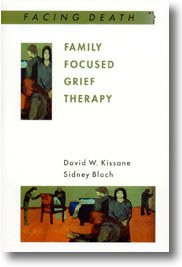
Family focused grief therapy.
David W Kissane, Sidney Bloch. Buckingham: Open University Press, 2002 (xviii + 254 pp). ISBN 0 335 20349 3.
Family focused grief therapy provides a scholarly overview of the research and theoretical basis of our current understanding of the impact of bereavement on the family. This work is highly relevant to many areas of healthcare and is particularly innovative in applying preventive approaches involving careful clinical screening and assessment of a familys functioning and coping. Kissane and Blochs work identifying high-risk patterns of family interaction is an important and an internationally recognised contribution to this field.
The authors successfully link a research framework and a strong theoretical base with practical clinical interventions to address a problem that frequently challenges clinicians. The provision of detailed clinical vignettes deepens the scope of the book and encompasses the complexities of family life and the realities of clinical practice. The examples are relevant to the broad range of cultural issues for families in the Australian community. The vignettes appropriately and sensitively recognise the multiple problems that many families contend with, but, at the same time, utilise an approach that recognises family resources. By doing so the authors walk an appropriately balanced path between acknowledgment of the significant adverse consequences of grief for families and individuals, and the resilience of many families. Underpinning this is the philosophy that family functioning and coping can be enhanced to protect the individuals who comprise the family, and that there are patterns of family functioning that can hinder recovery from bereavement.
As a whole, the book demonstrates the relevance and importance of mental health approaches to this very broad area of healthcare, and the contribution that can be made by bridging the fields of psychotherapy and palliative care. While the book would be of particular interest to professionals working in oncology and palliative care, the research methods, the nature of the intervention, and the understanding that this work brings to family work, are likely to be of interest to a very broad range of clinicians. By bringing research into clinical practice, the authors have made a major contribution to this field.
Brian J KellyPsychiatrist, St Vincents Hospital Darlinghurst, NSW
Reorienting Allied Health Into Community-Based Care for People Experiencing Trauma and Social Disadvantage
Simon Rosenbaum, Grace McKeon, Gulsah Kurt, Oscar Lederman, Kemi Wright, Sabuj Kanti Mistry, Jackie E. Curtis, Philip B. Ward, Zachary Steel, Hamish Fibbins, Rachel Morell, Melissa C. Eaton, Andrew Watkins, Ben Harris-Roxas, Brendan Goodger, Eleanor Beck, Megan Teychenne, Joseph Firth, Davy Vancampfort, David Burns, Russell Roberts, Tristan Favaloro, Danielle Weber, Rosanna Barbero, Vasili Maroulis, Melissa Holmes, Stefan Mackenzie, Chiara Mastrogiovanni, Afsana Anwar, Uzma Choudhry, Catherine Sherrington, Jane Currie, Thomas Gadsden, Scott Teasdale
Stigmatising Attitudes Towards People With Depression, Bipolar Disorder, Borderline Personality, ADHD and Early and Long-Term/Untreated Schizophrenia: Representative Survey of Australian Adults
Amy J. Morgan, Anna M. Ross, Gayle McNaught, Rachel Green, Nicola J. Reavley
Psychosocial Hazards for Healthcare Workers: Supporting the Second Victim Also Helps the Primary Victims
Sarah Michael
Supporting Population Mental Health in the Wake of Mass Tragedies
Susan J. Rees, Derrick M. Silove
In the Wake of the National Suicide Prevention Strategy 2025–2035: Suicide Prevention in Type 1 Diabetes
Rigel Paciente, Keely Bebbington, Alix Woolard, Helen Milroy