




Volume 180 - Issue 1
In Other Journals
Med J Aust 2004 || doi: 10.5694/j.1326-5377.2004.tb05761.x
Published online: 5 January 2004
Published online: 5 January 2004
Simply screening
Editorialists say that a NZ study is the first of many more to come that will give us newer simpler ways of diagnosing illness than the classic (and time-consuming) "first, take a thorough history".1,2
The study, of 421 consecutive patients aged 16 to 90 years seen in 15 general practices, found that two screening questions are all a GP need ask to virtually rule out one common illness — major depression.1 The questions (which have a common stem) are: "During the past month have you often been bothered by 1) feeling down, depressed, or hopeless; 2) little interest or pleasure in doing things."
Compared with an ideal screening tool for major depression, the questions (when the answer to both was "yes") showed a sensitivity of 97% for depression. However, further evaluation is needed in the "positive" patients as only about one in six will truly have depression.
1. BMJ 2003; 327: 1144-1146 2. BMJ 2003; 327: 1117
Door-to-door strategy
In 2004, Uganda will launch a door-to-door random and anonymous blood testing survey of 30 000 people across the country to try to get a more accurate picture of the prevalence of HIV/AIDS in Uganda. Consent will be obtained before testing.1
Meanwhile, international experts have called for China to take urgent action so that country can avoid duplicating the African trajectory in HIV/AIDS.2 It is estimated China has 840 000 people who are HIV-positive.
1. BMJ 2003; 327: 1186 2. Lancet 2003; 362: 1636
Backflip
Spanish researchers have challenged the conventional wisdom that the best mattress for people with low back pain is a firm one. In their randomised, double-blind, controlled trial of 313 adults with chronic non-specific low back pain, they compared study subjects' self-reported outcomes after 90 days of sleeping on either a firm or a medium-firm spring mattress. Those subjects who slept on a medium-firm mattress experienced less pain when lying in bed and less disability than those who slept on a firm mattress. All bed bases supported at least 50% of the mattress surface (ie, no slats).
Lancet 2003; 362: 1599-1604
Falling on deaf ears?
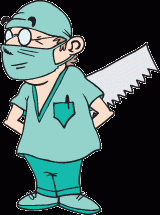 Orthopaedic surgeons (and any assistants close by) should don earmuffs when noisy power tools are being used in theatre, says a NZ researcher. Dr Hamish Love assessed sound levels with a noise dosimeter during three uncemented total hip replacements and two cemented total knee replacements. Although he found that the overall total dose of noise was within acceptable limits, sound levels did exceed the legislated NZ maximum of 140 dB on multiple occasions, for example, when cutting bone.
Love is concerned that, despite the risk of incurring long-term noise-induced hearing loss, orthopaedic surgeons will shun hearing protection, just as they have previously shown reluctance in adopting other protective devices, such as thyroid guards.
Aust N Z J Surg 2003; 73: 836-838
Relief by leech
Leech therapy holds promise for symptom relief in osteoarthritis of the knee, according to German researchers.1 They studied 51 patients older than 40 years with severe joint pain due to osteoarthritis of the knee. Their randomised, controlled-but-not-blinded study compared a once-off leech treatment session with more usual therapy with twice-daily topical NSAID diclofenac gel (applied for 4 weeks). Leech therapy led to greater short-term pain relief assessed at 7 days, as well as more improved function and less stiffness right up until the end of the study at 91 days.
In leech therapy, four to six medical leeches (Hirudo medicinalis) were applied to the peri-articular soft tissue of an affected knee until they detached themselves (an average of just over an hour). Mild to moderate itching at bite sites was a common minor side effect.
A commentator said he wasn't ready to refer patients for the treatment on the basis of this study alone, observing that "seven days is but a brief moment in the long epic of knee osteoarthritis".2 However, he did agree that novel agents might be derived from leech saliva that could eventually be given to patients without the need for a leech bite.
1. Ann Intern Med 2003; 139: 724-730 2. Ann Intern Med 2003: 139: 781-783
Suddenly
After a confirmed sudden, unexplained death in the family, US experts say it is now reasonable to offer surviving first-degree relatives a screening 12-lead ECG.1 Their advice follows UK research which found evidence of inherited cardiac disease in seven of 32 families in this same circumstance.2
1. Lancet 2003; 362: 1429-1430 2. Lancet 2003; 362: 1457-1459
— Dr Ann Gregory, MJA