




Volume 179 - Issue 2
Quest for objective assessment of impairment
Author: Seamus E Dalton
Med J Aust 2003 || doi: 10.5694/j.1326-5377.2003.tb05434.x
Published online: 22 May 2003
Published online: 22 May 2003
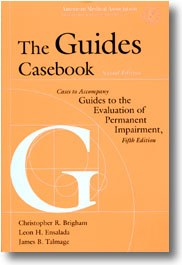
Guides casebook. Cases to accompany Guides to the evaluation of permanent impairment, 5th edition.
Christopher R Brigham, Leon H Ensalada, James B Talmange. Chicago: AMA Press, 2002 (xi + 384 pp). ISBN 1 57947 264 8.
Sixty-eight cases are presented, most of them relating to musculoskeletal disorders. There is a broad spread of clinical cases; ranging from the more severe and catastrophic injuries, to more common conditions. The more controversial and ill-defined conditions, such as complex regional pain syndrome, fibromyalgia and the curiously termed "elusive cumulative trauma disorder", are discussed in detail.
Each case is presented with a history and physical examination followed by a discussion of the rating according to the 4th and 5th edition of the Guides. After each case, there is a useful explanation of the differences between the ratings as well as relevant discussion on the difficulties of evaluating impairment. In most cases, there is little difference between the rating according to the 4th and 5th editions, one exception being impairment of the spine. The other differences are mostly with regard to musculoskeletal disorders.
Given the current preponderance of claims for loss of sexual function following spinal injury, and cognitive loss following relatively mild traumatic head injury, the detailed discussion of these cases is particularly relevant. Problems associated with impairment evaluation in the presence of pain behaviour and in patients with poor credibility are also discussed.
This book is topical, user friendly and essential for clinicians who carry out independent impairment evaluations. Although many insurance companies require clinicians to complete a certified course before undertaking evaluations, this casebook illustrates that being certified in the use of the Guides is not sufficient. Thorough and objective clinical examination remains a necessity for impairment evaluation, particularly in musculoskeletal injury.
My experience in reading medico-legal reports is that while ratings according to the AMA Guides are frequently quoted, the clinical findings of the examiner often do not stand up to close scrutiny, and incorrect impairment ratings are sometimes provided. Hopefully, this casebook will assist both doctors and lawyers in their quest to provide objective and accurate evaluation of impairment. The book is value for money and essential reading for those who are called upon to provide an assessment of impairment.
Seamus E DaltonOrthopaedic Surgeon Crows Nest, NSW
See also:• Guides to the evaluation of permanent impairment (5th edition) • Special package prices
Patterns of Osteoporosis Treatment Initiation Following Low-Trauma Fracture: A Population-Based Retrospective Cohort Study in New South Wales, Australia, Using Linked Administrative Health Data
Mike Lin, Huy Nguyen, Thach Tran, Robert D. Blank, Dana Bliuc, Jacqueline R. Center
Rapid Growth in Diagnostic CT Knee Imaging in Australia: Implications for Imaging Stewardship
Hanwen Chen, Rachelle Buchbinder, Sean Docking, Ian A Harris
Spinal cord stimulation patterns of care, re‐interventions, and costs for private health insurers, Australia, 2011–22: a retrospective observational study
Caitlin MP Jones, Christopher G Maher, Rachelle Buchbinder, Ian A Harris, Chung‐Wei Christine Lin, Christopher Hayes, Alexandra Gorelik
The incidence of and risk factors for hospitalisations and amputations for people with diabetes‐related foot ulcers in Queensland, 2011–19: an observational cohort study
Yuqi Zhang, Susanna M Cramb, Steven M McPhail, Rosana Pacella, Jaap J Netten, Ewan M Kinnear, Peter A Lazzarini
Bone health perspectives among Indigenous people: a qualitative study
Troy Walker (Yorta Yorta), Karan P Singh, Vanessa Gan, Brooke Conley (Ngiyampaa), Jessica Bravo, Nigel Smith (Weilwan), April Clarke (Eastern Maar, Kirrae Whurrung, Djap Wurrung), Jackson Baker, Louise J Maple‐Brown, Robin M Daly, Jennifer Browne, Jesse Zanker, Cat Shore‐Lorenti, David Scott, Peter R Ebeling, Ayse Zengin
I am a Civil War
Jennifer G Mowbray