




Volume 178 - Issue 3
Responses to access block in Australia: Royal North Shore Hospital
Authors: Rohan J H Hammett and Bruce G Robinson
Med J Aust 2003; 178 (3): 105-107. || doi: 10.5694/j.1326-5377.2003.tb05095.x
Published online: 3 February 2003
Published online: 3 February 2003
Royal North Shore Hospital (RNSH) is a 550-bed tertiary referral hospital serving a population of about 900 000 in the Northern Sydney Health Area.
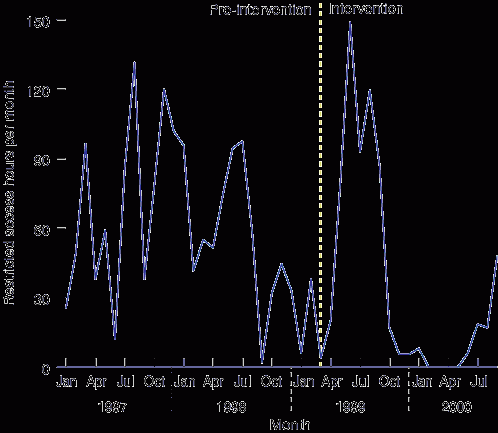
In 1999, the RNSH executive, to deal with ongoing restricted access (RA = ambulance bypass), decided to implement various changes to the structures, policies and practices of the hospital to alleviate the blockages to patients entering the emergency department (ED) by ambulance. The extent of RA at RNSH is shown in Box 1. As expected, RA was worse during winter, with more than 100 hours per month.
Interventions
In March 1999, the clinical heads of the hospital's divisions implemented a program aimed at improving utilisation of beds in the medical and surgical wards, in the belief that solutions to restricted access lay not within the ED, but within the rest of the hospital.
The specific interventions were implemented by committed multidisciplinary teams, underpinned with significant senior medical staff involvement and executive support.
Structural changes
Administrative responsibility for the ED was moved to the Division of Medicine so that the problems facing the ED were seen as belonging to the general ward areas.
Clinical Supervisors, with responsibility for coordinating bed management, were appointed in the divisions of medicine and surgery, and a Clinical Bed Manager was appointed with responsibility for bed management across the entire hospital.
Team-building initiatives
Daily meetings with divisional nursing unit managers, the clinical supervisor and the bed manager. These meetings identified patients awaiting discharge, potential delays in treatment requiring attention, delays in consultation, inappropriate admissions, and patients suitable for treatment through ambulatory care or other outpatient services.
Friday afternoon meetings with all medical registrars, divisional medical and nursing heads, the clinical supervisor, and the bed manager to ensure that all patients not requiring hospitalisation over weekends had appropriate discharge plans.
Provision of data to medical staff regarding clinical practice variation (eg, variation in average length of stay for specific conditions).
Clinical initiatives
Ambulatory care ward open every day with extended after-hours service, with referrals from all medical teams and directly from the ED. This ward currently treats more than 1400 patients each month, and is available for patients who are well enough to be at home, but require in-hospital treatment as day patients. For example, patients who require blood transfusions, joint aspirations, lumbar punctures, chemotherapy or intravenous antibiotics were all moved from inpatient beds to the ambulatory care service. Similarly, rural patients referred for multiple specialist consultations or investigations are managed in this unit.
Early-morning blood collection for patients awaiting results before discharge, with results available by 9: 00 am for discharge by 10: 00 am.
Day-only angiography.
Fax referral to rehabilitation beds to expedite transfer.
Weekend discharge rounds by the divisional medical head and the clinical supervisor.
Accommodation initiatives
Reconfiguration of beds to five-day short-stay to encourage management of elective activity from Monday to Friday.
Use of off-site residential accommodation for patients not requiring inpatient beds for investigations.
Provision of free transport (taxi vouchers, hospital transport) to patients to facilitate discharge.
Nursing home liaison committee to improve communication with local residential care providers and facilitate appropriate transfer from the acute- to the residential-care sector.
Leasing of 12 private hospital beds and attached clinical staff from Mater Misericordiae Hospital during winter.
Policy initiatives
Revision of the restricted access policy. Before activating RA, the ED Staff Specialist must contact inpatient managers to assess whether it is possible to avoid RA by hastening bed movements.
Revision of the weekend leave policy. Ward leave greater than eight hours suggests the patient should be treated in the ambulatory centre.
Development of an over-census bed policy. Wards to go one patient over census when the ED is considering RA and has no alternatives. This policy only needed implementation on two occasions between March 1999 and October 2000; on both occasions it prevented the hospital going onto RA.
Outcome
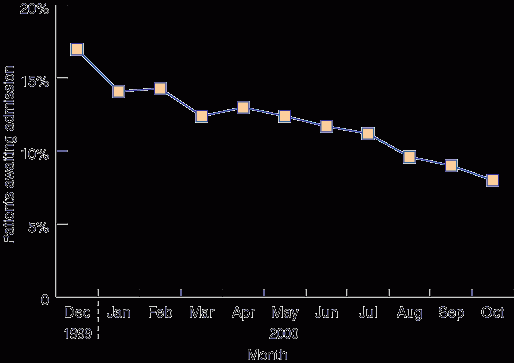
The effect of these interventions was dramatic. Within six months of commencing these initiatives, RNSH had effectively eliminated restricted access to the ED (Box 1, 2000), while maintaining elective surgical activity and significantly reducing the number of patients on the waiting list for admission (Box 2). These improvements occurred with bed occupancy rates in excess of 90%.
The key contributors to the success of this program appear to be:
significant medical leadership through visible operational roles for divisional heads and staff specialists/clinical supervisors in bed management processes;
attention to discharge planning for ward patients;
centralised bed management with a whole-hospital focus;
team-building among senior nursing and medical staff;
improved communication between ED and ward areas;
engagement of junior medical staff in bed management processes; and
a multifaceted implementation program that sought to correct process inefficiencies wherever they were identified.
The outcomes of the program support the hypothesis that reducing ED ambulance bypass can be achieved by interventions that address upstream blockages in the hospital rather than specific ED interventions. Maintaining organisational focus on continually questioning the appropriateness of bed management practices is a challenge that must be met to ensure the sustainability of these sorts of improvements.
Medical Colleges Have an Obligation to Ensure Full Participation in Clinical Quality Registries
Thomas J. Hugh
Getting on the Same Page: Why Australia Needs a National Maternity Early Warning System (MEWS) Chart
Briony A. Cutts, Lucy Bowyer, Nisha Khot, Sandra Lowe, Stefan C. Kane
Data for Equity: Can Linked Administrative Data Inform Pathways to More Equitable Child Health?
Sarah Gray, Shuaijun Guo, Meredith O'Connor, Elodie O'Connor, Katrina Williams, Hannah Badland, Susan Woolfenden, Josie Dickerson, Gerry Redmond, Marnie Downes, Sharon R. Goldfeld
Specialty College Selection: Why Change is Critical to Support a Future Rural Workforce
Matthew R. McGrail, Jenny May AM, Katherine Logan
Differentiated and simplified oral HIV pre‐exposure prophylaxis (PrEP) models hold the key to virtually eliminating HIV transmission in Australia by 2030
Tyson Arapali, Sarah Warzywoda, Anthony K J Smith, Curtis Chan, Timothy R Broady, Erin Sullivan, Catherine MacPhail, Mohamed A Hammoud, Alexander Dowell‐Day, Benjamin R Bavinton
The number of cancer‐related deaths that could be attributable to spatial disparities in survival in Australia, 2010–2019: a retrospective population‐based cohort study
Charlotte K Bainomugisa, Jessica Cameron, Paramita Dasgupta, Peter Baade