





Volume 177 - Issue 11
Knowledge and commitment for action: the 14th International AIDS Conference, Barcelona, July 2002
Authors: Stephen J Kent, C Jane Dale and Anne M Mijch
Med J Aust 2002; 177 (11): 587-589. || doi: 10.5694/j.1326-5377.2002.tb04975.x
Published online: 9 December 2002
Published online: 9 December 2002
The virus recognises the similarity of people on the planet. Scientists and policy makers must do the same. Helene Gayle (Director of the CDC's National Center for HIV, STD and TB Prevention)
The AIDS epidemic is wreaking havoc and misery around the world and exposing the most awful inequalities and human frailties. In Australia, our population is relatively cocooned from this chaos (Box 1), although the conference heard of the established epidemic in our nearest neighbour to the north, Papua New Guinea, and the worrying emerging epidemic in Indonesia.
Worldwide statistics can become numbing, causing human suffering to be ignored. Even for clinicians and researchers in the HIV/AIDS field, the magnitude of the problem is frequently too daunting to either comprehend or tackle in a useful way. However, the realities, and importantly the will, of good, hard-working people in the field were on display at the International AIDS Conference in Barcelona in July 2002.
International AIDS conferences are amazing events, bringing the global issues surrounding HIV to the fore. They can be incredibly poignant, wonderfully motivating and equally frustrating all at the same time. Frequently, issues come into stark focus that challenge the status quo. Activists in the field of HIV/AIDS are not shrinking violets.
Global access to anti-HIV medications
We must corner rich nations with the truth (Jeffrey Sachs, Economist and Advisor to the United Nations Secretary-General)
The issue that galvanised many of the participants at Barcelona was the injustice of the lack of access to life-saving, but expensive, antiretroviral drugs in developing nations. In Barcelona, the momentum of providing global access to HIV/AIDS medicines gathered steam. The road to global access is likely to be long and full of pot-holes. The establishment of the Global Fund for AIDS, TB and Malaria provides a major focus for raising the estimated US$13 billion required per year to scale-up preventive approaches and to provide wide access to antiretroviral drugs in resource-poor nations.
There was a real sense of holding political leaders accountable to ensure a more equitable future. In the words of Peter Piot, Executive Director of UNAIDS:
Let's make the AIDS response truly political — let's bring forward the day when leaders who keep their promises on AIDS are rewarded with our trust, and those who don't, lose their jobs to those who will.
Some political leaders were booed from the stage as the audience turned against their meagre or delayed responses to the epidemic.
There have been successful pilot and expanding programs of antiretroviral treatment in several developing countries. There is growing unease that a poorly coordinated approach in the developing world will lead to the high levels of resistance to antiretrovirals now present in the developing world, squandering an opportunity to make a very major impact in these countries. Averting the errors made in antiretroviral therapy in the developed nations could potentially lead to more durable responses to antiretroviral therapy. These errors include serial monotherapy, sequential changes in the presence of imperfect HIV suppression, and decisions made to introduce new therapies on the basis of single equivalence studies measuring only short-term surrogate endpoints.
The US-based AIDS Clinical Trial Group study, with 384 investigators, reported the first of the long-term strategy studies, in which outcome was based on time to first and second change of therapy in 980 individuals. This provides important information to guide treatment strategies across the globe. Essentially, the length of time to failure of first-line antiretroviral therapy was substantially longer with the initial combination of zidovudine, lamivudine and efavirenz, and the time to the second failure was substantially longer with either first- or second-drug regimens including zidovudine, lamivudine and efavirenz. No benefits of using four antiretrovirals over three were shown.1
For HIV-infected people with anti-retroviral resistance, the conference heard of encouraging efficacy reports of new drugs, such as tenofovir and T-20 (enfurvitide), as well as exciting preclinical information on integrase inhibitors. Unfortunately, the cost of these newer drugs will be prohibitive in developing countries.
Not only are the treatment factors (regimen, the timing of commencement, affordable appropriate monitoring, support of adherence) important, but also support for training of healthcare professionals and commitment to ongoing funding for therapy is essential. The World Health Organization (WHO) report entitled Scaling up antiretroviral therapy in resource-limited settings continues to assist this process.2
Providing treatment for HIV is now thought to provide tremendous spin-offs for enhanced prevention. People with access to treatment are more likely to get tested for HIV infection and modify behaviour if found to be positive. Reductions in infectious virus load after treatment are likely to reduce transmission, although this is not yet definitely proven. Increasing use of medications is likely to drive global prices down.
The problem of accurately taking all combination anti-retroviral therapy (adherence) continues to be shown to be a major factor affecting long-term success of therapy. To this end, an increasing number of studies of once-daily treatments are being reported. This offers practical options for improved adherence and intermittently delivered therapy (Box 2).
No cure
HIV treatments are most certainly not a cure. This was soberly brought home by a pioneering researcher in this field, Dr Robert Siliciano, from Johns Hopkins University, describing HIV as "intrinsically incurable". One problem lies with the dastardly ability of HIV to lie dormant in a population of cells called resting memory T cells. These cells are "designed to wait" for a lifetime to ward off previously encountered pathogens. It will prove very difficult to flush the virus out of these cells once it has taken hold.
Vaccines
There is hope that a vaccine will eventually be developed that can prevent HIV infection around the world. Although this is one of the "star-wars", "high-tech" approaches to prevention, significant gains have been made in the last two years. There are three important considerations for an effective vaccine against HIV/AIDS — the vaccine must induce (i) T cell responses against virus-infected cells, (ii) neutralising antibodies against free virions, and (iii) mucosal immunity. Vaccines that induce high levels of T cell responses against HIV in animal model systems, although incapable of preventing infection altogether, are able to control viral replication for long periods. To prevent infection altogether, high levels of neutralising antibodies will be required. The induction of broadly reactive neutralising antibodies to HIV has proven very difficult, but there are now hints about potentially successful approaches. The virus is in the mucosal tissue during the first few days of infection. In 3–5 days the virus spreads and virus latency occurs. In 6–9 days the virus has spread systemically. An effective vaccine needs to work at the mucosal site of infection before systemic dissemination occurs.
One major obstacle against engineering an effective vaccine is that HIV is capable of escaping both neutralising antibodies and cellular immune responses. Furthermore, there is no definitive HIV marker for protection. There were mixed reports on whether a vaccine could induce immunity across different subtypes of HIV-1 — cross-subtype T cell immune responses exist for T cell-inducing vaccines, but there are no vaccines offering a breadth of neutralising antibodies.
The vaccine world is waiting with bated breath for the outcome, due to be released early in 2003, of the world's first efficacy trials in humans of HIV vaccines using envelope protein approaches with alum as the adjuvant. These trials have been conducted efficiently, albeit not without controversy, in 2500 subjects in Thailand and 5000 subjects in the United States and elsewhere. Controversies in these trials have included whether it was justifiable to proceed to human efficacy trials with vaccines that performed poorly in some preclinical studies; the provision of clean injecting equipment to trial participants; and the lack of provision of antiretroviral treatment to subjects who become infected during the trial. Encouraging reductions in risk behaviour have occurred during these efficacy trials; however, a sufficient number of seroconversions have occurred which, when the data are unblinded, should provide a robust analysis of efficacy.
One final important point emphasised was that vaccine research should be complementary to, and not in competition with, therapeutic research.
Other prevention approaches
The definition of insanity is doing the same thing over and over again and expecting a different result. Rita Brown (arguing for innovative programs to prevent the spread of HIV).
In addition to enhanced standard prevention approaches of education, behavioural change, condoms (both male and female versions) and others, further exploration of biomedical approaches to prevention are being evaluated. Male circumcision appears to provide considerable protection from HIV, and observational studies and trials are now under way to evaluate this approach more rigorously in developing countries. Treatment of other sexually transmitted infections is now being evaluated (eg, control of herpes simplex with aciclovir) as a means of preventing HIV acquisition and transmission. Non-occupational postexposure prophylaxis with antiretrovirals is now common in many developed countries, although gathering data on its efficacy has been difficult. The spectre of pre-exposure prophlyaxis with antiretrovirals was also raised. Widespread use of antiretrovirals as pre-exposure prophylaxis has worrying implications for the development of antiretroviral resistance, but, if infection was completely prevented, resistance would not occur.
Call for action
A recurring message at the conference was the need for decisive action now. As Helen Gayle said, quoting an African proverb:
The best time to plant a tree was 20 years ago; the next best time is now.
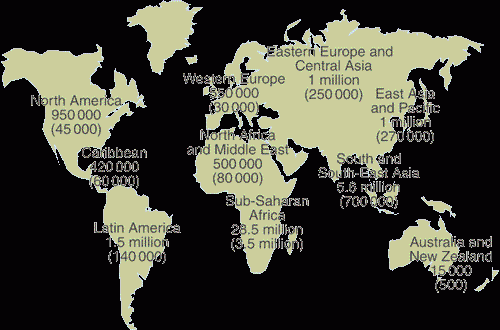
1: Global distribution of the AIDS epidemic in 2001
Numbers of people living with HIV at the end of 2001 (and, in parentheses, those newly infected with HIV during 2001) as estimated by UNAIDS and WHO. Data available at: http://www.unaids.org/barcelona/presskit/graphics.html#global.htm (accessed October 2002, no longer available).
2: Once-daily HIV medications to overcome problems of adherence
Currently available once-daily antiretroviral medications in Australia/USA |
|
|
|
|
Antiretroviral medications suggested for future development as once-daily medication |
|
|
|
|
|
|
|
|
3: More quotable quotes from the Barcelona AIDS conference
Helene Gayle (Director of the CDC's National Center for HIV, STD and TB Prevention, and of the Bill and Melinda Gates Foundation HIV/AIDS and Tuberculosis Program:
When will justice come to Athens? Justice will come when those that are not injured are as indignant as those that are (quoting the Greek historian Thucydides).
Suniti Solomon, Director, Centre for AIDS Research and Education, India:
In Zambia, a widow must cry with only one eye (describing how women whose husbands die of AIDS must keep an eye on their assets, which are often seized by relatives of the deceased).
Paul Farmer, Professor of Medical Anthropology, who has established a modern medical centre in a squatter settlement in central Haiti, and introduced antiretroviral treatment:
Now my children are not ashamed to be seen with me (quoting a Haitian patient describing the reduction in stigma since starting antiretroviral treatment).
References
- Robbins G, Shafer R, Smeaton L, et al. Antiretroviral strategies in naive HIV+ subjects: Comparison of sequential 3-drug regimens (ACTG 384). Program and abstracts of the XIV International AIDS Conference; July 7-12, 2002; Barcelona, Spain. Abstract LbOr20A <http://www.aids2002.com/Program/View Abstract.asp?id=/T-CMS_Content/Abstract/200206290751346179.xml> (accessed November 2002, no longer). i1067381
- Qazi S, Vareldzis B, Giaquinto C. HIV treatment for children: applying the 2002 WHO interim ARV treatment guidelines for resource poor settings. Program and abstracts of the XIV International AIDS Conference; July 7-12, 2002; Barcelona, Spain. Abstract TuPeB4655. <http://www.aids2002.com/Program/View Abstract.asp?id=/T-CMS_Content/Abstract/200206290750431226.xml> (accessed November 2002, no longer available). i1067384
Costs of Delivering the Hep B PAST Model of Care in Remote Australia: A Retrospective Pre–Post Study
Hoa Nguyen, Anh Le Tuan Nguyen, Paula Binks, Melita McKinnon, Emily Vintour-Cesar, Karen Wills, Nicola Stephens, Benjamin Cowie, Joshua S. Davis, Yuejen Zhao, Peter Nihill, Julie A. Campbell, Andrew J. Palmer, Jane Davies, Barbara de Graaff
Buruli Ulcer Acquired From Ringtail Possum Rescue
Daniel P. O'Brien, Naomi Clarke, Sara Bonnici, Mohammad A. Hussain
Q Fever Visceral Abscesses After Contact With Native Australian Marsupials
Samantha J. Laws, Enzo Binotto, James Stewart, Jennifer Ho, Trent Yarwood, Josh Hanson, Simon Smith
Hospital-Admitted Injection-Related Infections Among Incarcerated People Who Inject Drugs in Australia: A Retrospective Cohort Study
Andrew Palmer, Matthew Carter, Jeremy Yeo, Cecilia Shim, Jason Connor, Jeremy Hayllar, Gerald Holtmann, Naomi Moy, Elliott G. Playford, Naomi Runnegar, Paul J. Clark
The Live Attenuated Influenza Vaccine in Australia: An Additional Tool for Influenza Prevention
Cyra Patel, Alexis Pillsbury, Tran Nguyen, Xia Wang, Helen E. Quinn, Clayton K. Chiu, Allen C. Cheng, Katie L. Flanagan, Zhicheng Wang
Reflex Testing for Hepatitis D Infection: A Unique Opportunity to Reduce Hepatitis D-Related Chronic Liver Disease Deaths in Australia
Jessica Howell, Lauren Andersson, Miriam T. Levy, James O'Beirne, Leon Adams, Katharine Irvine, Avik Majumdar, Golo Ahlenstiel, Kathy Jackson, Krispin Hajkowicz, Joseph Doyle, Jane Davies, Sarah Cherian, Wayne Dimech, Alexander J. Thompson