




Volume 176 - Issue 4
Risk of death from methicillin-resistant Staphylococcus aureus bacteraemia: a meta-analysis
Author: James C Hurley
Med J Aust 2002; 176 (4): 188-189. || doi: 10.5694/j.1326-5377.2002.tb04355.x
Published online: 18 February 2002
Published online: 18 February 2002
To the Editor: I write to offer a re-analysis of the data presented by Whitby and colleagues.1 They reported a meta-analysis of crude estimates and relative risk of death derived from nine published studies for Staphylococcus aureus bacteraemia. They concluded that bacteraemia caused by methicillin-resistant S. aureus (MRSA) is associated with a "real increase in risk of death" compared with bacteraemia caused by methicillin-sensitive S. aureus (MSSA), with a relative risk of 2.12. However, they failed to explore fully the possible confounding effect of the patients' underlying diseases and treatment in their analysis.
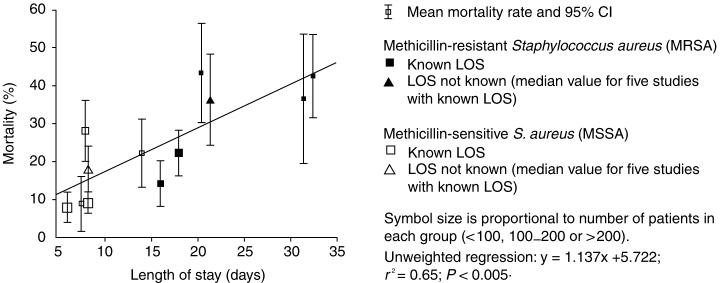
With this in mind, I offer a re-analysis of their data using regression analysis. Mortality rates versus median length of stay in hospital before bacteraemia (LOS) are shown in the Box (next page) for the five studies for which these data were presented by Whitby et al (in Boxes 1 and 2). The four studies without LOS data were combined, using the median LOS from the other five studies in the figure and the regression model.
The regression analysis was performed with and without the weights provided by Whitby et al (Box 2), and also with and without the four studies for which LOS data were not available.
Regression analysis revealed a significant association between mortality rate and LOS (P < 0.005). However, the addition of group status (MRSA or MSSA) failed to achieve significance in any iteration of the regression, while LOS remained a significant predictor of mortality risk.
This suggests that, with S. aureus bacteraemia, mortality rate increases with length of time in hospital before the bacteraemia. The likely explanation is that patients residing in hospital for longer periods are sicker. Moreover, they are more likely to have been exposed to antibiotics, leading to increased risk of acquiring an S. aureus strain that is methicillin-resistant. The mortality risk is no different for MRSA versus MSSA bacteraemia if LOS, a surrogate marker for severity of patient illness, is taken into account. The difference that Whitby et al observed between the groups of patients with MRSA and MSSA bacteraemia could be accounted for by the difference in LOS between these groups.
References
- Whitby M, McLaws M-L, Berry G. Risk of death from methicillin-resistant Staphylococcus aureus bacteraemia: a meta-analysis. Med J Aust 2001; 175: 264-267.
- Whitby M, McLaws M-L, Berry G. Risk of death from methicillin-resistant Staphylococcus aureus bacteraemia: a meta-analysis. Med J Aust 2001; 175: 264-267.
- Armitage P, Berry G. Statistical methods in medical research. 3rd ed. Oxford: Blackwell Science, 2001: 313. pgfId-1182737
- Rothman KJ. Modern epidemiology. Boston: Little, Brown and Company, 1986: 305. pgfId-1182744
- Selvey LA, Whitby M, Johnson B. Nosocomial methicillin-resistant Staphylococcus aureus bacteremia: Is it any worse than methicillin-sensitive Staphylococcus aureus? Infect Control Hosp Epidemiol 2000; 21: 645-648. pgfId-1182754
- Romero-Vivas J, Rubio M, Fernandez C, Picazo JJ. Mortality associated with nosocomial bacteremia due to methicillin-resistant Staphylococcus aureus. Clin Infect Dis 1995; 21: 1417-1423. pgfId-1182774
- French GL, Cheng AF, Ling JM, et al. Hong Kong strains of methicillin-resistant and methicillin-sensitive Staphylococcus aureus have similar virulence. J Hosp Infect 1990; 15: 117-125. pgfId-1182787
- Conterno LO, Wey SB, Castello A. Risk factors for mortality in Staphylococcus aureus bacteremia. Infect Control Hosp Epidemiol 1998; 19: 32-37. pgfId-1182804
- Topeli A, Unal S, Akalin HE. Risk factors influencing clinical outcome in Staphylococcus aureus bacteremia in a Turkish University hospital. Int J Antimicrob Agents 2000; 14: 57-63. pgfId-1182815
Costs of Delivering the Hep B PAST Model of Care in Remote Australia: A Retrospective Pre–Post Study
Hoa Nguyen, Anh Le Tuan Nguyen, Paula Binks, Melita McKinnon, Emily Vintour-Cesar, Karen Wills, Nicola Stephens, Benjamin Cowie, Joshua S. Davis, Yuejen Zhao, Peter Nihill, Julie A. Campbell, Andrew J. Palmer, Jane Davies, Barbara de Graaff
Buruli Ulcer Acquired From Ringtail Possum Rescue
Daniel P. O'Brien, Naomi Clarke, Sara Bonnici, Mohammad A. Hussain
Q Fever Visceral Abscesses After Contact With Native Australian Marsupials
Samantha J. Laws, Enzo Binotto, James Stewart, Jennifer Ho, Trent Yarwood, Josh Hanson, Simon Smith
Hospital-Admitted Injection-Related Infections Among Incarcerated People Who Inject Drugs in Australia: A Retrospective Cohort Study
Andrew Palmer, Matthew Carter, Jeremy Yeo, Cecilia Shim, Jason Connor, Jeremy Hayllar, Gerald Holtmann, Naomi Moy, Elliott G. Playford, Naomi Runnegar, Paul J. Clark
The Live Attenuated Influenza Vaccine in Australia: An Additional Tool for Influenza Prevention
Cyra Patel, Alexis Pillsbury, Tran Nguyen, Xia Wang, Helen E. Quinn, Clayton K. Chiu, Allen C. Cheng, Katie L. Flanagan, Zhicheng Wang
Reflex Testing for Hepatitis D Infection: A Unique Opportunity to Reduce Hepatitis D-Related Chronic Liver Disease Deaths in Australia
Jessica Howell, Lauren Andersson, Miriam T. Levy, James O'Beirne, Leon Adams, Katharine Irvine, Avik Majumdar, Golo Ahlenstiel, Kathy Jackson, Krispin Hajkowicz, Joseph Doyle, Jane Davies, Sarah Cherian, Wayne Dimech, Alexander J. Thompson