




Volume 216 - Issue 3
A large trial of screening for gestational diabetes mellitus in the United States highlights the need to revisit the Australian diagnostic criteria
Authors: Jenny A Doust, Paul P Glasziou and Michael C dʼEmden
Med J Aust 2022; 216 (3): 113-115. || doi: 10.5694/mja2.51388
Published online: 7 February 2022
Published online: 7 February 2022
A new trial validates the ongoing concerns regarding the introduction of the one-step approach to the diagnosis of gestational diabetes mellitus
Recent trial results validate previous concerns about the IADPSG criteria for gestational diabetes
The definition of gestational diabetes mellitus (GDM) varies considerably depending on the region where a woman lives, and considerable controversy remains on the best approach to diagnosis. A 2021 trial showed no benefit for women or infants screened with the International Association of the Diabetes and Pregnancy Study Groups (IADPSG) one‐step criteria over the Carpenter–Coustan two‐step diagnostic criteria.1 The results of the trial validate the concerns expressed by several groups, including the Royal Australian College of General Practitioners (RACGP) and a National Institutes of Health consensus panel, over the introduction of the IADPSG criteria and should prompt an early review of the diagnostic criteria used in Australia.
Whether a pregnant woman is diagnosed with GDM depends heavily on the region where she lives (Box 1), as the screening process and criteria vary considerably, with ongoing debate. To address this uncertainty, a trial conducted in the United States compared two common approaches, randomly allocating 23 792 women to screening for GDM using either the IADPSG one‐step approach (with an oral glucose tolerance test [OGTT]) or the Carpenter–Coustan two‐step criteria (with a glucose challenge followed by OGTT).1 The trial was conducted in Hawaii and northwest United States, with a slightly higher threshold used for the glucose challenge test in Hawaii than in northwest United States. Although the number of women diagnosed with GDM about doubled using the one‐step approach rather than the two‐step approach, no health benefits were seen for either the mother or the infants in this trial. No difference was observed for the proportion of infants who were large for gestational age, the proportion of infants born by primary caesarean delivery, the proportion of women diagnosed with gestational hypertension or preeclampsia, or for a composite outcome of perinatal outcomes (stillbirth, neonatal death, shoulder dystocia, bone fracture, or any arm or hand nerve palsy related to birth injury) (Box 2).
A significant proportion of the women who were assigned to the one‐step arm of the trial underwent a two‐step process. This reflects the real‐world preferences of the women and clinicians who participated in the trial. Because of this crossover, enrolment in the trial was extended to ensure sufficient power in the one‐step arm of the trial. In addition, the results of the trial were analysed with adjustments for those factors associated with non‐adherence to the one‐step process. The results of the trial are unlikely to be biased by this crossover because i) the main outcomes of the trial are hard outcomes that are unlikely to have been affected by any bias on the part of the clinicians, and ii) the results of the adjusted analyses also showed no statistically significant differences between the two arms of the trial and almost identical results to the unadjusted analyses.
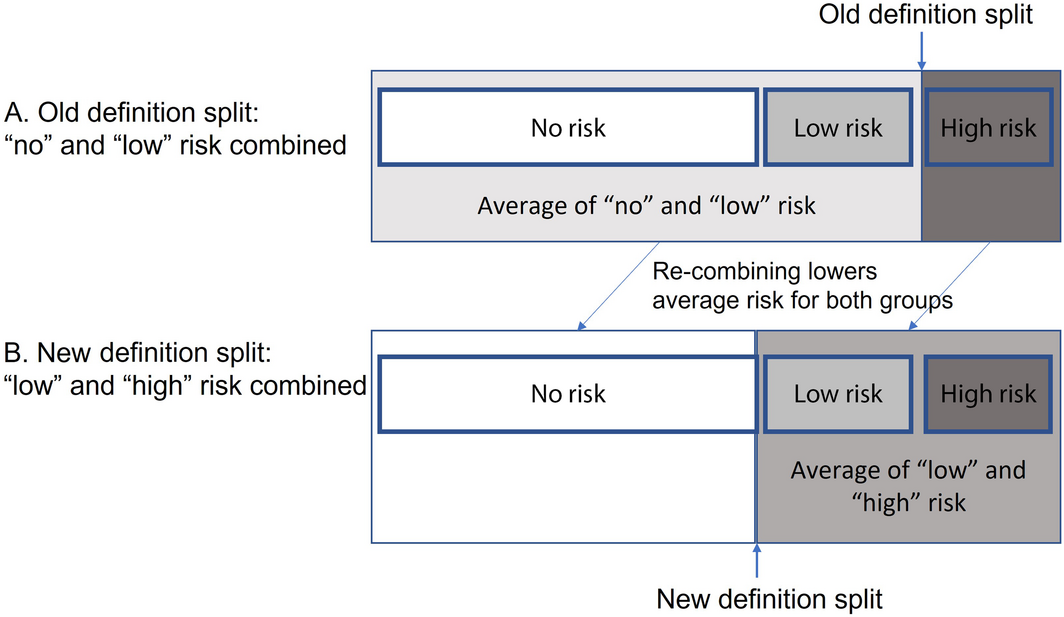
This large well conducted trial used the most appropriate study design to assess the impact of screening. Because of the nature of the trial, health care providers were not blinded to the trial‐group assignments. Trials comparing two diagnostic criteria need to enrol all those potentially diagnosed with the condition, and the results need to be analysed on this basis. Several previous studies of the outcomes of different diagnostic criteria for GDM have been biased by analysing the results only in women diagnosed with GDM; for example, the St Carlos Gestational Diabetes Study.4 The results of these studies cannot be used to determine the benefits of the change in the diagnostic criteria because of the effect of stage migration. Stage migration is a well known problem that occurs when new testing criteria or diagnostic criteria result in milder or earlier cases of disease being included in a case definition and results in artefactual improvements in survival or complication rates (Box 3).5 If the new GDM criteria include women with milder disease in the disease definition, these women will add to the number of women diagnosed but not to the number of women or infants with adverse outcomes, making it appear artificially as if results have improved.
The American trial1 was run as a superiority trial (ie, the investigators were looking for a difference between the two arms of the trial), and so a small difference between the two approaches cannot be ruled out. However, the large sample size and relatively small confidence intervals give reassurance that any such effect must be small and unlikely to be of clinical significance. The results are also consistent with an observational study conducted in Australia that showed no benefit after the introduction of the one‐step approach.6 An analysis of a subgroup of subjects in the Hyperglycaemia and Adverse Pregnancy Outcome (HAPO) study (those enrolled in sites in Australia, Canada, England, Singapore and the United States) also showed that a two‐step approach reduced the need for the OGTT by 80%, reduced the proportion of women diagnosed with GDM by 40%, and was not associated with an increase in pregnancy complications in the women who were no longer diagnosed with GDM using this strategy.7
The reason that the two‐step approach results in a smaller proportion of women being diagnosed with GDM is because of the large biological variation seen with each individual measure of hyperglycaemia.8 Women with even a mildly elevated measure of any of the three glucose measurements using the IADPSG criteria will be diagnosed with GDM. Other trials are also underway comparing the outcomes of using the IADPSG criteria versus a one‐step process with a narrower definition of GDM9 and comparing a one‐step screening test early in pregnancy with a one‐step process later in pregnancy.10 However, neither of these trials will help to answer the question about a one‐step versus a two‐step approach. As with all testing, the sensitivity and specificity depend on both the procedure for the test and the criteria used.
There is no simple dichotomy for defining “normal” in GDM, as in most other medical conditions, so we must consider the risks, benefits, and downsides of different options. There is clear benefit in treating women diagnosed with GDM using a two‐step approach, as shown by the results of two well conducted trials.11,12 Australia has largely adopted the IADPSG approach to defining GDM, as endorsed by the Australasian Diabetes in Pregnancy Society. However, the RACGP argued against this decision and has not endorsed the IADPSG approach. The RACGP has argued that there is a lack of evidence that the subset of women who are identified by the one‐step approach but who would have been considered normal by the two‐step approach benefit from the increased monitoring and interventions involved with the diagnosis.13 A consensus panel convened by the National Institutes of Health in 2013 came to the same conclusion.14 The widened definition also involves considerable potential for harm, including life disruptions for the women diagnosed, psychosocial burdens, a risk of more invasive forms of delivery in these women,15 and potential harms to the infant from restricted diets and the use of insulin, including an increased risk of neonatal hypoglycaemia.16 The one‐step approach also involves increased costs and poor targeting of resources. During the pandemic, many health services reverted to a two‐step process to minimise the number of women needing the prolonged contact of an OGTT.7 While future data may add some information, it will be mostly limited by its observational nature, whereas the American trial1 provides randomised controlled evidence of a lack of benefit for the one‐step approach.
This trial validates the ongoing concerns expressed by many practitioners regarding the introduction of the one‐step approach to the diagnosis of GDM. The new criteria were introduced without evidence of benefit, with significant risks of harms and considerable burdens to women and health care systems. About 25% of pregnancies diagnosed with gestational diabetes in Australia are affected by this change in the diagnostic criteria.7 We believe that the results of the American trial1 require an urgent need to revisit the diagnostic criteria used for GDM in Australia.
Box 1 – Criteria used for the diagnosis of gestational diabetes mellitus (GDM)
|
Criteria |
Approach |
Glucose challenge load (g) |
1‐hour threshold (mmol/L) |
OGTT load (g) |
Threshold (mmol/L) |
||||||||||
|
Fasting |
1 hour |
2 hours |
3 hours |
||||||||||||
|
|
|||||||||||||||
|
IADPSG*,1 |
1‐step |
|
|
75 |
≥ 5.1 |
≥ 10.0 |
≥ 8.5 |
|
|||||||
|
Carpenter–Coustan†,1 |
2‐step |
50 |
≥ 7.2 or ≥ 7.5 or ≥ 7.8‡ |
100 |
≥ 5.3 |
≥ 10.0 |
≥ 8.6 |
≥ 7.8 |
|||||||
|
United Kingdom§,2 |
1‐step |
|
|
75 |
≥ 5.6 |
|
≥ 7.8 |
|
|||||||
|
New Zealand§,3 |
2‐step |
50 |
≥ 7.8‡ |
75 |
≥ 5.6 |
|
≥ 9.0 |
|
|||||||
|
|
|||||||||||||||
|
IADPSG = International Association of the Diabetes and Pregnancy Study Groups; OGTT = oral glucose tolerance test. * GDM diagnosed if any of the results of the OGTT exceeds the threshold. The IADPSG criteria are used in most hospitals in Australia. † If the blood glucose level is ≥ 11.1, the patient is diagnosed with GDM. ‡ GDM is diagnosed if the 1‐hour glucose challenge result is > 11.1 mmol/L or if two or more of the four results of the OGTT exceed the thresholds above. The threshold for the glucose challenge test varies, and both ≥ 7.2 mmol/L and ≥ 7.8 mmol/L were used in the American trial. 1 A two‐step approach was used previously in Australia until the introduction of the IADPSG criteria. § GDM diagnosed if any of the results of the OGTT exceeds the threshold. |
|||||||||||||||
Box 2 – Risk of outcomes of one‐step (International Association of the Diabetes and Pregnancy Study Groups [IADPSG]) compared with two‐step (Carpenter–Coustan) screening for gestational diabetes mellitus (GDM) in the randomised controlled trial conducted in the United States1
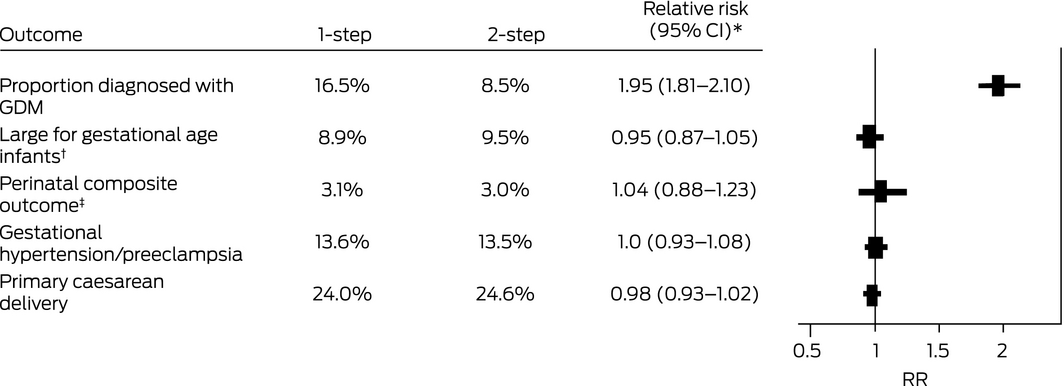
* Relative risk > 1 indicates increase with IADPSG. † Birth weight > 90th percentile. ‡ Stillbirth, neonatal death, shoulder dystocia, bone fracture, or any arm or hand nerve palsy related to birth injury.
Competing interests
No relevant disclosures.
References
- Hillier TA, Pedula KL, Ogasawara KK, et al. A pragmatic, randomized clinical trial of gestational diabetes screening. N Engl J Med 2021; 384: 895–904.
- Guideline Development Group. Management of diabetes from preconception to the postnatal period: summary of NICE guidance. BMJ 2008; 336: 714–717.
- Ministry of Health. Screening, diagnosis and management of gestational diabetes in New Zealand: a clinical practice guideline. Wellington: Ministry of Health, 2014. https://www.health.govt.nz/publication/screening‐diagnosis‐and‐management‐gestational‐diabetes‐new‐zealand‐clinical‐practice‐guideline (viewed Dec 2021).
- Duran A, Sáenz S, Torrejón MJ, et al. Introduction of IADPSG criteria for the screening and diagnosis of gestational diabetes mellitus results in improved pregnancy outcomes at a lower cost in a large cohort of pregnant women: the St. Carlos Gestational Diabetes Study. Diabetes Care 2014; 37: 2442–2450.
- Sormani MP. The Will Rogers phenomenon: the effect of different diagnostic criteria. J Neurol Sci 2009; 287 (Suppl): S46–S49.
- Meloncelli NJL, Barnett AG, dʼEmden M, De Jersey SJ. Effects of changing diagnostic criteria for gestational diabetes mellitus in Queensland, Australia. Obstet Gynecol 2020; 135: 1215–1221.
- McIntyre HD, Gibbons KS, Ma RCW, et al. Testing for gestational diabetes during the COVID‐19 pandemic. An evaluation of proposed protocols for the United Kingdom, Canada and Australia. Diabetes Res Clin Pract 2020; 167: 108353.
- Bonongwe P, Lindow SW, Coetzee EJ. Reproducibility of a 75 g oral glucose tolerance test in pregnant women. J Perinat Med 2015; 43: 333–338.
- Crowther CA, McCowan LME, Rowan JA, et al. GEMS Study Group. Lower versus higher diagnostic criteria for the detection of gestational diabetes for reducing maternal and perinatal morbidity: study protocol for the GEMS randomised trial. BMC Pregnancy Childbirth 2020; 20: 547.
- Simmons D, Hague WM, Teede HJ, et al. Hyperglycaemia in early pregnancy: the treatment of booking gestational diabetes mellitus (TOBOGM) study. A randomised controlled trial. Med J Aust 2018; 209: 405–406. https://www.mja.com.au/journal/2018/209/9/hyperglycaemia‐early‐pregnancy‐treatment‐booking‐gestational‐diabetes‐mellitus
- Crowther CA, Hiller JE, Moss JR, et al; Australian Carbohydrate Intolerance Study in Pregnant Women (ACHOIS) Trial Group. Effect of treatment of gestational diabetes mellitus on pregnancy outcomes. N Engl J Med 2005; 352: 2477–2486.
- Landon MB, Spong CY, Thom E, et al; Eunice Kennedy Shriver National Institute of Child Health and Human Development Maternal‐Fetal Medicine Units Network. A multicenter, randomized trial of treatment for mild gestational diabetes. N Engl J Med 2009; 361: 1339–1348.
- Royal Australian College of General Practitioners. Management of type 2 diabetes: a handbook for general practice. Melbourne, Vic: RACGP, 2020. https://www.racgp.org.au/getattachment/41fee8dc‐7f97‐4f87‐9d90‐b7af337af778/Management‐of‐type‐2‐diabetes‐A‐handbook‐for‐general‐practice.aspx (viewed Dec 2021).
- Vandorsten JP, Dodson WC, Espeland MA, et al. NIH consensus development conference: diagnosing gestational diabetes mellitus. NIH Consens State Sci Statements 2013; 29: 1–31.
- Feldman RK, Tieu RS, Yasumura L. Gestational diabetes screening: the International Association of the Diabetes and Pregnancy Study Groups compared with Carpenter–Coustan screening. Obstet Gynecol 2016; 127: 10–17. Erratum in: Obstet Gynecol 2016; 127: 806.
- Kong JM, Lim K, Thompson DM. Evaluation of the International Association of the Diabetes In Pregnancy Study Group new criteria: gestational diabetes project. Can J Diabetes 2015; 39: 128–132.
Provenance: Not commissioned; externally peer reviewed.
Forty Years in the Making: Reporting on the Co-Creation of a National Roadmap for Birthing on Country Services for the Best Start to Life
Res McCalman, Anneka J. Bowman, Roianne West, Kristie Watego, Jyai Allen, Claire Clack, Sue Kildea, Sue Kruske, Melanie Briggs, Cleone Wellington, Rebecca Coddington, Yu Gao, Isabella Garti, Sascha Kowalenko, Sarah Ireland, Catherine Austin, John D. Boffa, Marah Prior, Kelsie Kahl, Bettina Chaseling, Sarah Khaw, Emily Armstrong, Donna Hartz, Yvette Roe
Temporal Trends in Preterm Birth Associated With Hypertensive Disorders of Pregnancy in Victoria, Australia: A Population-Based Interrupted Time-Series Study
Melvin Marzan, Heng Jiang, Daniel Lorber Rolnik, Joanne M. Said, Lisa Hui
Linguistic Manoeuvres: Obstetric Violence Camouflages Harm and Loss of Consent From Birth
Liz Sutton, Harsha Ananthram, Rebecca Matthews
Linguistic Manoeuvres: Obstetric Violence Camouflages Harm and Loss of Consent From Birth
Bashi Kumar-Hazard, Andrew M. Bisits, Sharon L. Settecasse, Jenny Gamble, Hazel Keedle, Hannah G. Dahlen
Linguistic Manoeuvres: Obstetric Violence Camouflages Harm and Loss of Consent From Birth
Wendy Pollock, Alissa Fleming, Ensieh Fooladi, Joy Kloester, Anne Tremayne, Yasmin Zisin, Bethany Carr, Kym Davey, Suzanne Willey, Jenny Gamble
Getting on the Same Page: Why Australia Needs a National Maternity Early Warning System (MEWS) Chart
Briony A. Cutts, Lucy Bowyer, Nisha Khot, Sandra Lowe, Stefan C. Kane