




Medical education
Lessons from practice
Volume 208 - Issue 4
Insulinoma: important in the differential diagnosis of persistent hypoglycaemia unrelated to diabetes
Authors: Hui Yi Ng and Alexia Pape
Med J Aust 2018; 208 (4): 157-158. || doi: 10.5694/mja17.00174
Published online: 5 March 2018
Published online: 5 March 2018
Insulinoma is a rare cause of hypoglycaemia but should be considered in the differential diagnosis of persistent hypoglycaemia
Clinical record
An 89-year-old previously well man was found to have hypoglycaemia when investigated for an episode of altered level of consciousness resulting in a car accident. He had urinary sepsis and renal failure, which were initially thought to be the cause of his hypoglycaemia. However, even after the resolution of his acute illness, and with adequate oral intake, the hypoglycaemic episodes continued with a surprising lack of symptoms despite plasma glucose levels < 3 mmol/L.
On further questioning, he reported two further episodes of possibly significant hypoglycaemia in the preceding year. He remembered one episode of confusion that resolved with food, and one episode of collapse 6 months before admission, with a documented finger prick blood glucose level of 1.6 mmol/L (reference interval, 3.0–7.7 mmol/L) on ambulance attendance but no further investigations.
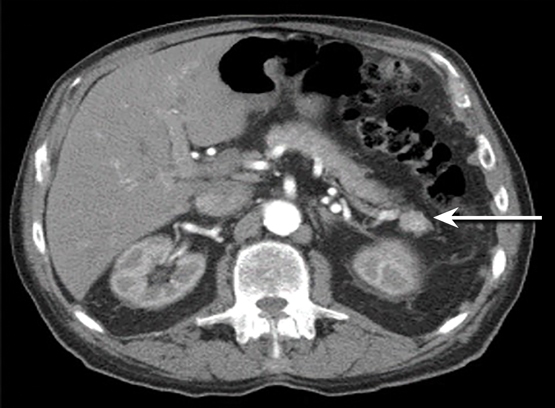
Blood tests taken during a hypoglycaemic event after resolution of urosepsis showed evidence of endogenous hyperinsulinaemic hypoglycaemia (Box 1). Subsequent imaging identified a single lesion in the tail of the pancreas that was suspicious for an insulinoma, with no evidence of local spread or hepatic metastases (Box 2).
The patient underwent laparoscopic distal pancreatectomy, which showed a low grade neuroendocrine tumour (Box 3). Despite a post-operative arrest from arrhythmia, which required insertion of a permanent pacemaker, he recovered well and has had no further episodes of hypoglycaemia over one year after discharge.
Hypoglycaemia is a common disorder that is most frequently seen in patients with diabetes on glucose-lowering medication. Owing to the potential for impaired concentration and level of consciousness, hypoglycaemia can be dangerous and has implications for the ability to drive and work.
In an adult patient without diabetes who fulfils Whipple’s triad, further investigation is warranted (Box 4).1 Whipple’s triad requires signs and symptoms consistent with hypoglycaemia and low measured plasma glucose, which resolve after the plasma glucose rises. However, hypoglycaemic unawareness may develop after repeated episodes of hypoglycaemia2 and was the presumed cause for the lack of symptoms in our patient.
An insulinoma is a mostly benign, functioning pancreatic neoplasm. It occurs in up to four people per million in the general population.3 Insulinoma remains challenging to diagnose, often leading to a delay in diagnosis with potentially lethal consequences. In our patient, the diagnosis could have been made earlier, and the car accident may have been avoided, if the previous documented hypoglycaemia had been investigated.
If biochemical test results obtained during a hypoglycaemic episode demonstrate endogenous hyperinsulinaemic hypoglycaemia (Box 1), and sulfonylurea ingestion has been excluded, the most likely diagnosis is an insulinoma, unless there is a history of bariatric surgery causing nesidioblastosis or there are insulin antibodies suggesting the rarer autoimmune-mediated hypoglycaemia (Box 5). If spontaneous hypoglycaemia does not occur, a supervised 72-hour fast is required. Only after biochemical confirmation of endogenous hyperinsulinaemic hypoglycaemia should further imaging to localise a lesion be performed. Five to ten per cent of insulinomas are associated with multiple endocrine neoplasia type 1, and further testing should be considered in individuals with a suggestive personal or family history of endocrinopathies.1
Insulinomas are evenly distributed throughout the pancreas and are often small; imaging therefore sometimes fails to localise the lesion. Computed tomography detects 70–80% of cases; magnetic resonance imaging has an improved rate of 85%. If computed tomography and magnetic resonance imaging fail to identify a lesion, endoscopic pancreatic ultrasonography with fine needle aspiration can be performed (sensitivity > 90%), and positron emission tomography may also be helpful. Other options are selective pancreatic arterial calcium injections (sensitivity, 94–100%), intra-operative pancreatic ultrasonography (80–100%) and palpation of the pancreas by an experienced surgeon (75–95%).3
Most patients with benign insulinomas are cured with surgery, with a good prognosis. If the patient is not suitable for surgery, other methods to improve hypoglycaemia include endoscopic ultrasound-guided ethanol and radiofrequency ablation.1 Medical therapies include octreotide, which binds to somatostatin receptors to inhibit insulin release and may have an additional anti-proliferative effect, and diazoxide, which acts through stimulation of α-adrenergic receptors.4 Glucocorticoids, which inhibit insulin production and increase insulin resistance, are an additional option.5
About 10% of insulinomas are malignant, with a 10-year survival of 29%.4 In addition to liver resection, adjuvant chemoradiotherapy is often required to improve survival.4 Everolimus and sunitinib have shown an improvement in progression-free survival of about 6 months longer compared with placebo.5 Everolimus has the added benefit of inducing hyperglycaemia, which may help symptom control.5
Peptide receptor radionuclide therapy for metastatic or inoperable insulinoma involves specific uptake and retention of radioactive lutetium-177 octreotate by the tumour, resulting in irradiation to the cancer cells.Lessons from practice
Insulinoma is a rare cause of hypoglycaemia but should be considered in the differential diagnosis of persistent hypoglycaemia, and hypoglycaemia without any clear cause warrants further investigation with a 72-hour fast.
Suspicion of a hypoglycaemic disorder is raised if Whipple’s triad is present: symptoms that could be due to hypoglycaemia, a documented low glucose level, and relief of symptoms with raising of glucose levels.
Hypoglycaemic unawareness from repeated hypoglycaemic episodes may occur (thus not technically fulfilling Whipple’s triad).
Box 1 – Patient’s blood test results
Test |
Level |
Criterion for EHH |
Comment |
||||||||||||
Laboratory glucose, mmol/L |
2.2 |
≤ 3.0 |
Low |
||||||||||||
Insulin, mU/L |
9.5 |
≥ 3.0 |
Non-suppressed |
||||||||||||
C-peptide, nmol/L |
1.16 |
≥ 0.2 |
Elevated |
||||||||||||
Pro-insulin, pmol/L* |
14.4 |
≥ 5.0 |
Elevated |
||||||||||||
β-Hydroxybutyrate, mmol/L |
0.21 |
≤ 2.7 |
Low |
||||||||||||
EHH = endogenous hyperinsulinaemic hypoglycaemia. * Pro-insulin elevation is especially suggestive of insulinoma.1 | |||||||||||||||
Box 2 – Computed tomography scan of abdomen showing lesion in the distal tail of the pancreas (arrow)
Box 3 – Insulinoma histopathology
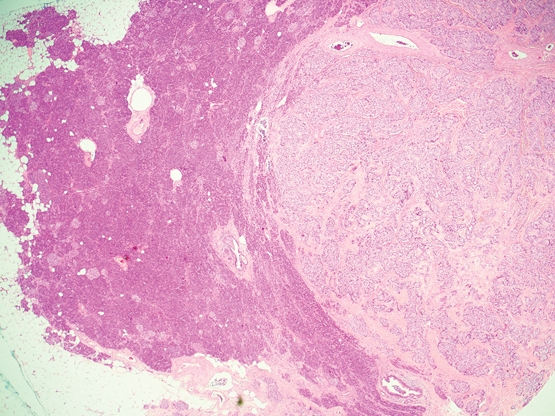
Normal pancreas (left); neuroendocrine tumour (right), approximately 1.3 cm, showing speckled nuclear chromatin (haematoxylin–eosin stain; original magnification × 20).
Box 4 – Differential diagnoses for hypoglycaemia in adults1
Well appearing individual |
Ill appearing or medicated individual |
||||||||||||||
Accidental, surreptitious or malicious hypoglycaemia |
Drugs: insulin, alcohol, sulfonylureas |
||||||||||||||
Endogenous hyperinsulinism: insulinoma, non-insulinoma pancreatogenous hypoglycaemia, post-gastric bypass hypoglycaemia, insulin autoimmune hypoglycaemia |
Hormonal deficiency: cortisol, glucagon, adrenaline |
||||||||||||||
Idiopathic postprandial hypoglycaemia |
Critical illnesses: sepsis, inanition, hepatic, renal or cardiac failure |
||||||||||||||
Non-islet cell tumour |
|||||||||||||||
Box 5 – Interpretation of hypoglycaemia screening results*,1
Interpretation |
Insulin |
Pro-insulin |
C-peptide |
β-Hydroxybutyrate |
Other |
||||||||||
Normal response to hypoglycaemia (normal reference intervals) |
↓ |
↓ |
↓ |
↑ |
|||||||||||
Exogenous insulin |
↑↑ |
↓ |
↓ |
↓ |
|||||||||||
Sulfonylurea ingestion |
↑ |
↑ |
↑ |
↓ |
Sulfonylurea screen in serum positive |
||||||||||
Endogenous hyperinsulinism |
↑ |
↑ |
↑ |
↓ |
Sulfonylurea screen in serum negative |
||||||||||
Autoimmune |
↑↑ |
↑↑ |
↑↑ |
↓ |
Insulin antibody positive |
||||||||||
Non-islet cell tumour |
↓ |
↓ |
↓ |
↑ |
IGF-2 serum levels may be elevated |
||||||||||
Not insulin (or IGF) mediated |
↓ |
↓ |
↓ |
↑ |
|||||||||||
IGF = insulin-like growth factor. * Tests to be performed during an episode of hypoglycaemia if the patient fulfils Whipple’s triad. | |||||||||||||||
Competing interests
No relevant disclosures.
References
- Cryer PE, Axelrod L, Grossman AB, et al. Evaluation and management of adult hypoglycaemic disorders: an endocrine society clinical practice guideline. J Clin Endocrinol Metab 2009; 94: 708-728.
- Mitrakou A, Fanelli C, Veneman T, et al. Reversibility of unawareness of hypoglycaemia in patients with insulinomas. N Engl J Med 1993; 329: 834-839.
- Okabayashi T, Shima Y, Sumiyoshi T, et al. Diagnosis and management insulinoma. World J Gastroenterol 2013; 19: 829-837.
- Taye A, Libutti S. Diagnosis and management of insulinoma: current best practice and ongoing developments. Res Rep Endocr Disord 2015; 5: 125-133.
- Ong GS, Henley DE, Hurley D, et al. Therapies for the medical management of persistent hypoglycaemia in two cases of inoperable malignant insulinoma. Eur J Endocrinol 2010; 162: 1001-1008.
Provenance: Not commissioned; externally peer reviewed.
When ‘Liver Enzymes’ Are Not Hepatic: Late-Onset Pompe Disease
Shauna Madigan, Georgina England, Wayne Rankin
Primary Hyperparathyroidism in Adults: Recent Developments in Diagnosis and Management
Elizabeth Wootton, Sunita M. C. De Sousa, Richard L. Prince, Donald S. A. McLeod, David A. Pattison, Mathis Grossmann
Severe Hypoglycaemia Secondary to Chronic Opioid-Induced Hypothalamic–Pituitary–Adrenal Axis Suppression: An Under-Recognised Phenomenon
Michael Do, Annabelle Hayes, Malgorzata Brzozowska
Rethinking diabetes care for Indigenous Australians: the need for Indigenous‐codesigned and led diabetes models of care
Natalie Nanayakkara, Sharon Atkinson‐Briggs, Alicia J Jenkins, Neale D Cohen
The first Australian evidence‐based guidelines on male infertility
Darren J Katz, Liza O’Donnell, Robert I McLachlan, Tim J Moss, Clare V Boothroyd, Veena Jayadev, Sarah R Catford