




Volume 203 - Issue 4
Perspectives from the field: Ebola response in Sierra Leone
Author: Rosalie Schultz
Med J Aust 2015; 203 (4): 199. || doi: 10.5694/mja15.00253
Published online: 17 August 2015
Published online: 17 August 2015
An Australian doctor reflects on a difficult but satisfying 6-week placement at an Ebola Treatment Centre in Freetown, Sierra Leone
On Christmas Day 2014, I started a 6-week placement at the Australian-flagged Ebola Treatment Centre, managed by Aspen Medical, in Freetown, Sierra Leone. I joined about 30 doctors, nurses, environmental health officers, and management and support staff from across Australia and New Zealand, working alongside 120 Sierra Leoneans.
A societal disaster
The West African Ebola virus disease (EVD) outbreak is a medical and societal disaster. Most patients die, leaving devastated families and communities. EVD spreads by interpersonal contact, so the community prevention message is “Avoid Body Contact” — ABC. However, body contact makes us human, and the ABC protocol is freakish in all cultures. Dramatic community-wide behaviour change is needed to control an EVD outbreak.
The EVD outbreak is occurring in West African countries already devastated by ecological, economic and governance crises. Access to food is limited; many people require food aid. Schools have closed, and a generation may never reach their potential. Health care services have collapsed — deaths from malaria, tuberculosis, HIV and diarrhoea will far exceed deaths from EVD.1
Challenges in the Ebola Treatment Centre
Outbreaks of EVD are brutal. The Ebola Treatment Centre assists in controlling the outbreak by isolating patients with EVD infection. A razor wire fence surrounds the treatment centre. Incinerators spew smoke as contaminated clothes, bedding, food and personal belongings are burnt. Controlled access to the treatment centre, and its white, green and red zones, prevents spread of the disease within the centre.
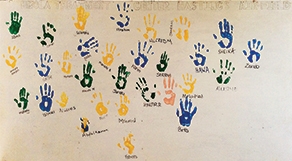
Survivors of Ebola virus disease leave their mark on this special wall at the Freetown Ebola Treatment Centre as they return home free of the disease. Image courtesy of Aspen Medical .
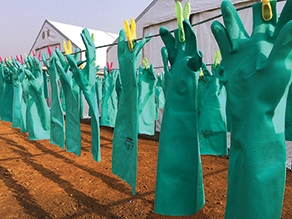
Clean gloves are part of the personal protective equipment (PPE) used every time anyone enters the red zone of an Ebola Treatment Centre. For tasks that do not require dexterity, thick gloves are used. All PPE is carefully removed on exiting the red zone, and the gloves are washed in chlorine and dried in the sun for reuse. Image courtesy of Aspen Medical.
Inside the Ebola Treatment Centre, personal protective equipment (PPE) is conspicuous. This equipment is required for entry to the red zone and is donned under supervision. Scrubs, boots, overalls, double gloves, an apron, an N95 mask, a hood and goggles must cover the entire body. The PPE soon becomes hot and goggles fog up, so time in the red zone is limited to 60 minutes. Patient care is restricted by these time limitations and by the PPE itself, which impairs communication and makes the stethoscope useless. Frequent chlorine spraying damages the available medical equipment.
Personal reflections
Despite the Ebola Treatment Centre’s restrictions and the lack of specific treatment for EVD, the work was satisfying. We offered symptom relief, particularly fluids and opiates, along with compassion, counselling and support. We witnessed life and death and celebrated each EVD survivor. The placement gave me insights into how health determinants can be so cruel, yet individuals so inspiring.
Competing interests
No relevant disclosures.
Acknowledgements
Thanks to Anna Ralph, infectious diseases physician, Darwin. I was employed by Aspen Medical for my 6-week placement in Sierra Leone and 3 weeks of monitoring on return to Australia.
References
- Menendez C, Lucas A, Munguambe K, Langer A. Ebola crisis: the unequal impact on women and children’s health. Lancet Global Health 2015; 3: e130.
Provenance: Not commissioned; not externally peer reviewed.
Costs of Delivering the Hep B PAST Model of Care in Remote Australia: A Retrospective Pre–Post Study
Hoa Nguyen, Anh Le Tuan Nguyen, Paula Binks, Melita McKinnon, Emily Vintour-Cesar, Karen Wills, Nicola Stephens, Benjamin Cowie, Joshua S. Davis, Yuejen Zhao, Peter Nihill, Julie A. Campbell, Andrew J. Palmer, Jane Davies, Barbara de Graaff
Buruli Ulcer Acquired From Ringtail Possum Rescue
Daniel P. O'Brien, Naomi Clarke, Sara Bonnici, Mohammad A. Hussain
Q Fever Visceral Abscesses After Contact With Native Australian Marsupials
Samantha J. Laws, Enzo Binotto, James Stewart, Jennifer Ho, Trent Yarwood, Josh Hanson, Simon Smith
Hospital-Admitted Injection-Related Infections Among Incarcerated People Who Inject Drugs in Australia: A Retrospective Cohort Study
Andrew Palmer, Matthew Carter, Jeremy Yeo, Cecilia Shim, Jason Connor, Jeremy Hayllar, Gerald Holtmann, Naomi Moy, Elliott G. Playford, Naomi Runnegar, Paul J. Clark
The Live Attenuated Influenza Vaccine in Australia: An Additional Tool for Influenza Prevention
Cyra Patel, Alexis Pillsbury, Tran Nguyen, Xia Wang, Helen E. Quinn, Clayton K. Chiu, Allen C. Cheng, Katie L. Flanagan, Zhicheng Wang
Reflex Testing for Hepatitis D Infection: A Unique Opportunity to Reduce Hepatitis D-Related Chronic Liver Disease Deaths in Australia
Jessica Howell, Lauren Andersson, Miriam T. Levy, James O'Beirne, Leon Adams, Katharine Irvine, Avik Majumdar, Golo Ahlenstiel, Kathy Jackson, Krispin Hajkowicz, Joseph Doyle, Jane Davies, Sarah Cherian, Wayne Dimech, Alexander J. Thompson