




Volume 203 - Issue 4
Impact of grief delivered via media technology
Authors: Anastasia S Mihailidou, Thomas Buckley, Alexandra JC Bune and Geoffrey Tofler
Med J Aust 2015; 203 (4): 198. || doi: 10.5694/mja15.00108
Published online: 17 August 2015
Published online: 17 August 2015
Advances in media technology have had a significant impact on our daily lives, in terms of how we conduct business and leisure. Recent events have also had significant emotional impact and we wish to highlight the potential health impact. The grief experienced following the death of a loved one can be one of the greatest stressors for those surviving — spouse and/or relatives. It is not only the emotional strain but also physiological changes in the immediate period after bereavement1,2 that affect health.
Bereavement may also affect non-relatives, which was only captured by these two patients referred independently for ambulatory blood pressure (ABP) monitoring as part of their clinical management. Both watched the televised broadcast of funeral proceedings for Australian cricketer Phillip Hughes. Although neither was a relative of Phillip Hughes and neither had met him, they both reported an emotional response to the broadcast.
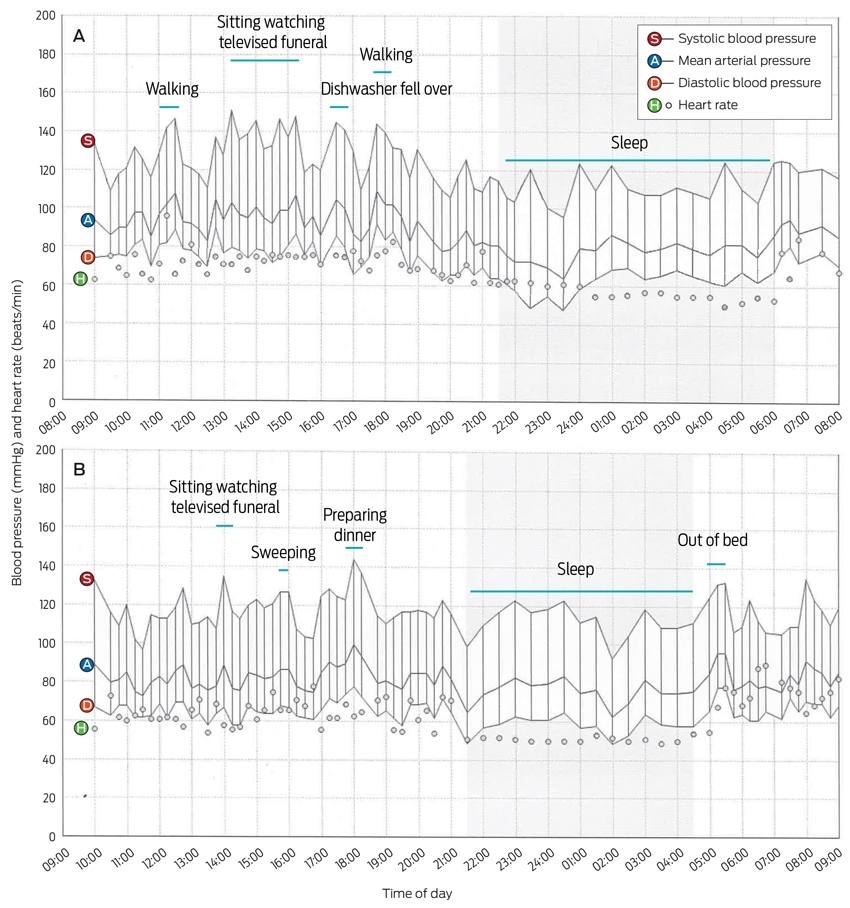
Panel A in the Box shows the ABP recording for a woman who was taking an angiotensin II receptor antagonist. The recording shows that she had an increase in systolic blood pressure (25 mmHg) while she was sitting watching the funeral that was comparable with her responses to physical activity.
The ABP recording for the second woman is shown in Panel B in the Box; her antihypertensive therapy included β-blockade. There was a 25 mmHg increase in systolic blood pressure while she sat watching the broadcast of the funeral. The increase was comparable with that for people with mild hypertension receiving mental stressor tests3 and may have been greater in the absence of β-blockade.
Such increases in blood pressure reflect overall changes in the cardiovascular system at the time of emotional stress and are associated with heightened cardiovascular risk.4,5 We therefore need to be aware of the significant impact that media technology may have on our health and consider preventive treatment strategies.
Competing interests
No relevant disclosures.
References
- Buckley T, Mihailidou AS, Bartrop R, et al. Hemodynamic changes during early bereavement: potential contribution to increased cardiovascular risk. Heart Lung Circ 2011; 20: 91-98.
- Buckley T, Morel-Kopp M-C, Ward C, et al. Inflammatory and thrombotic changes in early bereavement: a prospective evaluation. Eur J Prev Cardiol 2012; 19: 1145-1152.
- Jimenez AH, Tofler GH, Chen X, et al. Effects of nadolol on hemodynamic and hemostatic responses to potential mental and physical triggers of myocardial infarction in subjects with mild systemic hypertension. Am J Cardiol 1993; 72: 47-52.
- Rothwell PM, Howard SC, Dolan E, et al. Prognostic significance of visit-to-visit variability, maximum systolic blood pressure, and episodic hypertension. Lancet 2010; 375: 895-905.
- Glozier N, Tofler GH, Colquhoun DM, et al. Psychosocial risk factors for coronary heart disease. Med J Aust 2013; 199: 179-180.
Linked content
-
Podcast with Dr Susie Mihailidou
-
Video with Dr Susie Mihailidou
Fatty Liver Disease in Australia: A Narrative Review on the Epidemiology, Natural History, Prognostication and Management in People With Metabolic Dysfunction
Karl Vaz, Daniel Clayton-Chubb, William W. Kemp, Stuart K. Roberts, Ammar Majeed
Sex Differences in Management and Outcomes of People With ST-Elevation Myocardial Infarction, New South Wales, 2011–2020: A Retrospective Cohort Study
Adam C. Livori, Jedidiah I. Morton, Dianna J. Magliano, Jonathan E. Shaw
Rethinking Rheumatic Fever Diagnosis: Progress, Pitfalls and the Path Towards a Definitive Test
Anna P. Ralph, Rachel Webb, Tom Parks, Nicole J. Moreland, Asha C. Bowen, Benjamin Jones, Emma Ndagire, Andrea Z. Beaton
Sex Differences in Management and Outcomes of People With ST-Elevation Myocardial Infarction, New South Wales, 2011–2020: A Retrospective Cohort Study
Samia Kazi, Simone Marschner, Clara K. Chow
Distribution of Cardiovascular Disease Risk Based on the Updated 2023 Guideline-Recommended Australian Cardiovascular Disease Risk Algorithm and Comparison With the 2012 Algorithm: An Observational Study
Nina Lazarevic, Meghana Bhat, Grace Joshy, Danielle C. Butler, Mark Woodward, Anushka Patel, Rod T. Jackson, Garry Jennings, Rosemary Wyber, Ellie Paige, Emily Banks
They Brought the Hospital to Me
Hugh N. Burrill