




Volume 201 - Issue 7
Unrelieved pain: are we making progress? Shared education for general practitioners and specialists is the best way forward
Authors: Michael J Cousins and Lesley Brydon
Med J Aust 2014; 201 (7): 379-380. || doi: 10.5694/mja14.00572
Published online: 6 October 2014
Published online: 6 October 2014
The National Pain Strategy is driving improvements in pain management, but greater impetus is needed
The National Pain Strategy is driving improvements in pain management, but greater impetus is needed
One in five people are afflicted by chronic pain in Australia, with many experiencing severe disability.1,2 Such disability is strongly correlated with greater use of health resources and increasing reliance on disability support payments.3 Low back pain is now the number one cause of years lived with disability in Australia and globally.
A key Australian study was the first to report that people with chronic pain who use “active” self-management strategies experience markedly reduced disability, compared with those who rely on “passive” treatments such as medication and massage.2 A wide range of other effective treatments and a recommended treatment framework are detailed in the National Pain Strategy (NPS). However, a nationwide study of access to pain services reported major inadequacies, with average wait times of 150 days,4 and a Canadian study reported adverse outcomes of waiting for access to treatment for chronic pain.5
The widespread prescription and misuse of opioids in chronic pain, often associated with adverse events, further highlights the need for improved access to multidisciplinary services.
An article in the Journal in 2012 called for prioritisation of chronic pain management to address the lack of equity of access, compared with other chronic conditions.6 The moral imperative of this is evidenced by the millions of people worldwide who suffer unnecessarily with unrelieved pain7 and the financial costs in Australia of more than $34 billion annually8 including the costs of lost workforce participation, forced early retirement and numerous other financial burdens.3,8
Progress is now being made to address this including, but not limited to:
- federal government recognition in 2005 of pain medicine and palliative medicine as independent medical specialties;
- establishment of the Faculty of Pain Medicine (FPM), with qualifications administered by five specialist bodies — Australian and New Zealand College of Anaesthetists, Royal Australasian College of Surgeons, Royal Australasian College of Physicians, Australasian Faculty of Rehabilitation Medicine and Royal Australian and New Zealand College of Psychiatrists;
- creation of world-leading education and training resources in pain medicine administered by the FPM, postgraduate pain education programs provided by the Pain Management Research Institute, University of Sydney, and recognition of pain medicine as an independent academic discipline by the University in 2012;
- development of the NPS by 150 health professional and consumer organisations, and approval of the NPS by consensus at the National Pain Summit (2010); and
- the formation in 2011 of advocacy body Painaustralia (http://www.painaustralia.org.au) — to work with state and federal governments and health care and consumer stakeholders to facilitate its implementation.
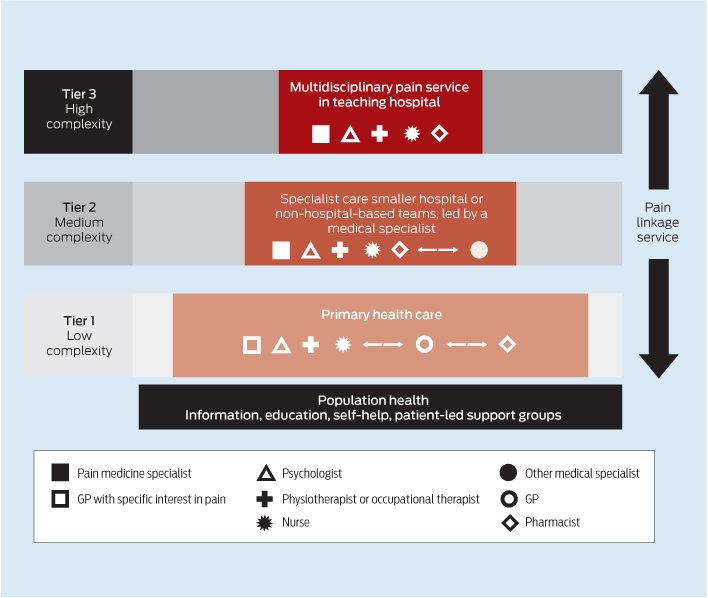
The initial focus of state and territory governments has been to consolidate capacity in tertiary multidisciplinary clinics and expand access by establishing regional pain centres. Fourteen new centres are now operating in regional areas of New South Wales, Victoria and Queensland. With wait times for tertiary services still unacceptably long, many tertiary pain centres are providing education and training for general practitioners and allied health professionals in their area to support more effective intervention at the primary care level, as recommended in the NPS (Box). Web-based resources for consumers are now available (http://www.aci.health.nsw.gov.au/chronic-pain and http://painhealth.csse.uwa.edu.au), with support groups in the community including a pain helpline run solely by volunteers.
With the high percentage of GP consultations involving a person with chronic pain, and considering rising concerns about over-reliance on pain medications including opioids, there is a need to ensure that pain management education and training is accessible to all GPs. A lot of effort and resources are now being applied to this critical area of need in an effort to address this serious community health problem.
The “gamebreaker” lies in the development of multidisciplinary teams of GPs, nurses and allied health professionals including physiotherapists, clinical psychologists, occupational therapists and pharmacists — all with training in pain management — capable of working in an interdisciplinary manner to assess and treat physical, psychological and environmental factors in patients with chronic pain. Recognising the need for early intervention, several Medicare Locals have established innovative pain programs in primary care. A trial of such a model in Western Australia showed significantly reduced wait times at tertiary pain centres.9 There is an opportunity for such programs to be expanded into other areas as Medicare Locals transition into Primary Health Networks.
It is encouraging to note that seven GPs have now qualified as Fellows of the FPM, with another seven at various stages of training. Web-based resources have been developed for GPs and allied health professionals including:
- gplearning (http://gplearning.racgp.org.au/Home/index.aspx), a resource developed by the FPM and the Royal Australian College of General Practitioners with funding from Bupa Health Foundation;
- a range of programs provided by the Pain Management Research Institute;
- a postgraduate degree program in pain management at the University of Sydney (http://sydney.edu.au/medicine/pmri/education/postgraduate/index.php); and
- practical resources developed by the NSW Agency for Clinical Innovation Pain Management Network (http://www.aci.health.nsw.gov.au/chronic-pain).
Additional funding is urgently required to meet the nationwide demand for enhanced skills and capacity. Another barrier to progress is the restrictive access to Medicare funding for allied health services.
The NPS proposes a “seamless” two-way movement of patients between tertiary, secondary and primary care, with most patients having access to assessment and treatment at primary care level, and only those with the most complex pain conditions being referred to tertiary pain centres or other specialists (eg, rheumatologists or neurologists) as appropriate. The NPS envisages that such specialists would welcome the option of referring laterally to pain medicine specialists when, despite their best efforts, chronic pain remains unrelieved.
Although early intervention and seamless referral and service integration is common practice for some chronic conditions (eg, diabetes or stroke), there is surprisingly little data about the effects of formal cooperation between specialists and GPs managing patients with chronic pain.10
In stroke treatment, for example, outcomes for patients who had a formal care meeting at discharge (by teleconference if necessary), between the tertiary inpatient stroke team and community health professionals, were evaluated and compared with outcomes for patients who did not receive such a process.10 For those patients discharged after a care meeting, the benefit was a negotiated care plan with a 50% increase in likelihood of independent living compared with patients who did not receive such a process. A similar process for people with chronic pain would ensure optimum management of their condition while minimising the likelihood of patients re-presenting for treatment or hospitalisation.
Experience suggests it would be beneficial if educational materials were shared, with a pain management module available to all medical specialties. Joint multidisciplinary educational meetings on all forms of pain have already been held on multiple occasions. This gradual process of sharing knowledge is greatly enhanced by face-to-face discussion, as recommended by J J Bonica, the founding father of multidisciplinary pain medicine.11
Competing interests
No relevant disclosures.
References
- Blyth FM, Cousins MJ, March LM. Chronic pain-related disability and use of analgesia and health services in a Sydney community. Med J Aust 2003; 179: 84-87. 1
- Blyth FM, March LM, Nicholas MK, Cousins MJ. Self-management of chronic pain: a population-based study. Pain 2005; 113: 285-292. 2
- Schofield DJ, Shrestha RN, Passey ME, et al. Chronic disease and labour force participation among older Australians. Med J Aust 2008; 189: 447-450. 3
- Semple TJ, Hogg MN. Waiting in pain [editorial]. Med J Aust 2012; 196: 372-373. 4
- Lynch ME, Campbell F, Clark AJ, et al. A systematic review of the effect of waiting for treatment for chronic pain. Pain 2008; 136: 97-116. 5
- Cousins MJ. Unrelieved pain: a major health care priority [editorial]. Med J Aust 2012; 196: 373-374. 6
- Cousins MJ, Lynch ME. The Declaration of Montreal: access to pain management is a fundamental human right [editorial]. Pain 2011; 152: 2673-2674. 7
- MBF Foundation. The high price of pain: the economic impact of persistent pain in Australia in 2007. Report by Access Economics in collaboration with the University of Sydney Pain Management Research Institute. 2007. http://www.bupa.com.au/staticfiles/BupaP3/Health%20and%20 Wellness/MediaFiles/PDFs/MBF_Foundation_the_price_of_pain.pdf (accessed Jul 2014).
- Davies S, Quintner J, Parsons R, et al. Preclinic group education sessions reduce waiting times and costs at public pain medicine units. Pain Med 2011; 12: 59-71. 9
- Mitchell GK. Improving coordination of care between specialist and general practice for people with chronic pain. Med J Aust 2013; 198: 301-302. lefthere
- Fishman SM, Ballantyne JC, Rathmell JP. Bonica's management of pain. 4th ed. Philadelphia: Lippincott Williams and Wilkins, 2010. 11
Provenance: Commissioned; externally peer reviewed.
Reducing Nitrous Oxide Emissions Across the Melbourne Biomedical Precinct
Ross Robertson, Andrew Downey, Daryl Williams, Bjorn Makein, Ben Dunne, Tugce Ozturk, Ying Gu, Rebecca McIntyre
Greenhouse gas emissions associated with anaesthetic gases in Australia, 2002–2022: a retrospective descriptive analysis
Krista Verlis, Jessica F Davies, Forbes McGain, Hayden Burch, Alexandra L Barratt, Luise Kazda
Opioids and the challenges of managing chronic non‐cancer pain in rural Australia: a qualitative study
Jessica A Thomas, Jill Benson, Philip Davidson, Paul R Ward
Spinal cord stimulation patterns of care, re‐interventions, and costs for private health insurers, Australia, 2011–22: a retrospective observational study
Caitlin MP Jones, Christopher G Maher, Rachelle Buchbinder, Ian A Harris, Chung‐Wei Christine Lin, Christopher Hayes, Alexandra Gorelik