




Volume 201 - Issue 2
Eye injuries and tasers
Authors: Annette K Hoskin and David A Mackey
Med J Aust 2014; 201 (2): 89-90. || doi: 10.5694/mja14.00256
Published online: 21 July 2014
Published online: 21 July 2014
Managing ocular damage caused by taser barbs
To the Editor: Taser (TASER International) injuries have been topical in the news media. This provides an important reminder of the possible traumatic sequelae associated with the use of electronic control devices.
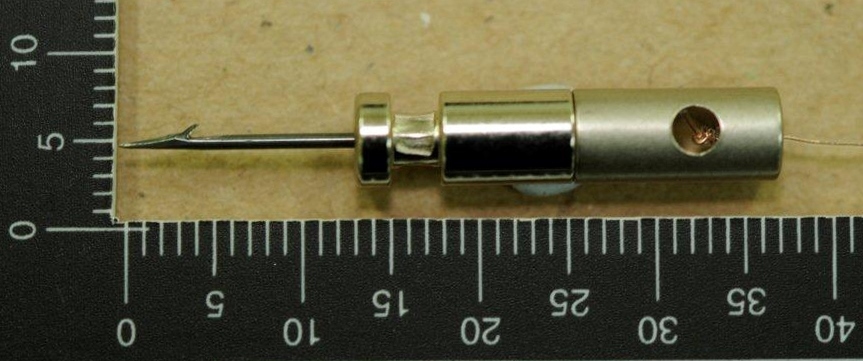
A taser is a battery-powered unit that uses a nitrogen cartridge to propel two darts on a 7 m copper wire.1 Each dart consists of a 4 mm harpoon-like barbed electrode on a 13 mm × 1 mm shaft (Box), deployed at 18 m/s from a distance of 3–6 m. Increasingly, tasers are being used by police in every state of Australia to subdue violent people.
When the deployed darts attach to a target individual's skin or clothing, a current of up to 50 000 volts is released for a period of up to 5 s, depending on the skin's resistance (which varies based on fat content, thickness, cleanliness and body chemistry).2 The mechanical impact of the barbs, combined with the subsequent voltage released, represents a considerable hazard to eyes, genitalia and large blood vessels in the neck.2
Essentially, the eyeball is a liquid-filled globe with a wall thickness < 1 mm, making it particularly susceptible to electrical damage. TASER International states that “serious injury, including permanent vision loss” can result from barb contact with the eye.3 Our literature search found seven case reports and one review of ocular damage relating to taser use.1,2,4-8 In five cases, penetration of the globe was reported;1,4,5,7,8 in three cases, entry through the lids made this difficult to determine without ophthalmic surgical examination.1,2,7 Ocular damage associated with taser use includes mydriasis, iritis, macular cysts, lid lacerations, cataracts, retinal detachment, optic neuritis, vitreous haemorrhage and globe penetration.6 Damage may be thermal or mechanical,6 with visual outcome ranging from final visual acuity of 6/9 to total vision loss and enucleation.1,2,4,5,7,8
As taser use increases, medical staff need to be aware of the implications of both the impact energy and the electrical damage associated with taser deployment. As in the management of a barbed fishhook penetrating the eye or ocular area, a taser barb should not be removed at the scene but should be immobilised (eg, by covering it with a foam or paper cup) until appropriate ophthalmic surgical removal is possible.1
Competing interests
No relevant disclosures.
References
- Ng W, Chehade M. Taser penetrating ocular injury. Am J Ophthalmol 2005; 139: 713-715. _ENREF_2
- Sayegh RR, Madsen KA, Adler JD, et al. Diffuse retinal injury from a non-penetrating TASER dart. Doc Ophthalmol 2011; 123: 135-159. _ENREF_3
- TASER International. Volunteer: warnings, risks, release and indemnification agreement. http://www.taser.com/images/training/training-resources/downloads/Volunteer_Exposure_Release_030113.pdf (accessed Jan 2014).
- Chen SL, Richard CK, Murthy RC, Lauer AK. Perforating ocular injury by Taser. Clin Experiment Ophthalmol 2006; 34: 378-380. 4
- Teymoorian S, San Filippo AN, Poulose AK, Lyon DB. Perforating globe injury from Taser trauma. Ophthal Plast Reconstr Surg 2010; 26: 306-308. 5
- Robb M, Close B, Furyk J, Aitken P. Review article: emergency department implications of the TASER. Emerg Med Australas 2009; 21: 250-258. 6
- Han JS, Chopra A, Carr D. Ophthalmic injuries from a TASER. CJEM 2009; 11: 90-93. 7
- Li JY, Hamill MB. Catastrophic globe disruption as a result of a TASER injury. J Emerg Med 2013; 44: 65-67. lefthere
A Diagnostic Headache
Thomas Glynn, Michelle T. Leech, Stacy K. Goergen, Emily Lin, Nadeem Toodayan, Ralph Junckerstorff
Neisseria meningitidis: an uncommon cause of conjunctivitis
Chloe Story, Tina Marinelli, Simeon Crawford, Amrita Ronnachit
Dismantling barriers to research and clinical care for individuals with a vision impairment
Eden G Robertson, Kate Hetherington, Meredith Prain, Julia Hall, Leighton Boyd AM, Rosemary Boyd OAM, Emily Shepard, Hollie Feller, Sally Karandrews, Fleur O'Hare, Kanae Yamamoto, Matthew P Simunovic, Robyn V Jamieson, Alan Ma, Lauren Ayton AM, Anai Gonzalez‐Cordero
The New South Wales Pharmacy Trial for herpes zoster: on the nose?
Christian P Pappas, Timothy R Holmes, Minas T Coroneo
Skin fragility disorder misdiagnosed as child abuse: a cautionary tale
Heather G Mack, Fred K Chen, John R Grigg
Health economic aspects of inherited retinal diseases: looking for cost‐effective treatments
Benjamin Kamien, Rachael Heath Jeffery, Fred K Chen