




Volume 198 - Issue 3
The impact of age and sex on person-level Medicare costs
Author: Catherine L Keating
Med J Aust 2013; 198 (3): 138. || doi: 10.5694/mja12.11606
Published online: 18 February 2013
Published online: 18 February 2013
To the Editor: The impact of population ageing on health care expenditure was a hot topic in the late 1990s in Australia.1 Previous studies have adopted various modelling approaches to estimate age- and sex-specific health care costs to inform population health care expenditure projections.2-4 Medicare funds about 3800 medical services, including consultations provided by general practitioners and specialists, medical diagnostic services (such as medical imaging and ...
To the Editor: The impact of population ageing on health care expenditure was a hot topic in the late 1990s in Australia.1 Previous studies have adopted various modelling approaches to estimate age- and sex-specific health care costs to inform population health care expenditure projections.2-4 Medicare funds about 3800 medical services, including consultations provided by general practitioners and specialists, medical diagnostic services (such as medical imaging and pathology), dental surgery, optometry and selected allied health services through the Medicare Benefits Schedule (MBS). It also funds about 2100 pharmaceutical therapies, or about 80% of all prescription medications dispensed in Australia, through the Pharmaceutical Benefits Scheme (PBS).
This letter reports annual Medicare costs at the person level for 10-year age and sex groups, drawing on de-identified Medicare linked data. Medicare randomly selected 10 000 men and 10 000 women from each of the following 2009 age groups, irrespective of their associated Medicare expenditure: 15–24, 25–34, 35–44, 45–54, 55–64, 65–74 and 75–84 years. Health care cost data for each of the samples were sourced from the MBS and PBS databases for the period 1 July 2005 to 31 December 2008. Costs were annualised and mean costs per person were calculated for each sample in 2007 Australian dollars.5
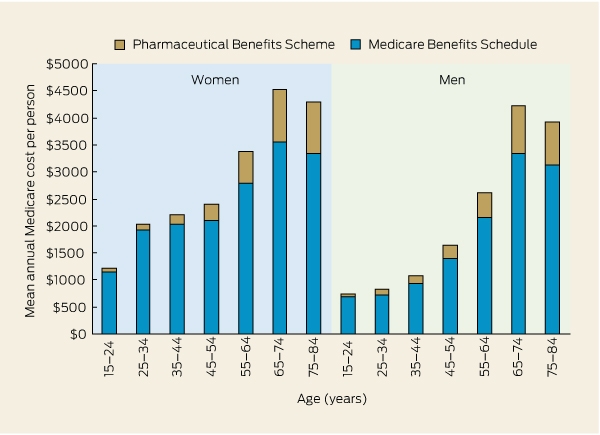
Medicare costs increased with each 10-year age increment, with the exception of a decrease in costs observed in the 75–84-year age group, which is likely to have resulted from the death of patients who previously had heavy health care use. Medicare costs per person peaked for both sexes in the population aged 65–74 years (women, $4518; men, $4215), where costs were 3.7 times and 5.6 times higher than equivalent costs for women and men aged 15–24 years. Medicare costs per capita were consistently higher for women. The differential was most pronounced for the younger age groups, particularly the 25–34-year and 35–44-year age groups where costs for women were more than double the equivalent costs for men (Box).
Observed health care cost data for demographic groups can be used to inform future Australian health care expenditure projections.
Competing interests
No relevant disclosures.
Acknowledgements
I thank Medicare Australia staff, who assisted with the identification of samples analysed in this study and provided detailed medical and pharmaceutical data for each sample.
References
- Coory MD. Ageing and healthcare costs in Australia: a case of policy-based evidence? Med J Aust 2004; 180: 581-583. 0_BABGCHCD
- Cooper C, Hagan P. The ageing Australian population and future health costs: 1996–2051. Canberra: Department of Health and Aged Care, 1999. http://www.health.gov.au/internet/main/publishing.nsf/Content/health-historicpubs-hfsocc-ocpanew7.htm (accessed Jan 2012).
- Badham J. Future financial impact of the current health financing system. Aust Health Rev 1998; 21: 96-110. 0_i1142874
- Richardson J, Robertson I. Ageing and the cost of health services. Melbourne: Centre for Health Program Evaluation, 1999. http://www.buseco.monash.edu.au/centres/che/pubs/wp90.pdf (accessed Jan 2012).
- Keating CL, Moodie ML, Bulfone L, et al. Healthcare utilization and costs in severely obese subjects before bariatric surgery. Obesity (Silver Spring) 2012; 20: 2412-2419. 0_i1142881
Capturing the Benefits of Clinical Quality Registries
Taryn Bessen, Stephen McDonald
Medical Colleges Have an Obligation to Ensure Full Participation in Clinical Quality Registries
Thomas J. Hugh
Getting on the Same Page: Why Australia Needs a National Maternity Early Warning System (MEWS) Chart
Briony A. Cutts, Lucy Bowyer, Nisha Khot, Sandra Lowe, Stefan C. Kane
Data for Equity: Can Linked Administrative Data Inform Pathways to More Equitable Child Health?
Sarah Gray, Shuaijun Guo, Meredith O'Connor, Elodie O'Connor, Katrina Williams, Hannah Badland, Susan Woolfenden, Josie Dickerson, Gerry Redmond, Marnie Downes, Sharon R. Goldfeld
Specialty College Selection: Why Change is Critical to Support a Future Rural Workforce
Matthew R. McGrail, Jenny May AM, Katherine Logan
Differentiated and simplified oral HIV pre‐exposure prophylaxis (PrEP) models hold the key to virtually eliminating HIV transmission in Australia by 2030
Tyson Arapali, Sarah Warzywoda, Anthony K J Smith, Curtis Chan, Timothy R Broady, Erin Sullivan, Catherine MacPhail, Mohamed A Hammoud, Alexander Dowell‐Day, Benjamin R Bavinton