




Volume 196 - Issue 2
An unrecognised case of tenofovir-associated Fanconi syndrome
Authors: David M Gracey, Mangalee Fernando, John Ziegler, Christopher P White and Jeffrey J Post
Med J Aust 2012; 196 (2): 111-112. || doi: 10.5694/mja11.11122
Published online: 6 February 2012
Published online: 6 February 2012
To the Editor: Tenofovir disoproxil fumarate is a nucleotide analogue reverse transcriptase inhibitor that is used in Australia as first-line antiviral treatment for HIV infection.1,2 Tenofovir may be nephrotoxic, particularly affecting proximal tubular function.3 We report a case of tenofovir-associated Fanconi syndrome, which demonstrates the need for vigilance in patients taking tenofovir.
A 17-year-old rurally residing boy with perinatally acquired HIV infection presented to a tertiary referral hospital with renal impairment. His serum creatinine level had been normal 4 years previously. He had had severe leg pain and weakness for over a year, and was unable to mobilise without a walking frame. Because of his illness, he had stopped studying. He had commenced antiretroviral therapy in 1996, when he was 3 years old, and at presentation was taking tenofovir plus emtricitabine and lopinavir plus ritonavir. Follow-up with his local clinician was intermittent.
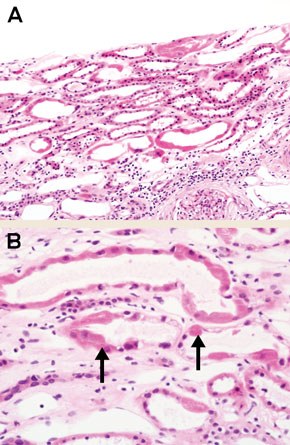
The patient’s HIV viral load was undetectable, and he had a CD4 count of 0.62 × 10⁹ cells/L. His serum creatinine level was 150 μmol/L (reference interval, 60–110 μmol/L) and his estimated glomerular filtration rate (eGFR) was 52 mL/min/1.73 m2 (normal value, > 90 mL/min/1.73 m2). He had all the features of Fanconi syndrome — hypophosphataemia with renal phosphate wasting, glycosuria, aminoaciduria, a reduced serum uric acid level and proteinuria (1.93 g/day). He also had hypokalaemia and acidosis, and his urine tested positive for β2-microglobulin. Histological analysis of a renal biopsy specimen showed proximal tubular abnormalities (Box). In addition, he had severely reduced bone mineral density, elevated bone turnover markers and vitamin D deficiency.
The patient’s tenofovir therapy was ceased, he was started on an alternative antiretroviral regimen, and he was given phosphate, potassium, bicarbonate and calcium supplementation plus vitamin D and calcitriol therapy. Two months later, his serum creatinine level was 130 μmol/L, his eGFR was > 60 mL/min/1.73 m2, and his proteinuria, glycosuria and aminoaciduria had resolved. His leg pain and weakness resolved within another month. He has since been able to recommence full-time study.
The persistent biochemical and renal abnormalities in this patient may have been a result of delayed recognition of Fanconi syndrome leading to prolonged illness. Risk factors for tenofovir-associated nephrotoxicity include a GFR of less than 90 mL/min/1.73 m2, use of nephrotoxic medications, comorbidities (eg, diabetes and hypertension) and use of some protease inhibitors. Patients on tenofovir should be screened at least 6-monthly for eGFR, serum phosphate levels, proteinuria and glycosuria.4 Three-monthly testing is also suggested in the initial year, due to the occurrence of tenofovir-associated nephrotoxicity without risk factors.5 Urinary protein to creatinine ratio is usually increased in tenofovir-associated nephrotoxicity, and tests for some urinary proteins may be useful in subtle cases of the condition.3 Testing for albuminuria (a marker of glomerular disease) and sole reliance on eGFR are insufficient for detecting tenofovir-associated tubular dysfunction.3
Due to potential renal toxicity, optimal outcomes for patients on tenofovir require careful monitoring of patients and close liaison between treating practitioners.
Renal biopsy specimens showing proximal tubular abnormalities in a patient with tenofovir-associated Fanconi syndrome
Competing interests
No relevant disclosures.
References
- Gallant JE, DeJesus E, Arribas JR, et al. Tenofovir DF, emtricitabine, and efavirenz vs zidovudine, lamivudine and efavirenz for HIV. N Engl J Med 2006; 354: 251-260. 0_CHDEBDEB
- Panel on Antiretroviral Guidelines for Adults and Adolescents. Guidelines for the use of anti-retroviral agents in HIV-1-infected adults and adolescents, with Australian commentary. http://www.ashm.org.au/projects/arvguidelines (accessed Jan 2012).
- Hall AM, Hendry BM, Nitsch D, et al. Tenofovir-associated kidney toxicity in HIV-infected patients: a review of the evidence. Am J Kidney Dis 2011; 57: 773-780. 0_i1142887
- Gupta SK, Eustace JA, Winton JA, et al. Guidelines for the management of chronic kidney disease in HIV-infected patients: recommendations of the HIV Medicine Association of the Infectious Diseases Society of America. Clin Infect Dis 2005; 40: 1559. 0_i1142891
- European AIDS Clinical Society. Guidelines: clinical management and treatment of HIV infected adults in Europe. http://www.europeanaidsclinical society.org/images/stories/EACS-Pdf/eacs guidelines-v6_english.pdf (accessed Jan 2012).
Costs of Delivering the Hep B PAST Model of Care in Remote Australia: A Retrospective Pre–Post Study
Hoa Nguyen, Anh Le Tuan Nguyen, Paula Binks, Melita McKinnon, Emily Vintour-Cesar, Karen Wills, Nicola Stephens, Benjamin Cowie, Joshua S. Davis, Yuejen Zhao, Peter Nihill, Julie A. Campbell, Andrew J. Palmer, Jane Davies, Barbara de Graaff
Buruli Ulcer Acquired From Ringtail Possum Rescue
Daniel P. O'Brien, Naomi Clarke, Sara Bonnici, Mohammad A. Hussain
Q Fever Visceral Abscesses After Contact With Native Australian Marsupials
Samantha J. Laws, Enzo Binotto, James Stewart, Jennifer Ho, Trent Yarwood, Josh Hanson, Simon Smith
Hospital-Admitted Injection-Related Infections Among Incarcerated People Who Inject Drugs in Australia: A Retrospective Cohort Study
Andrew Palmer, Matthew Carter, Jeremy Yeo, Cecilia Shim, Jason Connor, Jeremy Hayllar, Gerald Holtmann, Naomi Moy, Elliott G. Playford, Naomi Runnegar, Paul J. Clark
The Live Attenuated Influenza Vaccine in Australia: An Additional Tool for Influenza Prevention
Cyra Patel, Alexis Pillsbury, Tran Nguyen, Xia Wang, Helen E. Quinn, Clayton K. Chiu, Allen C. Cheng, Katie L. Flanagan, Zhicheng Wang
Reflex Testing for Hepatitis D Infection: A Unique Opportunity to Reduce Hepatitis D-Related Chronic Liver Disease Deaths in Australia
Jessica Howell, Lauren Andersson, Miriam T. Levy, James O'Beirne, Leon Adams, Katharine Irvine, Avik Majumdar, Golo Ahlenstiel, Kathy Jackson, Krispin Hajkowicz, Joseph Doyle, Jane Davies, Sarah Cherian, Wayne Dimech, Alexander J. Thompson