




Volume 193 - Issue 7
World cup fever
Authors: Bridget E Barber, Krispin M Hajkowicz, Vicki L Krause, Kevin G Freeman and Bart J Currie
Med J Aust 2010; 193 (7): 425. || doi: 10.5694/j.1326-5377.2010.tb03978.x
Published online: 4 October 2010
Published online: 4 October 2010
To the Editor: We report a case of measles in a 24-year-old man who returned from the Fédération Internationale de Football Association (FIFA) World Cup in South Africa in July 2010. Despite Australian health alerts about measles in South Africa,1 the patient had received no pretravel medical advice or vaccinations.
Six days after returning home to the Northern Territory, the patient developed fever, headache and myalgia. The following day he developed vomiting, diarrhoea, and productive cough, with a widespread rash appearing the subsequent day. He visited two general practitioners, was prescribed doxycycline and then admitted to hospital on Day 6 of his illness.
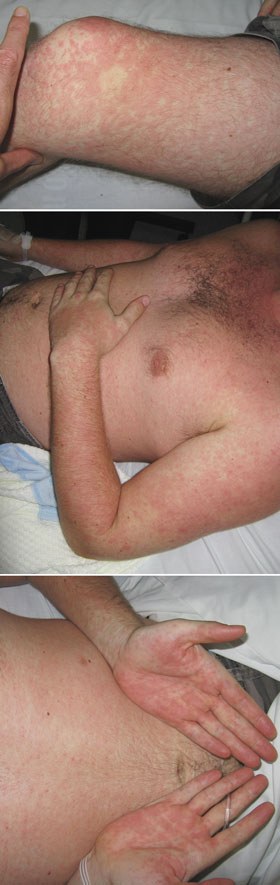
On examination, his temperature was 38.9ºC; pulse, 112 beats per minute; blood pressure, 133/72 mmHg; and oxygen saturation, 96% on room air. He had conjunctivitis, a widespread blanching maculopapular rash involving his face, trunk, limbs, hands and feet (Box) and cervical lymphadenopathy. He had bilateral basal lung crackles and tender hepatomegaly. Investigations showed thrombocytopenia (platelet count, 148 × 109/L; reference range, 150–450 × 109/L); hyponatraemia (sodium concentration, 131 mmol/L; reference range, 132–142 mmol/L); and abnormal liver function test results (alanine transaminase concentration, 417 U/L [reference range, < 40 U/L]; alkaline phosphatase concentration, 236 U/L [reference range, 39–117 U/L]). His chest x-ray was normal. The following day, measles virus RNA was detected from a throat swab, and the patient was put into respiratory isolation and therapy with doxycycline ceased. He made a full recovery. The patient reported receiving childhood vaccinations, and while he thought he may have received one measles, mumps and rubella vaccination, he had not had two. Follow-up was required for 84 identified contacts, with no measles cases subsequently notified in the NT.
The FIFA World Cup is the world’s largest single-sport event, with an attendance this year of over 3 million people. Mass gatherings may be associated with outbreaks of communicable diseases such as meningococcal disease, measles and pandemic (H1N1) 2009 influenza, in addition to an increased risk of sexually transmitted diseases.2 These risks should be considered when seeing patients who have travelled to such events, in addition to country-specific health risks.
Recent data from the GeoSentinal surveillance network showed that a systemic febrile illness was the most common presenting syndrome among travellers returning from South Africa. Most of these cases of illness (54.5%) were due to spotted fever group rickettsiosis.3 The risk of acquiring rickettsiosis increases among travellers visiting game parks, with an incidence of African tick bite fever (Rickettsia africae) among short-term safari tourists of 4.0%–5.3%.4
Measles has rarely been reported in travellers returning from South Africa,2 but the country is in the midst of a measles epidemic, with 17 354 confirmed cases between January 2009 and 12 August 2010.5 Measles presents with fever, cough, rhinorrhoea and conjunctivitis, followed by a widespread rash. The incubation period is usually 7–10 days, but may be up to 18 days. The virus is highly infectious, from 5 days before to 4 days after the onset of rash. Young adults from non-endemic countries such as Australia are at particular risk, as they may only have had one childhood vaccination for measles, with consequent inadequate protection.
Although measles has been eliminated in Australia,6 sporadic outbreaks continue to occur,7 and travellers returning from overseas create an ongoing potential for the re-establishment of endemic measles. Given the public health implications of a delayed diagnosis, doctors must be alert to possible cases of measles in travellers returning from endemic countries.
References
- Hunter New England Health Service. Measles in S Africa — travelling soccer supporters need to be protected. Hunter New England NSW Health Commun Diseases Bull 2010; 192: 1. http://www.hnehealth.nsw.gov.au/__data/assets/pdf_file/0018/71451/HNEPH_Bulletin_March-April_DD.pdf (accessed Aug 2010).
- Baleta A. South Africa prepares for the football World Cup. Lancet Infect Dis 2010; 10: 373-374. 0_CBBEDACA
- Mendelson M, Davis XM, Jensenius M, et al. Health risks in travelers to South Africa: the GeoSentinel experience and implications for the 2010 FIFA World Cup. Am J Trop Med Hyg 2010; 82: 991-995. 0_CBBGHCGC
- Jensenius M, Fournier PE, Vene S, et al. African tick bite fever in travellers to rural sub-Equatorial Africa. Clin Infect Dis 2003; 36: 1411-1417. 0_i1095430
- South African National Institute for Communicable Diseases (a division of National Health Laboratory Service). Laboratory-confirmed measles report. Updated 18 August 2010. http://www.nicd.ac.za/measles_out/measles_current.pdf (accessed Aug 2010).
- Kelly H, Riddell M, Heywood A, Lambert S. WHO criteria for measles elimination: a critique with reference to criteria for polio elimination. Euro Surveill 2009; 14 (50): pii=19445. 0_i1095434
- New South Wales Department of Health. North Coast Area Health Service. Public health advice — measles. Posted: 20 Aug 2010. http://www.ncahs.nsw.gov.au/news/fullstory.php?storyid=775&siteid=142 (accessed Aug 2010).
Costs of Delivering the Hep B PAST Model of Care in Remote Australia: A Retrospective Pre–Post Study
Hoa Nguyen, Anh Le Tuan Nguyen, Paula Binks, Melita McKinnon, Emily Vintour-Cesar, Karen Wills, Nicola Stephens, Benjamin Cowie, Joshua S. Davis, Yuejen Zhao, Peter Nihill, Julie A. Campbell, Andrew J. Palmer, Jane Davies, Barbara de Graaff
Buruli Ulcer Acquired From Ringtail Possum Rescue
Daniel P. O'Brien, Naomi Clarke, Sara Bonnici, Mohammad A. Hussain
Q Fever Visceral Abscesses After Contact With Native Australian Marsupials
Samantha J. Laws, Enzo Binotto, James Stewart, Jennifer Ho, Trent Yarwood, Josh Hanson, Simon Smith
Hospital-Admitted Injection-Related Infections Among Incarcerated People Who Inject Drugs in Australia: A Retrospective Cohort Study
Andrew Palmer, Matthew Carter, Jeremy Yeo, Cecilia Shim, Jason Connor, Jeremy Hayllar, Gerald Holtmann, Naomi Moy, Elliott G. Playford, Naomi Runnegar, Paul J. Clark
The Live Attenuated Influenza Vaccine in Australia: An Additional Tool for Influenza Prevention
Cyra Patel, Alexis Pillsbury, Tran Nguyen, Xia Wang, Helen E. Quinn, Clayton K. Chiu, Allen C. Cheng, Katie L. Flanagan, Zhicheng Wang
Reflex Testing for Hepatitis D Infection: A Unique Opportunity to Reduce Hepatitis D-Related Chronic Liver Disease Deaths in Australia
Jessica Howell, Lauren Andersson, Miriam T. Levy, James O'Beirne, Leon Adams, Katharine Irvine, Avik Majumdar, Golo Ahlenstiel, Kathy Jackson, Krispin Hajkowicz, Joseph Doyle, Jane Davies, Sarah Cherian, Wayne Dimech, Alexander J. Thompson