




Volume 189 - Issue 7
A heart-stopping orbital injury
Authors: Vivek B Pandya, R Max Conway and Richard Conway
Med J Aust 2008; 189 (7): 410. || doi: 10.5694/j.1326-5377.2008.tb02095.x
Published online: 6 October 2008
Published online: 6 October 2008
To the Editor: The oculocardiac reflex is a potentially life-threatening phenomenon requiring prompt recognition and management. It is defined as a 20% or greater reduction in heart rate and/or the presence of arrhythmias during stimulation of the orbital contents.1 It is most commonly encountered in the context of paediatric squint surgery.
We report its occurrence in a young healthy adult man after a traumatic facial injury. While being transported to hospital by ambulance, he had intermittent bradycardia, with a heart rate as low as 38 beats/min, and was administered a 1 g dose of intravenous atropine. His medical and ocular histories were unremarkable, and he had no history of unexplained syncope.
In the emergency department, his heart rate remained low (40 beats/min) and his blood pressure was 122/52 mmHg. There was diffuse periorbital lid swelling and bony tenderness along the inferolateral orbital margin. He had restricted upgaze of his left eye; during this manoeuvre, his heart rate dropped to 20 beats/min and he developed hypotension, with a blood pressure of 92/48 mmHg. He was given three intravenous 500 μg boluses of atropine to improve his haemodynamic condition.
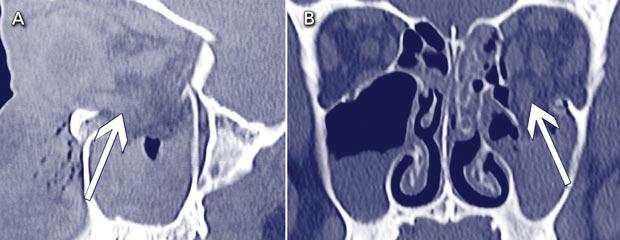
An electrocardiogram showed sinus bradycardia, and subsequent recordings showed intermittent Mobitz II second-degree atrioventricular block. A computed tomography scan of the left orbit showed a moderately displaced fracture of the orbital floor involving the maxillary bone, with entrapment of orbital fat and the inferior rectus muscle (Box).
Given the presence of the oculocardiac reflex with haemodynamic compromise, the fracture was immediately repaired surgically. Postoperatively, the patient’s blood pressure was 134/90 mmHg and his heart rate was 86 beats/min, with normal sinus rhythm. He recovered full eye movement, and no further oculocardiac reflex was recorded. He remained well 1 year after discharge.
The oculocardiac reflex was first described by Aschner as a slowing of the radial pulse when pressure was applied to the eye.2 It is a rare but recognised occurrence among young healthy adults with orbital fractures. Clinical manifestations of the reflex may include bradycardia, hypotension, nausea, vomiting and syncope.3 The reflex is acknowledged as an important indication for immediate surgical repair of the orbit.4 In addition to reducing morbidity from the reflex, urgent repair is beneficial as it releases incarcerated soft tissue, leading to a more favourable outcome with less likelihood of squint.5
Cardiac decompensation due to traumatic facial injuries should alert clinicians to the possibility of the oculocardiac reflex and the need for urgent surgical intervention.
Acknowledgements
Acknowledgement: We thank Mr Douglas Nash for his assistance in image preparation.
References
- Ziccardi VB, Russavage J, Sotereanos GC, Patterson GT. Oculocardiac reflex: pathophysiology and case report. Oral Surg Oral Med Oral Pathol 1991; 71: 137-138. 0_CBBJICDJ
- Aschner B. Über einen bisher noch nicht beschriebenen Reflex, vom Auge auf Kreislauf und Atmung. Verschwinden des Radialispulses bei Druck auf das Auge [Concerning a hitherto not yet described reflex from the eye on circulation and respiration. Disappearance of the radial pulse with pressure on the eye] [German]. Wien Klin Wochenschr 1908; 21: 1529-1590. 0_i1091847
- Sires BS, Stanley RB, Levine LM. Oculocardiac reflex caused by orbital floor trapdoor fracture: an indication for urgent surgical repair. Arch Ophthalmol 1998; 116: 955-956. 0_i1091849
- Burnstine MA. Clinical recommendations for repair of orbital facial fractures. Curr Opin Ophthalmol 2003; 14: 236-240. 0_i1091851
- Sires BS. Orbital trapdoor fracture and the oculocardiac reflex [letter]. Ophthal Plast Reconstr Surg 1999; 15: 301. 0_CBBHHJIF
Fatty Liver Disease in Australia: A Narrative Review on the Epidemiology, Natural History, Prognostication and Management in People With Metabolic Dysfunction
Karl Vaz, Daniel Clayton-Chubb, William W. Kemp, Stuart K. Roberts, Ammar Majeed
Sex Differences in Management and Outcomes of People With ST-Elevation Myocardial Infarction, New South Wales, 2011–2020: A Retrospective Cohort Study
Adam C. Livori, Jedidiah I. Morton, Dianna J. Magliano, Jonathan E. Shaw
Rethinking Rheumatic Fever Diagnosis: Progress, Pitfalls and the Path Towards a Definitive Test
Anna P. Ralph, Rachel Webb, Tom Parks, Nicole J. Moreland, Asha C. Bowen, Benjamin Jones, Emma Ndagire, Andrea Z. Beaton
Sex Differences in Management and Outcomes of People With ST-Elevation Myocardial Infarction, New South Wales, 2011–2020: A Retrospective Cohort Study
Samia Kazi, Simone Marschner, Clara K. Chow
Distribution of Cardiovascular Disease Risk Based on the Updated 2023 Guideline-Recommended Australian Cardiovascular Disease Risk Algorithm and Comparison With the 2012 Algorithm: An Observational Study
Nina Lazarevic, Meghana Bhat, Grace Joshy, Danielle C. Butler, Mark Woodward, Anushka Patel, Rod T. Jackson, Garry Jennings, Rosemary Wyber, Ellie Paige, Emily Banks
They Brought the Hospital to Me
Hugh N. Burrill