




Volume 188 - Issue 2
Mandometer treatment of Australian patients with eating disorders
Authors: John Court, Cecilia E K Bergh and Per Södersten
Med J Aust 2008; 188 (2): 120-121. || doi: 10.5694/j.1326-5377.2008.tb01539.x
Published online: 21 January 2008
Published online: 21 January 2008
To the Editor: The Mandometer treatment for patients with eating disorders (Box 1), developed at the Karolinska Institute in Stockholm, was brought to the attention of the public and the profession in Australia through Norman Swan’s Health Report in 2003.1 Since then, 40 patients from Australia have received treatment using this method, 29 of whom were treated in Stockholm, seven in Melbourne and four in San Diego.
In a randomised controlled trial, Mandometer treatment brought 75% of patients into remission in an average 14 months, with a relapse rate of about 10% during 5 years of follow-up.2 There are seven criteria for remission, including normal eating behaviour, normal body mass index (BMI) and physical parameters, and remission of psychiatric symptoms. Patients must have returned to school or work, be comfortable with their body weight, and have avoided binge eating and vomiting for at least 3 months. Patients fulfilling five of these criteria are considered in partial remission.
Of the 40 (39 female) patients reported here, 27 patients (68%) were diagnosed according to criteria of the Diagnostic and statistical manual of mental disorders, 4th edition, with anorexia nervosa, seven (17%) with bulimia nervosa, and six (15%) with an eating disorder not otherwise specified. The median age of patients was 18.7 years (range, 10.7–39.3 years). On admission, they had been ill for a median period of 5 years (range, 1–25 years) and they had had up to 20 previous unsuccessful episodes of treatment (median, 3 episodes).
Fourteen patients (35%) fulfilling five remission criteria have returned to Australia for follow-up, but have not yet returned to school or work. Eight patients (20%) are in full remission, 11 (28%) are in treatment, and seven (17%) withdrew from treatment before completion, some after only a few days. All patients who are treated in Stockholm and San Diego are followed up in Melbourne, and outpatient treatment is also offered at the Melbourne clinic.
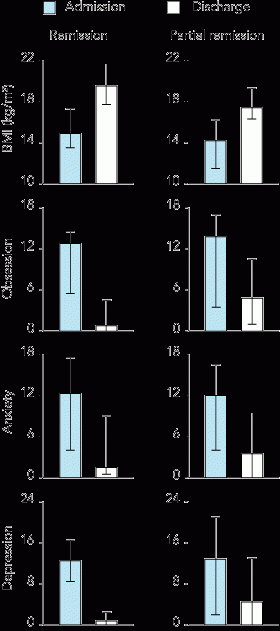
Of the 27 patients with anorexia, 16 have entered full or partial remission, with marked improvement in all parameters (Box 2). Six achieved remission and 10 partial remission in 220 (range, 129–257) and 220 (range, 168–570) days, respectively. The five anorexic patients who dropped out of the treatment had low BMI (11.3, 13.5, 13.8, 14.6 and 15.7 kg/m2), had been ill for 4, 5, 8, 14 and 25 years, and had had up to nine previous episodes of treatment.
This report concerns severely ill Australian patients who had previously undergone many episodes of care. These preliminary results are encouraging, given the known resistence of these disorders to treatment.4,5 Although the outcomes reported here appear to be better, comparison with other methods used in Australia should be made in a randomised controlled trial. The Melbourne Mandometer Clinic is willing to participate in such a trial.
1 Mandometer treatment has four interventions
1. The patient re-learns how to eat using Mandometer, a computerised procedure that provides feedback during meals (Figure). In about 5–6 months, anorexic patients are able to eat a normal meal and perceive a normal level of satiety after practising eating gradually larger meals. Bulimic patients are similarly trained, but they are able to eat normal amounts of food from the beginning of treatment. After using Mandometer, patients are trained to eat socially.
2. Patients rest in warm rooms after each meal. Warmth has an anxiolytic effect and prevents compensatory hyperactivity and vomiting after the meal.
3. Physical hyperactivity is prevented by use of wheelchairs and warming jackets between meals.
4. Patients are trained to re-learn social skills.
Manuals describing the details of treatment are used at all clinics.

The patient can adapt her or his eating rate to a linear curve displayed on the monitor (A), because she or he sees her or his own eating rate emerging (B). At regular intervals, the patient rates her or his feeling of fullness on a scale that appears on the monitor (C) and adapts her or his ratings to an s-shaped curve (D). The axes have no numerical values during training.
2 Body mass index (BMI) and obsession, anxiety and depression scores in six Australian anorexic patients treated to remission and in 10 anorexic patients treated to partial remission
 | |||||||||||||||
|
Psychiatric symptoms were evaluated by the Comprehensive Psychopathological Rating Scale.3 Values are medians and ranges. There were no significant differences between the groups. | |||||||||||||||
Competing interests
John Court is employed by Mandometer Melbourne and receives a salary. Cecilia Bergh and Per Södersten are part-owners of AB Mando, Sweden.
Acknowledgements
The cost for the treatment of the patients was covered by their parents or by insurance. We thank the staff of Mandometer Clinics in Stockholm, San Diego and Melbourne for treating the patients and collecting the data in this report.
References
- Swan N [presenter]. Anorexia and bulimia nervosa. The health report [transcript]. Radio National 2003; 23 Jun. http://www.abc.net.au/rn/talks/8.30/helthrpt/stories/s883176.htm (accessed Oct 2007).
- Bergh C, Brodin U, Lindberg G, Södersten P. Randomized controlled trial of a treatment for anorexia and bulimia nervosa. Proc Natl Acad Sci U S A 2002; 99: 9486-9491. 0_CBBGFJJB
- Svanborg P, Åsberg M. A new self-rating scale for depression and anxiety states based on the Comprehensive Psychopathological Rating Scale. Acta Psychiatr Scand 1994; 89: 21-28. 0_CBBJEECD
- Berkman ND, Lohr KN, Bulik CM. Outcomes of eating disorders: a systematic review of the literature. Int J Eat Disord 2007; 40: 293-309. 0_i1091851
- Ben-Tovim DI, Walker K, Gilchrist P, et al. Outcome in patients with eating disorders: a 5-year study. Lancet 2001; 357: 1254-1257. 0_i1091854