




Volume 180 - Issue 2
Management of chronic suppurative otitis media
Author: Alan E Dugdale
Med J Aust 2004; 180 (2): 91-93. || doi: 10.5694/j.1326-5377.2004.tb05809.x
Published online: 19 January 2004
Published online: 19 January 2004
Alan E Dugdale
Principal Honorary Research Fellow, Department of Paediatrics and Child Health, Medical School, University of Queensland, Herston, QLD 4006. A.DugdaleATuq.edu.au
To the Editor: Chronic suppurative otitis media (CSOM) is a long-term problem which often has serious effects on hearing, speech and learning. Couzos and colleagues have shown that local treatment with ciprofloxacin (CIP) eardrops clears episodes of purulent discharge more efficiently than the commonly used framycetin, gramicidin and dexamethasone (FGD) eardrops.1 This hardly ranks as a “cure” as suggested by the authors.
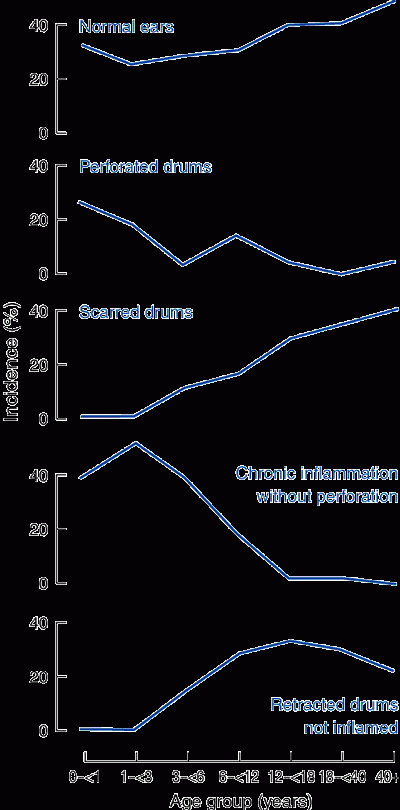
The natural history of CSOM is known2-4 (see Box). The disease commonly starts in infancy with painless perforation of the ear drum and purulent discharge. The perforation is usually central and often large. It remains for several years. During this time there are episodes of painless discharge of foul-smelling pus associated with a blocked ear canal and poor hearing. Between these episodes, the perforation remains, but the ear is usually dry and hearing can be normal or at least adequate. By mid-childhood the perforation often closes spontaneously. In some children this leaves a scarred retracted eardrum, but, in others, fluid collects behind the now intact drum, and this chronic serous otitis media decreases hearing. Eventually, this chronic serous otitis media clears, leaving a scarred, retracted eardrum. Hearing then improves and is often functionally normal. Cholesteatoma and other medical complications are uncommon, but the loss of hearing during childhood has severe social and educational effects on the child.
Attempts to hasten closure of the perforation and limit the episodes of purulent discharge have had incomplete success.5,6 Any treatment that hastens recovery is welcome, but we should ask:
Does local CIP treatment retain its effectiveness in repeated episodes of purulent discharge? (The most common organisms are Pseudomonas spp which rapidly develop resistance to antibiotics);
Does CIP treatment alter the interval between purulent episodes compared with other treatments?; and
Is there any evidence that local CIP treatment alters the natural history of the disease or lessens the hearing loss? (it is probably too early to detect this).
CSOM is a disease of poverty and overcrowding, but the mechanism leading from social disadvantage to ear disease is not clear. In Cherbourg Aboriginal Community where I work, social and living conditions have improved and CSOM is now much less common than reported by Stuart and co-workers more than 25 years ago.2 I hope that treatment with local CIP eardrops will maintain its promise as a significant improvement in the management of this disease in children who have already acquired it, while we work towards eliminating the disease in the long term.
References
- Couzos S, Lea T, Mueller R, et al. The effectiveness of ototopical antibiotics for chronic suppurative otitis media in Aboriginal children: a community-based, multi-centre, double-blind randomised controlled trial Med J Aust 2003; 179: 185-190. <eMJA full text>
- Stuart JE, Quayle CJ, Lewis AN. Follow-up studies of Aboriginal children with ear disease and hearing loss at Cherbourg. Med J Aust 1975; 1 (10 May Suppl): 38-40. i1082848
- Dugdale AE, Canty A, Lewis AN, Lovell S. The natural history of middle ear disease in Australian Aboriginals: a cross-sectional study. Med J Aust 1978; 1 (25 Mar Suppl): 6-9. CBBIDIHG
- McCafferty GJ, Lewis AN, Coman WB, Mills C. A nine-year study of ear disease in Australian Aboriginal children. J Laryngol Otol 1985; 99: 117-125. CBBFIDJD
- Leach AJ. Otitis media in Australian Aboriginal children: an overview. Int J Otorhinolaryngol 1999; 49 (Suppl 1): S173-S178. CBBFDABG
- Mak D, MacKendrick A, Weeks S, Plant AJ. Middle ear disease in remote Aboriginal Australia: a field assessment of surgical outcomes. J Laryngol Otol 2000; 114: 26-32. CBBBEHHA