Volume 173 - Issue 11
XIII International AIDS Conference, Durban, 9-14 July, 2000
Authors: John B Ziegler and Rosemary A Ffrench
Med J Aust 2000; 173 (11): 572-574.
Published online: 4 December 2000
Published online: 4 December 2000
Conference Report
XIII International AIDS Conference, Durban, 9-14 July, 2000Nelson Mandela argues for urgent action against HIV in Africa

John B Ziegler and Rosemary A Ffrench
Let us not equivocate: a tragedy of unprecedented proportions is unfolding in Africa. AIDS today in Africa is claiming more lives than the sum total of all wars, famines and floods, and the ravages of such deadly diseases as malaria . . . Economic growth is being undermined and scarce development resources have to be diverted to deal with the consequences of the pandemic . . . Decades have been chopped from life expectancy and young child mortality is expected to more than double in the most severely affected countries of Africa. AIDS is clearly a disaster, effectively wiping out the development gains of the past decades and sabotaging the future. Earlier this week we were shocked to learn that within South Africa one in two, that is half, of our young people will die of AIDS. The most frightening thing is that all of these infections, which statistics tell us about, and the attendant human suffering, could have been, can be, prevented. Something must be done as a matter of the greatest urgency. And with nearly two decades of dealing with the epidemic, we now do have some experience of what works.-- Nelson Mandela1
MJA 2000; 173: 572-574
Prevention - Mother-to-child transmission - Vaccines - Treatment strategies - Hope - References - Authors' details
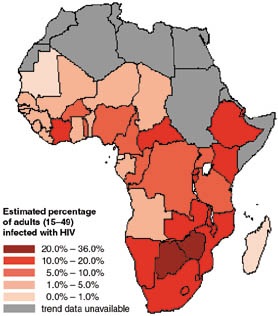
| Box 1: HIV in African countries, 1999
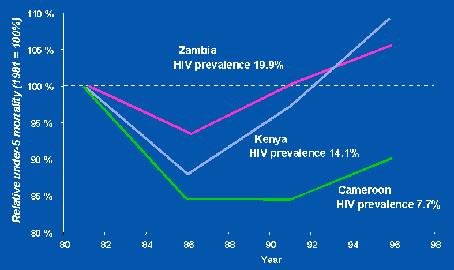
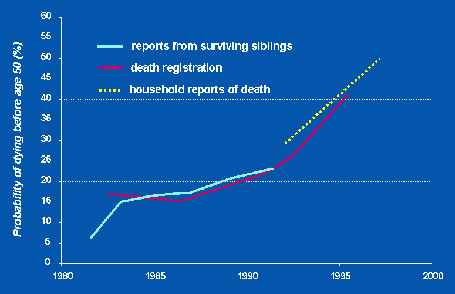
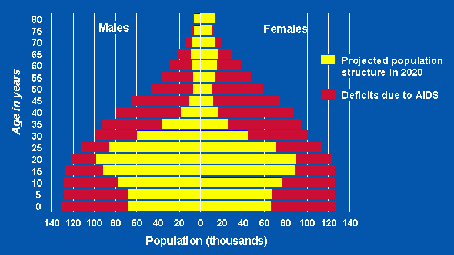
Box 2: Trends in mortality among children under five Nelson Mandela's closing address to the conference1 was a welcome contrast to the opening address by Thabo Mbeki, President of South Africa, who disappointed delegates by failing to resolve their concerns about his view that HIV does not cause AIDS. In his plenary address, David Ho (Director, Aaron Diamond AIDS Research Center, New York) noted that Mbeki would be judged harshly by history. Judge Ed Cameron, a gay white South African living with HIV, in a moving address, pointed out that his government had consistently mismanaged the epidemic, and that he was only alive because his income allowed him to purchase antiviral drugs not available to most South Africans with AIDS.PreventionBox 3: Probability of a Zimbabwean boy aged 15 dying before age 50 Box 4: Projected population structure, Botswana 2020 While news of the explosive spread of HIV in the Republic of South Africa highlighted the urgency of effective preventive strategies, there was relatively good news from some countries where decisive action by pragmatic governments was paying off: the HIV infection rate has stabilised at a relatively low level in Senegal; Uganda has brought its estimated prevalence rate down to about 8% from a peak of close to 14% in the early 1990s; Thailand's "100% condom use" campaign among female sex workers has contributed to falling prevalence in military recruits and antenatal clinic patients.2 In the opening plenary session, Professor Roy Anderson (Director, Centre for the Epidemiology of Infectious Disease, Oxford) explained that interventions to interrupt the spread of HIV in populations would have relatively little impact once prevalence was high. Targeting individuals engaging in high risk behaviours was only effective early in an epidemic; unfortunately, few governments have been prepared to invest resources in the early stages, when such efforts are most cost-effective. There was hope that relatively inexpensive strategies to prevent heterosexual transmission of HIV might emerge from the conference. Unfortunately, the results of a study of a vaginal microbicide containing nonoxynol-9 among sex workers in Côte d'Ivoire showed a higher infection rate in the experimental arm. This suggests that the microbicide's detergent action caused ulceration that enhanced HIV transmissibility. Mother-to-child transmissionAmid the gloom of the inexorable spread of HIV in Africa and emerging epidemics in Eastern Europe, delegates were virtually unanimous that there should be no delay in implementing cost-effective measures to prevent mother-to-child transmission of HIV, especially with some drug companies offering to provide free drugs in less developed countries. Data from a prospective observational study in the USA showed that, with optimal maternal combination antiretroviral treatment, the risk of mother-to-child transmission falls to as low as 1%. In breast feeding populations treated with only one drug the gains were less dramatic, but nevertheless very impressive, with the potential to prevent the infection of 25 000 infants a year in South Africa alone. Data presented at the conference reinforced concern that the benefit of perinatal antiviral therapy would be lost when mother-to-child transmission occurred during subsequent breast feeding. However, analysis of the HIVNET 012 trial (mother and infant each received a single dose of nevirapine in labour and by Day 3, respectively) at 18 months showed that an absolute 8% reduction persisted despite prolonged breast-feeding.3 These interventions prevent only about a third of mother-to-child transmission, but they point to cost-effective strategies relevant in resource-poor settings. Implementation will be challenging; it was clear that many women attending African antenatal clinics do not accept HIV screening, do not return for results or do not accept antiretrovirals if HIV positive; attrition rates of 80% were reported. The role of breast feeding in perinatal transmission of HIV was firmly established by a randomised, controlled trial in Nairobi, Kenya.4 While observational data suggested that exclusive breast feeding may be safer than mixed feeding, bottle feeding provides the best protection against HIV infection. The Nairobi investigators reported that the mode of feeding did not affect survival to 24 months, either in the infected or uninfected infants. Surprisingly, breast feeding was associated with three times as much maternal mortality at two years as formula feeding. VaccinesNew candidate HIV vaccines presented at the conference provided some hope for the future control of the pandemic. After the disappointing immunogenicity of the recombinant protein vaccines, which were designed to elicit antibody responses, it was thought that strategies for eliciting cellular immunity, particularly cytotoxic T lymphocyte (CTL) activity, may be more successful. The trials of vCP205 (a canarypox virus expressing HIV genes), both alone or with a recombinant protein boost, showed very few vaccine recipients with detectable CTL activity, and these few responses were not sustained. However, it was shown that responses were detected more frequently when vaccine recipients received higher doses of vCP205, so more antigen expresssion may be necessary to achieve the desired levels of immunity.Results of a Phase II trial of the whole, killed HIV vaccine, Remune, in HIV-positive individuals in Thailand were presented. The subjects who received the therapeutic vaccine had a small but significant increase in the CD4+ cell count (P = 0.05) of about 46 cells/µL, with increased antibody levels but no change in viral load. Probably the most controversial decision relating to HIV vaccines in the past few years was to take the AIDSVAX recombinant envelope protein into Phase III clinical trials (in Phase I/II trials the vaccine did not induce antibodies that would neutralise circulating strains of HIV). It was reported in Durban that enrolment in the Phase III trials had been completed in Thailand (n = 2100) and the USA (n = 5400). Efficacy data will not be available until early 2003. There are many new vaccine concepts currently undergoing preclinical testing and some impressive data were presented on experiments in mice and macaques. Stephen Kent (Principal Research Fellow, HIV Vaccines Laboratory, University of Melbourne) presented further evidence that a prime-boost vaccine strategy using DNA vectors, followed by fowlpox virus recombinant for gag and pol simian immunodeficiency virus genes, produced very high levels of cellular immunity in macaques, and that these responses could be increased by the co-expression of the cytokine gene IFN-g. This candidate vaccination strategy, for which the University of New South Wales was recently awarded $27 million by the US National Institutes of Health (NIH), will be tested in Phase I/II human clinical trials in Australia within two years. Another vaccine that has generated considerable interest was presented by Dr Robert Johnson (Director, Alphavax, Professor of Virology, University of North Carolina). The vector for the vaccine, a Venezuelan equine encephalitis replicon, was shown to target dendritic cells, one of the most powerful inducers of cellular immune responses. Testing of this vaccine will begin in South Africa early next year. Dr B. Ensoli (Virologist, Instituto Superiore di Sanità, Rome) also presented some convincing data on preclinical macaque studies of a vaccine targeting immune responses to the tat gene of HIV. She found that five of seven macaques were protected from infection with pathogenic simian/human immunodeficiency virus challenge, and that these monkeys had developed good cellular immune responses to tat protein. Clinical trials are due to begin with this vaccine in Italy and Africa. Thus, although HIV vaccines tested to date have produced somewhat disappointing results, there was optimism at Durban that the next generation of vaccines are promising. Treatment strategiesClinicians and patients have recently become excited by the concept of structured treatment interruptions, which have been suggested to enhance immune responses to HIV while providing relief from the cost, inconvenience and toxicity of complex antiretroviral regimens. Dr Tony Fauci (Director, National Institute of Allergy and Infectious Diseases, NIH, Bethesda, Maryland) presented a pilot study of five patients selected because they had achieved undetectable viral levels with potent therapy. They then interrupted therapy for one week in two. During seven such interruption cycles the patients' viral levels remained undetectable and their immune function was preserved. However, because the cohort was small, the subjects highly selected (with extremely well controlled viral replication) and the period of observation was too short, the results did not provide reassurance that such a strategy would not be associated with the risk of induction of drug-resistant variants. It is thus much too early to recommend this strategy in clinical practice.HopeOverall, the conference was hugely successful. Despite talk of boycotts because of Mbeki's views, the conference was well attended. The colourful national costumes of delegates, signage, art and craft displays and street theatre all provided a celebratory atmosphere. There was a mood of optimism that the problems of access to treatments in resource-poor countries were at last beginning to be addressed. Simple, cost-effective, population-based prevention strategies are working in those countries which have implemented them. The hope is that an affordable preventive vaccine that is active against strains of HIV in areas of high prevalence is not too far off.References
Authors' detailsDepartment of Immunology, Sydney Children's Hospital, Sydney, NSW.John B Ziegler, MD, FRACP, Associate Professor. Rosemary A Ffrench, PhD, Senior Scientist, Research Laboratory. Reprints will not be available from the authors. j.zieglerATunsw.edu.au
References
Costs of Delivering the Hep B PAST Model of Care in Remote Australia: A Retrospective Pre–Post StudyHoa Nguyen, Anh Le Tuan Nguyen, Paula Binks, Melita McKinnon, Emily Vintour-Cesar, Karen Wills, Nicola Stephens, Benjamin Cowie, Joshua S. Davis, Yuejen Zhao, Peter Nihill, Julie A. Campbell, Andrew J. Palmer, Jane Davies, Barbara de Graaff Buruli Ulcer Acquired From Ringtail Possum RescueDaniel P. O'Brien, Naomi Clarke, Sara Bonnici, Mohammad A. Hussain Q Fever Visceral Abscesses After Contact With Native Australian MarsupialsSamantha J. Laws, Enzo Binotto, James Stewart, Jennifer Ho, Trent Yarwood, Josh Hanson, Simon Smith Hospital-Admitted Injection-Related Infections Among Incarcerated People Who Inject Drugs in Australia: A Retrospective Cohort StudyAndrew Palmer, Matthew Carter, Jeremy Yeo, Cecilia Shim, Jason Connor, Jeremy Hayllar, Gerald Holtmann, Naomi Moy, Elliott G. Playford, Naomi Runnegar, Paul J. Clark The Live Attenuated Influenza Vaccine in Australia: An Additional Tool for Influenza PreventionCyra Patel, Alexis Pillsbury, Tran Nguyen, Xia Wang, Helen E. Quinn, Clayton K. Chiu, Allen C. Cheng, Katie L. Flanagan, Zhicheng Wang Reflex Testing for Hepatitis D Infection: A Unique Opportunity to Reduce Hepatitis D-Related Chronic Liver Disease Deaths in AustraliaJessica Howell, Lauren Andersson, Miriam T. Levy, James O'Beirne, Leon Adams, Katharine Irvine, Avik Majumdar, Golo Ahlenstiel, Kathy Jackson, Krispin Hajkowicz, Joseph Doyle, Jane Davies, Sarah Cherian, Wayne Dimech, Alexander J. Thompson |