|
|
Since Banting and Best's development of insulin treatment in 1921,
several major advances in production and delivery of insulin have
revolutionised the care of people with diabetes. From this
beginning, when crude animal insulin extracts and uncomfortable
syringes and needles were used, the late 20th century has seen the
development of pure genetically engineered human insulin delivered
by convenient and almost painless pen delivery devices. These
technological advances have been coupled with recent clinical
trials that have confirmed the importance of euglycaemia to avoid the
chronic complications of diabetes. The Diabetes Control and
Complications Trial (DCCT)1 and the most recent United
Kingdom Prospective Diabetes Study (UKPDS)2 have clearly shown the
benefit of intensive compared with conventional insulin therapy.
However, for many people with diabetes, intensive insulin therapy
means multiple insulin injections and frequent blood sampling, as
well as an increased risk of hypoglycaemia. Insulin analogues, or
designer insulins, promise a new era of greater convenience and
mastery for people with diabetes by replacing insulin in a more
convenient and physiological manner.
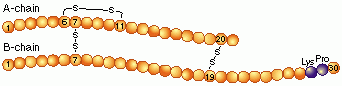
The first of these analogues available in Australia is insulin lispro
(Figure). To make insulin lispro, the order of the amino acids proline
and lysine on the B chain at positions 28 and 29 has been
reversed.3 This subtle but important
conformational change improves the solubility and absorption of the
insulin molecule. Unlike conventional regular insulin, the peak
insulin response is more rapid, occurring within 60-90 minutes, and
the total duration of action is shorter, lasting 5-6 hours. The
greatest potential benefits of these new types of insulins are
improved blood glucose control with less risk of hypoglycaemia, as
the peak of insulin action is more likely to coincide with peak glucose
levels. Furthermore, as insulin lispro may be administered
immediately before meals, it promises to provide greater
convenience and flexibility.
In this issue of the Journal, Stocks reports the use
of this new insulin in a large cohort of 150 patients with type 1
diabetes managed in a private practice setting; results in 125
patients could be fully analysed.4 Before commencing the study
all patients were receiving intensive insulin therapy, with at least
four injections of insulin per day. The reported findings are similar
to those of several randomised studies comparing regimens of
multiple daily doses of lispro and regular insulin in patients with
type 1 diabetes.5 As with Stocks' study, most
of these have, of necessity, been unblinded, because of the different
times of administration of the two insulins, and many have used a
crossover design to minimise bias. In Stocks' study, despite the use
of an intensive insulin regimen, more than half the patients had
glycohaemoglobin values (expressed as %HbA1c) above
the acceptable level of 8%. This is not an unusual finding in most
clinical reports of type 1 diabetes and reflects the imprecise or
unphysiological nature of insulin therapy.
So does insulin analogue therapy live up to expectations? After
changing to insulin lispro more than half the patients reported less
glucose fluctuation. In addition, half experienced a reduction in
HbA1c, and in those with initial HbA1c
values above 8% this change was highly significant. In most other
reported studies, lower HbA1c values are not usually
achieved with insulin lispro compared with regular
insulin.5 This difference may be
explained by the appropriate adjustments made to overnight basal
insulin in Stocks' study to ensure that fasting blood glucose levels
remained within the target range. Coupled with improved glucose
control, there was also a reduction in the number of hypoglycaemic
episodes, both during the day and the night. The effect on
hypoglycaemic episodes in other lispro studies has varied from no
change to a 12% reduction. Intensive insulin therapy has been
associated with weight gain,1 but in Stocks' study
improvement in blood glucose control was not accompanied by changes
in weight. The unblinded nature of this and other studies of lispro,
and the use of a non-validated questionnaire, complicates the
assessment of its impact on patient quality of life. Nevertheless,
most patients reported that they felt better when taking insulin
lispro.
John Main recently described the nature of clinical practice as the
"disorderly world of real medical practice".6 The
evidence-based-medicine purists among us may undervalue the
importance of the reported findings, as the highest level of evidence
-- the double-blind randomised controlled trial -- was not used.
Nevertheless, Stocks' study is valuable for several reasons, and the
findings may be generalisable to other clinical settings. Firstly,
it provides "real world" local outcome data on a large number of
patients who would be typically seen in routine practice. Secondly,
the study reminds us that biochemical outcomes are only one aspect of
good diabetes management. Lifestyle issues, flexibility and
convenience must also be considered. The perspective of some
physicians may, however, be quite different, focusing on
biochemical outcomes that may not be easily achieved without
significant detriment to quality of life. With the rise of
consumerism, the incorporation of patient values into
decision-making is likely to gain further momentum. Lastly, in an age
of audit, quality and accountability, as well as good clinical
governance, it is heartening to see that serious health-outcomes
research can and is being conducted in private practice settings.
In the near future there is likely to be a vast array of new designer
insulins as well as new methods of delivery.7 Other rapid-acting
analogues, such as insulin aspart (aspartic acid replaces proline at
position 28), are currently being tested. A neutral protamine lispro
has also been developed and mixtures of lispro and neutral protamine
lispro are being tested. Research is also progressing towards true
basal insulin analogues, long-acting insulins with a prolonged
action profile that will be reproducibly absorbed to maintain
intermediate metabolism. These designer insulins, coupled with new
developments such as inhaled insulin delivery, herald a new horizon
for people with diabetes as we approach the 80th year of insulin
treatment.7 Steven C Boyages
Clinical Associate Professor
Department of Diabetes and Endocrinology, Westmead Hospital,
Sydney, NSW
(Presently, Director Research and Clinical Policy, NSW Health,
Sydney, NSW)
- The Diabetes Control and Complications Trial Research Group. The
effect of intensive treatment of diabetes on the development and
progression of long term complications in insulin dependent
diabetes mellitus. N Engl J Med 1993; 329: 977-986.
-
UK Prospective Diabetes Study Group: Intensive blood glucose
control of sulphonylureas or insulin compared with conventional
treatment and risk of complications in patients with type 2 diabetes
(UKPDS 33). Lancet 1998; 352: 837-853.
-
Barnett AH, Owens DR. Insulin analogues. Lancet 1997; 349:
47-51.
-
Stocks AE. Insulin lispro: experience in a private practice
setting. Med J Aust 1999; 170: 364-367.
-
Lee W, Zinman B. From insulin to insulin analogs: progress in the
treatment of type 1 diabetes. Diabetes Rev 1998; 6: 73-88.
-
Main J. Doctors advocating evidence based medicine may be out of
touch with real medicine. BMJ 1999; 318: 332.
-
Marks J. Diabetes management in the future: a whiff and a long shot?
Clin Diabetes 1998; 16: 3.
Reprints: Professor S C Boyages, Department of Diabetes and
Endocrinology, Westmead Hospital, Westmead, NSW 2145.
Make a
comment
|