




Volume 168 - Issue 4
The health consequences of unemployment: the evidence
Authors: Colin D Mathers and Deborah J Schofield
Med J Aust 1998; 168 (4): 178-182.
Published online: 16 February 1998
Published online: 16 February 1998
The health consequences of unemployment: the evidence
Colin D Mathers and Deborah J Schofield
For editorial introduction see Creed
Mathers and Schofield, from the Australian Institute of
Health and Welfare, review recent studies, including
Australian research, on the health effects of unemployment and the
mechanisms by which unemployment causes adverse health outcomes.
The relationship is complex: ill-health also causes unemployment,
and confounding factors include socioeconomic status and
lifestyle. However, longitudinal studies with a range of designs
provide reasonably good evidence that unemployment itself is
detrimental to health and has an impact on health outcomes --
increasing mortality rates, causing physical and mental ill-health
and greater use of health services. (MJA 1998; 168: 178-182)
Introduction -
Health outcomes and determinants -
Conclusions -
Acknowledgements -
References -
Authors' details
-
-
©MJA1998
Introduction |
The first convincing evidence of a causal relationship between
unemployment and ill-health came from a British longitudinal study
in the mid 1980s.1,2 At the
same time an influential series of reviews in the British Medical
Journal (1985; 291), and a related book,3 drew widespread attention to the
effects of unemployment on health. Australian studies during the
1980s and early 1990s demonstrated adverse effects of unemployment
on the mental health of young people4,5 (see Morrell et al in the next issue
of the Journal [2 March 1998] for a review of the health
consequences of youth unemployment6), and in the past few years the
National Health Strategy and reports from the Australian Institute
of Health and Welfare have documented worse health among unemployed
Australians using a wide range of health indicators.7-9 There has been subsequent vigorous debate about the direction of causality: Does unemployment cause a deterioration in health? Are the sick more likely to become unemployed (health selection effects)? Or are both unemployment and poor health associated with another, underlying, causal factor such as socioeconomic disadvantage? Here, we review the Australian and international evidence for an association between unemployment and adverse health outcomes and the potential causal mechanisms for this association. We searched the literature for the past decade using MEDLINE and chose key studies evaluating current knowledge about the relationship between unemployment and ill-health for a range of health outcomes and determinants: mortality rates, mental health, lifestyle factors, and health service use. We have included some pivotal studies drawn from a longer time span, and refer to existing recent relevant reviews. We placed particular emphasis on recent Australian studies. In assessing the evidence, it is important to keep in mind that unemployment is a complex and diverse experience rather than an easily categorised exposure variable like tobacco smoking, and that its effects will be mediated by a large number of social and individual factors. |
Health outcomes and determinants |
Mortality rates
In the 1970s, Brenner found correlations for several countries at the population level between annual unemployment levels and mortality rates over periods of up to 40 years.10-12 However, these studies have been seriously criticised and cannot be used to infer causation.3,13 Other studies looked at correlations between variations in unemployment levels and death rates for geographical regions and obtained generally consistent findings.14,15 Again, such studies cannot be used to infer causation, as unemployment may be correlated at the population level with other factors causing increased mortality. Much more convincing evidence for causality was obtained from longitudinal studies (not specifically set up to examine unemployment and health) in several countries in the 1980s. A 1% sample of census records was used to analyse mortality in unemployed men aged 15 to 64 in England and Wales in 1971 and 1981.1,2 For both samples, employment meant lower mortality rates than the average (the "healthy worker" effect). Those unemployed who had a pre-existing illness or disability had mortality rates over three times higher than the average. Those who were unemployed but not ill at census time showed a 37% excess mortality over the following 10 years (95% confidence interval [CI], 22%-52%). In all social classes, the mortality rate of unemployed people was higher than that of the employed, particularly for deaths from cardiovascular disease, lung cancer, accidents and suicide. If health selection were occurring among the "not-ill" unemployed, despite a strong incentive to declare illness to obtain additional benefits, then there would have been higher mortality rates at the beginning of the follow-up period that would have fallen with time. This pattern occurred among the group chronically ill at the beginning of follow-up, but the excess mortality for those "not-ill" and unemployed rose slightly over the 10-year follow-up. These findings were confirmed and extended by other large longitudinal studies in Europe.16-18 A census-linked study in Denmark found a 40%-50% excess death rate among the unemployed after adjustment for occupation, housing category, geographical region and marital status,16 with suicides and accidents being prominent causes of excess mortality. Excess mortality was also found among unemployed women, although the relative mortality was somewhat higher for unemployed men. There was also an inverse association between relative mortality and the level of local unemployment. A Finnish longitudinal study of linked census data for people aged 25-59 years found a higher mortality rate in unemployed than employed people, after controlling for age, education, type of occupation and marital status.18 Mortality ratios for men and women unemployed for the first time in 1990, at a time of low national unemployment, were 2.11 (95% CI, 1.76-2.53) and 1.61 (95% CI, 1.09-2.36), respectively. The comparable ratios for those unemployed for the first time in 1992, when the national employment rate was very high, were much lower: men, 1.35 (95% CI, 1.16-1.56); women, 1.30 (95% CI, 0.97-1.75). A recent prospective cohort study of over 6000 British men, aged 40-59 years, and continuously employed for the five years before initial screening, found that men who experienced some unemployment or retired during the five years after screening were twice as likely to die in the following 5.5 years as those who remained continuously employed.19 After excluding men who became unemployed or retired because of ill-health, and adjusting for the effects of socioeconomic status, smoking, alcohol consumption, body weight and health indicators, the mortality ratio was 1.47 (95% CI, 1.10-1.96) for the unemployed group and 1.86 (95% CI, 1.34-2.59) for the retired group. In Australia, the serious limitations of the information recorded on death certificates have prevented analysis of mortality rates for unemployed people.8 However, an early Australian study20 found a correlation between aggregate unemployment trends and death from ischaemic heart disease (see also Morrell et al6 for suicide rate and unemployment rate correlations in Australia). Mental health
As with mortality, it is likely that the impact of unemployment on mental health is dependent on general social conditions. An earlier British study found lower levels of psychological distress among men from areas of chronically high unemployment than among men living in areas of low unemployment23 -- perhaps reflecting better adaptation through networks, community solidarity and lower costs of living in areas with higher unemployment. In Australia, several longitudinal studies have shown poorer psychological health in unemployed compared with employed young people and that these differences first emerge after entry into the labour market. Furthermore, when unemployed young people find jobs their mental health improves.4,5,24 Disease and disability
Factory-closure studies, which minimise the effects of health selection, have found increased levels of medically diagnosed health problems, particularly cardiovascular disease and its risk factors, including high serum cholesterol levels and high blood pressure.28-30 Despite occasional studies finding no association between unemployment and ill-health,31 the balance of evidence suggests that unemployment, at least among adult men, has an association with physical health, and in particular with cardiovascular disease.
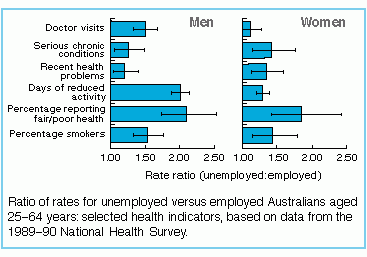
In Australia, unemployed men and women aged 25-64 years were
found to be about twice as likely to report being in poor or fair health
(as opposed to good or excellent health); they also reported 30%-40%
more serious chronic illnesses and 20%-30% more recent health
problems than their employed counterparts. Differences in levels of
smoking, risk drinking, physical inactivity and overweight did not
account for these health differences (Figure).8 Lifestyle risk factors
In Australia, the 1989-90 National Health Survey found that unemployed Australians were about 40%-50% more likely to be smokers, but were less inactive than the employed;8,38 unemployed men were 57% more likely to have had measured hypertension than employed men (95% CI, 13%-100%).8 Health service use
In Australia, the 1989-90 National Health Survey found that unemployed men visited the doctor significantly more often, unemployed women reported significantly more hospital outpatient visits, and unemployed people used more pharmaceutical agents.8,40 A multivariate analysis suggested that reported health status largely accounted for reported differentials in health service use.8 Differences between demographic groups
Excess mortality caused by unemployment is highest for middle-aged men, and there is also some evidence that unemployment affects mental health more for this group than others. Health status reported by unemployed women tends not to be as low as for unemployed men, and similarly unemployed women report fewer health risk factors.8,27,38 All these studies emphasise that the health consequences of unemployment are not the same for all groups in the population. This point is also underlined by the few studies that have found groups of employed people whose health is worse than that of unemployed people.5 Interpersonal effects
In Australia, children whose parents are unemployed, compared with those with one or more of their parents employed, were reported to have around 26% more serious chronic illnesses (95% CI, 3%-55%), 20%-30% more visits to the doctor, and around twice as many outpatient visits.44 Aetiology
|
Conclusions | Although the relationship between unemployment and health is complex and varies for different population groups, there is consistent evidence from different types of studies that unemployment is associated with adverse health outcomes. Health selection effects do occur, but longitudinal studies provide reasonably convincing evidence that unemployment has a direct effect on health over and above the effects of socioeconomic status, poverty, risk factors, or prior ill-health. Our review highlights several priorities for future research (Box 2). |
Acknowledgements | The authors thank Sarojini Martin for assistance in literature searches. |
References |
|
Authors' details
Australian Institute of Health and Welfare, Canberra, ACT.Colin D Mathers, BSc(Hons), PhD, Principal Research Fellow, Health Division;
Deborah J Schofield, BSpThy, GradDipCompSc, Project Manager, National Public Health Indicators.
Reprints will not be available from the authors.
Correspondence: Dr C
D Mathers, Principal Research Fellow, Australian Institute of
Health and Welfare, GPO Box 570, Canberra, ACT 2601.
E-mail: colin.mathers AT aihw.gov.au
Readers may print a single copy for personal use. No further
reproduction or distribution of the articles
should proceed without the permission of the publisher. For
permission, contact the
Australasian Medical Publishing Company
Journalists are welcome to write news stories based on what they read here, but should acknowledge their source as "an article published on the Internet by The Medical Journal of Australia <http://www.mja.com.au>".
<URL: http://www.mja.com.au/>