




Volume 168 - Issue 1
Long-term ventilatory support at home: any progress?
Authors: Donald A Campbell and Robert J Pierce
Med J Aust 1998; 168 (1): 7-8.
Published online: 5 January 1998
Published online: 5 January 1998
Long-term ventilatory support at home: any progress?
Is breathing at home a right or a privilege?
MJA 1998; 168: 7-8
|
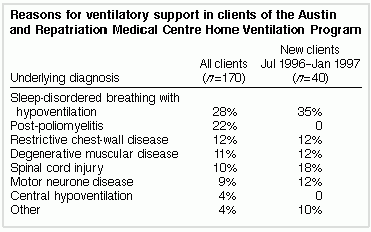
Since Newton-John's 1989 editorial in the MJA calling for better support for patients needing long-term mechanical ventilation,1 there has been little progress nationally. However, a start has been made in Victoria with the establishment of the Victorian Respiratory Support Service. It seems self evident that home rather than institutional care is desirable for these patients -- in this age, it is not only Superman,2 but Everyman, who should be able to live at home on a ventilator. However, home care is possible only when the financial costs and caregiver needs can be adequately met, which depends primarily on patients' personal resources and access to government-funded programs. Access to community programs such as the joint federal- and state-funded Linkages program, which provides for up to 32 hours of attendant care per week, is severely restricted, with waiting lists in many areas. In addition, this level of care may be inadequate to meet the needs of severely disabled people. The cost of ventilators is met by the federally funded Program of Aids for Disabled People in New South Wales, but not in Victoria, where it is met by a specific program grant. Further, for patients who need discontinuous (e.g., nocturnal) ventilation, the cost of acute hospital care to introduce the treatment is not adequately addressed under casemix funding. Chronic ventilator dependence has been defined as use of mechanical ventilation for at least six hours daily for at least 21 days.3 In the past, patients who were ventilator dependent for part or all of the day comprised mainly those who failed to wean after bouts of acute respiratory failure (e.g., post-poliomyelitis),4 and a cumbersome negative-pressure "iron lung" ventilator was used. Recent technological advances, particularly development of small portable ventilators and face and nose masks that allow non-invasive, intermittent positive-pressure ventilation, have made mechanical ventilation practical in a wider range of patients. It can improve quality and duration of life in patients with chronic hypercapneic ventilatory failure caused by restrictive chest-wall disease, spinal cord injury, slowly progressive neuromuscular disease, central hypoventilation or obesity-hypoventilation syndrome.5 The awareness that ventilation is effective treatment for a wider range of indications has led to a rapid increase in the number of ventilator-assisted individuals in Australia and other countries. The Victorian Respiratory Support Service, based at Austin and Repatriation Medical Centre, now provides care for over 170 people, an increase from 25 in 1989. Their underlying diagnoses are shown in the Box (below); 15 receive continuous ventilatory support via tracheostomy, five use a negative-pressure ventilator (iron lung) at night, and the remainder use non-invasive positive pressure ventilation via nasal mask. New patients also tend to have more complex needs. For example, of the 40 new patients started on ventilatory support in the six months to January 1997, eight (20%) required a tracheostomy, including five (13%) receiving continuous ventilatory support.
Nationally, the National Health and Medical Research Council (NHMRC) identified 19 children and 39 young adults receiving home ventilation in 1993, including six with a tracheostomy.6 In the absence of a national register, it seems likely that there are more than 500 adult ventilator-assisted individuals at present, 95% of whom live at home (Associate Professor Ron Grunstein, Senior Staff Specialist, Centre for Respiratory Failure and Sleep Disorders, Royal Prince Alfred Hospital, Sydney, NSW, personal communication). The proportion of ventilator-assisted individuals cared for at home varies between countries, largely depending on the support available and types of patients undergoing ventilation. In Japan, a national survey of long-term ventilator-assisted children in 1993 found that only 61 (14%) of 434 patients aged under 20 years were ventilated at home, largely because there was no system in place to support their care at home.7 In the United States, Medicaid reimbursement in 1990 was estimated to cover only 46% of the costs of care of the approximately 11 000 chronic ventilator-dependent patients.4 Patient discharge from acute care facilities to home was often delayed by a lack of community resources, and to long term care facilities by a shortage of beds.4 In 1990, this delay was estimated to average 35 days, adding US$27 000 per patient to the cost of acute care.4 In Minnesota, the proportion of ventilator-assisted individuals cared for at home decreased from 81% to 65% between 1986 and 1992, while total numbers increased by 110%.8 Studies of the long term outcomes of home mechanical ventilation and the factors that influence these are limited. However, a case-control study from Papworth Hospital in the United Kingdom showed that patients managed in a specialised weaning centre had a higher rate of survival to discharge from hospital than control subjects receiving conventional management (94% versus 59%) and a three-year survival rate (63.5%) similar to the one-year survival rate for control subjects.9 In France, which has a national program responsible for nearly all ventilator-dependent patients and for 70% of those receiving home oxygen therapy, a survey of ventilator-assisted individuals found mean survival for those with a neuromuscular disease and kyphoscoliosis was 6.5 and 8 years, respectively.10 We believe that initial care for patients who become ventilator dependent should be provided in designated acute care hospitals by specialised units with expertise in their management. Such units can undertake weaning from continuous ventilatory support and/or initiation of nocturnal ventilatory support with a multidisciplinary team approach that focuses on pulmonary and general rehabilitation. Although current casemix formulas include categories for patients requiring continuous ventilatory support, they fail to address adequately the acute hospital costs of those requiring discontinuous support, which vary widely depending on the complexity of care needed. For non-invasive ventilation, initial cost for the ventilator varies between $4500 and $17000, and annual costs for consumables vary between $200 and $3800. Equipment maintenance can exceed $1000 a year, and enteral feeding, if required, can also add up to $4500 a year. For tracheostomy patients, initial costs may be up to $6500 higher and consumables may add another $2400 a year. Ultimately, home rather than institutional care is desirable for ventilator-assisted individuals, but can be considered only when the financial and caregiver needs can be met. When home care is not feasible, supported accommodation must be found in the community. We believe that, ideally, payment for the care of ventilator-assisted individuals after discharge from an acute care hospital should be provided under a program grant that:
There is an urgent need to monitor the characteristics of ventilator-assisted patients and to evaluate treatment outcomes so that policies and programs can be developed to provide effective support services. A national approach is needed, with an NHMRC report on home ventilation for adults as a necesary first step towards identifying the needs of this neglected but growing group. Donald A Campbell
Robert J Pierce
|
Readers may print a single copy for personal use. No further
reproduction or distribution of the articles
should proceed without the permission of the publisher. For
permission, contact the
Australasian Medical Publishing Company
Journalists are welcome to write news stories based on what they read here, but should acknowledge their source as "an article published on the Internet by The Medical Journal of Australia <http://www.mja.com.au>".
<URL: http://www.mja.com.au/>
© 1997 Medical Journal of Australia.
Barriers and Facilitators to Timely Detection and Optimal Management of Chronic Wet Cough in Aboriginal Children Across Australia From the Perspectives of Carers of Aboriginal Children: A Qualitative Study
Gloria T. Y. Lau, Pam Laird, Robyn Aitken, Melanie Barwick, Liam Bedford, Emily R. Bowden, Jamie Everingham, Angela Fuery, Reece Griffin, Neha Jain, Mina Kinghorn, Renae Knapp, Gabrielle B. McCallum, Peter Morris, Richard Norman, Peter C. Richmond, Aarti Saiganesh, Slade Sibosado, Cameron Taylor, Maree Toombs, Roz Walker, Joan Wilson, Anne B. Chang, André Schultz
Barriers and Facilitators to Timely Detection and Optimal Management of Chronic Wet Cough in Aboriginal Children Across Australia From the Perspective of Health Care Providers: A Qualitative Study
Gloria T. Y. Lau, Pamela Laird, Robyn Aitken, Melanie Barwick, Liam Bedford, Emily R. Bowden, Corey Dalton, Jamie Everingham, Angela Fuery, Reece Griffin, Neha Jain, Mina Kinghorn, Renae Knapp, Gabrielle B. McCallum, Peter Morris, Richard Norman, Peter C. Richmond, Aarti Saiganesh, Slade Sibosado, Maree Toombs, Roz Walker, Joan Wilson, Anne B. Chang, André Schultz
Respiratory Syncytial Virus Disease Burden and Evidence Gaps in Australia Before Immunisation Introduction: A Retrospective Population-Based Study Using 2016–2019 Hospitalisation and 2023 Laboratory Surveillance Data
Chisato Imai-Boulter, Jean Li-Kim-Moy, Clayton Chiu, Sanjay Jayasinghe, Kristine Macartney
Not Gone but Often Forgotten: Action Needed to Address Tuberculosis in Aboriginal and Torres Strait Islander Communities
Nikkita Joshua, Emma L. Smith, Eunice (Cheeky) Love, Christopher P. Lowbridge, Nicole Tukana, Amy Bowden, Megan A. Campbell, Dawn Casey, James Ward
Uneven Ground: Survival Differences Among Victorian Lung Cancer Patients by Location of Residence (2011–2023): A Retrospective Cohort Study
Evangeline Samuel, Eldho Paul, Mike Lloyd, Sanuki Tissera, Craig Underhill, Sagun Parakh, Phillip Parente, Inger Olesen, Javier Torres, Katharine See, Gavin M. Wright, David Langton, Thomas John, Matthew Conron, James Bartlett, Nicola Atkin, Nikolajs Zeps, Susan V. Harden, Wasek Faisal, John R. Zalcberg, Rob G. Stirling
Treatment and Survival Outcomes for Indigenous and Non-Indigenous Australians Within the Victorian Lung Cancer Registry: A Retrospective Cross-Sectional Cohort Study
Melanie Wong, Mike Lloyd, Jessie Zeng, Sanuki Tissera, Kalinda E. Griffiths, Justine Clark, Jonathan Gillies, Lisa Briggs, Jacqueline Lesage, Tom Wood, Craig Underhill, Sagun Parakh, Louis B. Irving, Wasek Faisal, Rob Blum, Gary E. Richardson, Phillip Parente, Michelle Caldecott, Inger Olesen, Javier Torres, Evangeline Samuel, Christopher Lyne, Katharine See, David Langton, Thomas John, Gavin Wright, Matthew Conron, James Bartlett, Golsa Adabi, Maggie Moore, Susan Harden, Zoe K. McQuilten, John R. Zalcberg, Rob Stirling