




Volume 219 - Issue 4
Second look diagnosis: dual sinus nodes rhythm in heart transplant patient
Author: Gabriela Strey
Med J Aust 2023; 219 (4): 152-152. || doi: 10.5694/mja2.52045
Published online: 21 August 2023
Published online: 21 August 2023
A 76-year-old woman presented to a regional hospital with COVID-19-related symptoms
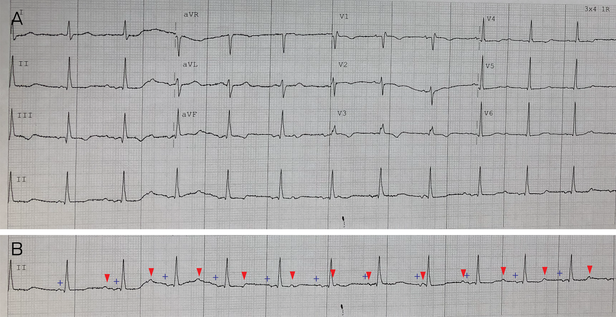
A 76‐year‐old woman presented to our regional hospital with coronavirus disease 2019 (COVID‐19)‐related symptoms. Her past medical history was significant for an orthotopic heart transplant in 2007 (no records available). An electrocardiogram showed sinus rhythm 65 beats per minute, but we noted increased atrial activity with two distinct p waves on the rhythm strip (Figure, A and B): the preserved recipient and the donor sinoatrial node activity, which is typical for biatrial heart transplants.1,2 Only the transplanted sinoatrial nodal activity is able to conduct to the ventricles, as the surgical anastomosis creates an electrical block that prevents transmission to the ventricles (Figure, B).
Competing interests
No relevant disclosures.
Acknowledgements
The author thanks all medical teams and staff involved in the care of this patient, and Angela Ratsch for her helpful comments on the preparation of this manuscript.
References
- Beukian S, Mahmood K, Anyanwu A, et al. A tale of 2 nodes after orthotopic heart transplant. JACC Case Rep 2020; 2: 1849‐1851.
- Thajudeen A, Stecker EC, Shehata M, et al. Arrhythmias after heart transplantation: mechanisms and management. J Am Heart Assoc 2012; 1: e001461.
Fatty Liver Disease in Australia: A Narrative Review on the Epidemiology, Natural History, Prognostication and Management in People With Metabolic Dysfunction
Karl Vaz, Daniel Clayton-Chubb, William W. Kemp, Stuart K. Roberts, Ammar Majeed
Sex Differences in Management and Outcomes of People With ST-Elevation Myocardial Infarction, New South Wales, 2011–2020: A Retrospective Cohort Study
Adam C. Livori, Jedidiah I. Morton, Dianna J. Magliano, Jonathan E. Shaw
Rethinking Rheumatic Fever Diagnosis: Progress, Pitfalls and the Path Towards a Definitive Test
Anna P. Ralph, Rachel Webb, Tom Parks, Nicole J. Moreland, Asha C. Bowen, Benjamin Jones, Emma Ndagire, Andrea Z. Beaton
Sex Differences in Management and Outcomes of People With ST-Elevation Myocardial Infarction, New South Wales, 2011–2020: A Retrospective Cohort Study
Samia Kazi, Simone Marschner, Clara K. Chow
Distribution of Cardiovascular Disease Risk Based on the Updated 2023 Guideline-Recommended Australian Cardiovascular Disease Risk Algorithm and Comparison With the 2012 Algorithm: An Observational Study
Nina Lazarevic, Meghana Bhat, Grace Joshy, Danielle C. Butler, Mark Woodward, Anushka Patel, Rod T. Jackson, Garry Jennings, Rosemary Wyber, Ellie Paige, Emily Banks
They Brought the Hospital to Me
Hugh N. Burrill