




Volume 216 - Issue 4
Reasons for rejection of self‐collected samples for cervical screening
Authors: Julia ML Brotherton, David Hawkes and Marion Saville
Med J Aust 2022; 216 (4): 214-214. || doi: 10.5694/mja2.51412
Published online: 7 March 2022
Published online: 7 March 2022
To the Editor: Self‐collected vaginal samples are as effective as clinician‐collected cervical samples for detecting underlying cervical intraepithelial neoplasia grade 2 or higher (the target lesion of cervical screening) using polymerase chain reaction‐based oncogenic human papillomavirus DNA assays.1 However, the use of self‐collection within Australia’s cervical screening program is currently restricted to women who are underscreened or never screened (at least 2 years overdue, so 4 years since their last Pap test), aged ≥ 30 years and refuse a clinician‐collected sample. This is because, at the time the current policy was developed, self‐collection was believed to result in a small loss of sensitivity. Accredited laboratories are not permitted to test samples that do not meet these requirements.
VCS Pathology (part of the Australian Centre for the Prevention of Cervical Cancer) was the first laboratory to receive regulatory approval to process self‐collected samples. Here we report the reasons for rejection of samples received between February 2018 and 30 June 2021, which is important given that about one‐third (34%; 2166/6234) of samples received could not be processed (37.4% in 2018; 37.9% in 2019; 34.1% in 2020; 22.8% in 2021). The three most common reasons were that the person was not sufficiently overdue (54.1% of rejected samples; 18.5% of all samples); that the wrong type of collection device was used (17.3% of rejected samples; 5.9% of all samples); or that the person was < 30 years of age (11.2% of rejected samples; 3.8% of all samples). Other reasons included delayed sample receipt (5.2% of rejected samples; 1.8% of all samples), presence of symptoms (3.0% of rejected samples; 1.0% of all samples) and multiple reasons (combination of above factors: 6.6% of rejected samples; 2.3% of all samples) (Box).
The implementation of self‐collection, while known to be highly acceptable to many women who will not accept a speculum examination for screening,1,2 has been problematic in Australia to date.3,4 The eligibility restrictions and strict laboratory requirements have created unintended barriers for practitioners and potential participants, as demonstrated by both the sample rejection rate and low overall numbers compared with the eligible population (< 1%).3 The recently announced mainstreaming of self‐collection, by making it a choice for all screening participants using on‐label tests, should overcome many of these barriers5 and improve program equity and participation. Successful implementation will depend on timely education, communication and change management.
Box – Proportion of 6234 self‐collected samples received that were unable to be processed, by reason and year of receipt (VCS Pathology, February 2018 to the end of June 2021)
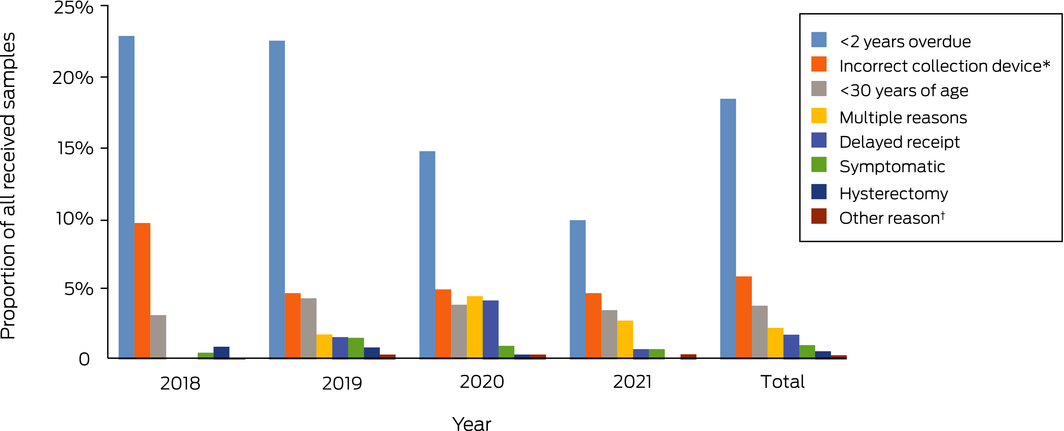
* Incorrect collection device refers to wrong swab type or media. † Other reasons include duplicate samples, and pregnancy (which was initially an exclusion criterion).
Competing interests
No relevant disclosures.
References
- Arbyn M, Smith SB, Temin S, et al. Detecting cervical precancer and reaching underscreened women by using HPV testing on self samples: updated meta‐analyses. BMJ 2018; 363: k4823.
- Saville M, Hawkes D, McLachlan E, et al. Self‐collection for under‐screened women as part of the renewed National Cervical Screening Program: a pilot study. Curr Oncol 2018; 25: e27–e32.
- Creagh NS, Zammit C, Brotherton JM, et al. The implementation of self‐collection cervical screening under the renewed National Cervical Screening Program: a qualitative insight from Victoria, Australia. Med J Aust 2021; 215: 354–358. https://www.mja.com.au/journal/2021/215/8/self‐collection‐cervical‐screening‐renewed‐national‐cervical‐screening‐program
- Smith M, Hammond I, Saville M. Lessons from the renewal of the National Cervical Screening Program in Australia. Public Health Res Pract 2019; 29: e2921914.
- The Hon Greg Hunt MP. Landmark changes improving access to life saving cervical screenings [media release]. 8 Nov 2021. https://www.health.gov.au/ministers/the‐hon‐greg‐hunt‐mp/media/landmark‐changes‐improving‐access‐to‐life‐saving‐cervical‐screenings (viewed Nov 2021).
Designing Housing to Reduce Overcrowding-Related Harms: Rheumatic Heart Disease as the Canary in the Coal Mine
Simon Quilty, Veronica Matthews, Angus Baumann, James Marangou, Bo Remenyi, Gavin Wheaton, Serena Morton Nabanunga, Norman Frank Jupurrurla, Simon Robinson, Steve Mintern, Cary Duffield, Joshua R. Francis, Paul C. Memmott
Australian Climate Leadership in 2026: COP-Out or Step-Up for Health?
Catherine G. A. Pendrey, Angie Bone, Aletha Ward, Francis Nona, Michelle Isles, Paul M. Kelly, Nicholas J. Talley
The impact of the Breast Screen NSW transition from film to digital mammography, 2002–2016: a linked population health data analysis
Rachel Farber, Nehmat Houssami, Katy J L Bell
Shifting focus to adolescent wellbeing and inclusive participation in the digital age
Allyson R Todd, Elena Wang, Stephanie R Partridge
The CURE Asthma roadmap
Gary P Anderson, Anthony Flynn, Phil G Bardin, John D Blakey, Shyamali C Dharmage, Paul Foster, Peter G Gibson, Adam Jaffe, Alan James, Christine R Jenkins, Sundram Sivamalai, Peter D Sly, Guy B Marks, Vanessa M McDonald, Judy Wetttenhall
Protecting public interest journalism as a public health good
Bronwyn Fredericks, Neha Lalchandani, Melissa A Sweet, Alex Cramb, Carmel Williams