




Volume 214 - Issue 7
Evidence‐based care to support longer, healthier lives for cancer survivors
Authors: Emily Banks and Grace Joshy
Med J Aust 2021; 214 (7): 308-309. || doi: 10.5694/mja2.50995
Published online: 19 April 2021
Published online: 19 April 2021
Improving integrated care and systematically targeting major cancer and non- cancer causes of morbidity and mortality could yield major benefits
Improving integrated care and systematically targeting major cancer and non‐cancer causes of morbidity and mortality could yield major benefits
Cancer is the leading cause of death and disability in Australia, and it is estimated that more than 1.6 million people were living with cancer at the end of 2015.1 Most of these people will live with the disease for many years; for all cancers combined, five‐year relative survival in 2012–2016 was about 69%.1 Although cancer is regarded by many people as a single condition, it is highly heterogeneous, with extreme variations in experiences and outcomes according to the type, aggressiveness, treatment, and stage of the cancer, and the age and comorbid conditions of the patient.
Maximising the health, wellbeing, and longevity of cancer survivors is informed by large scale evidence about long term outcomes. In this issue of the MJA, Koczwara and colleagues report mortality outcomes for the more than 32 000 people diagnosed with cancer in South Australia during 1990–1999 and still living at least five years after diagnosis.2 The authors found that this group had an estimated 24% higher risk of dying in the subsequent 12 years than people in the general population. Consistent with overseas findings,3 cancer was the most common cause of death for people with cancer; 45% of all deaths in this group were attributed to cancer. Other causes of death were important — ischaemic heart disease, stroke, dementia, chronic obstructive pulmonary disease, diabetes — and their contributions increased with age and time since cancer diagnosis. The same phenomenon is observed in the general Australian population, in which the proportion of fatal burden of disease attributed to cardiovascular disease (CVD) rapidly increases with age (Box).4
This, to some extent, is what success looks like: people with cancer living long enough to die of conditions that are generally more common in later life. The higher mortality risk among long term survivors of cancer, although significant, is moderate; at the same time, major opportunities for improvement remain.
Cancer survivors have a higher risk of CVD than the general population2,5 and those diagnosed with cancers with good prognoses often die of CVD rather than because of cancer recurrence or progression.3,6 While the cardiotoxicity of certain types of cancer chemotherapy, immunotherapy, and radiotherapy is recognised, other factors that increase CVD risk in cancer survivors are often underappreciated. Like people without cancer,7 cancer survivors have an appreciable background CVD risk. Many types of cancer and CVD share risk factors, such as smoking and obesity, and cancer itself increases CVD risk, especially that of venous thrombo‐embolism.5 Finally, focusing on cancer and its treatment can lead to suboptimal CVD preventive care.8
What, then, are the implications of the evidence regarding late mortality for cancer survivors and people caring for those with cancer? It is reassuring that mortality outcomes for many long term survivors gradually approach those of the general population. This underscores the importance of integrated, holistic, and tailored long term care, particularly primary care, for cancer survivors, including care for reducing cancer progression and recurrence, balanced by prevention and management of the patient’s other, often overlooked conditions.8
A key strategy for cancer survivorship is ensuring that best practice support for smoking cessation is consistently and universally provided. Smoking leads to large increases in all‐cause mortality, including among people with cancer, and increases mortality attributable to many cancers9 and to four of the five other leading causes of death identified by Koczwara and his colleagues.2 While many smokers with cancer quit successfully, most continue to smoke after diagnosis.10
As many as 80% of CVD events can be prevented,11,12 and Australian guidelines recommend health behaviour changes and pharmacotherapy tailored to a person’s level of absolute risk.13 However, more than half the people with existing CVD and more than 75% of the general Australian population at high risk of CVD do not receive recommended blood pressure‐ and lipid‐lowering preventive therapies.7 Despite higher CVD risks, the uptake of CVD preventive pharmacological and lifestyle treatments by people with cancer is low, and is similar to or lower than uptake by the general population.14
Ensuring that the CVD risk of cancer survivors is systematically assessed and managed according to best practice could substantially improve their outcomes. While no specific modification of CVD risk algorithms for cancer survivors is currently recommended, clinical judgement can be applied to tailoring preventive interventions for people at particularly high risk of CVD.13
Improvements in cancer survival are a tribute to efforts across the entire health system, from prevention and early detection to treatment and long term primary care. Improvements in integrated care that systematically target major cancer and non‐cancer causes of morbidity and mortality could yield even greater benefits.
Box – Relative proportions of years of life lost because of fatal conditions, Australia, 2015; by disease and age group
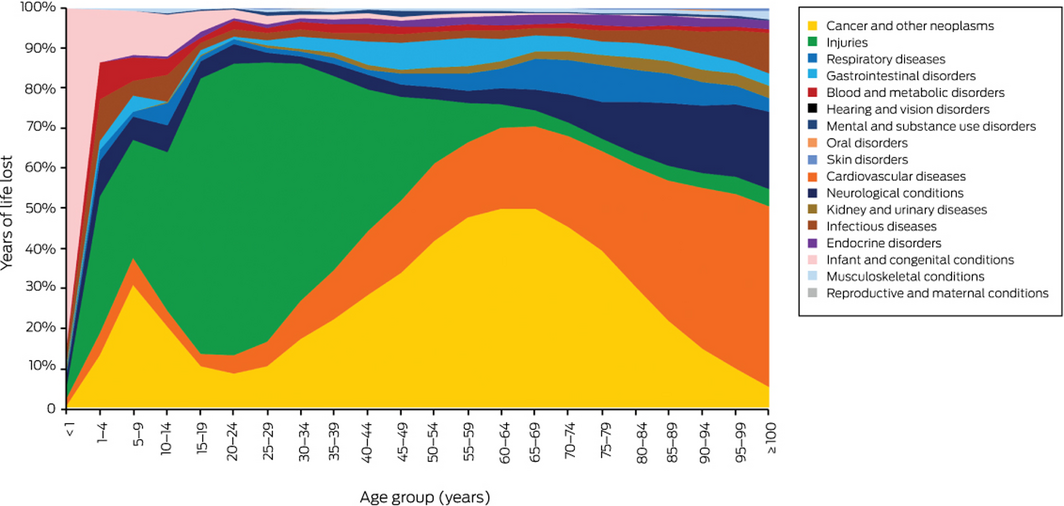
Data source: Australian Institute of Health and Welfare.4
Competing interests
No relevant disclosures.
Acknowledgements
Emily Banks is supported by a Principal Research Fellowship from the National Health and Medical Research Council.
References
- Australian Institute of Health and Welfare. Cancer data in Australia (Cat. vol no. CAN 122). Canberra: AIHW, 2020: https://www.aihw.gov.au/reports/cancer/cancer-data-in-australia (viewed Mar 2021).
- Koczwara B, Meng R, Miller M, et al. Late mortality in people with cancer: a population‐based Australian study. Med J Aust 2021; 214: 318–323.
- Zaorsky NG, Churilla TM, Egleston BL, et al. Causes of death among cancer patients. Ann Oncol 2017; 28: 400–407.
- Australian Institute of Health and Welfare. Australian Burden of Disease Study: impact and causes of illness and death in Australia 2015 (Australian Burden of Disease series no. 19; Cat. no. BOD 22); supplementary table S4.5. Canberra: AIHW, 2019. https://www.aihw.gov.au/getmedia/a67416f3-7713-43f0-b96b-a7ab3c104845/ABDS2015-detailed-report-supplementary-tables-final.xlsx.aspx (viewed Mar 2021).
- Strongman H, Gadd S, Matthews A, et al. Medium and long‐term risks of specific cardiovascular diseases in survivors of 20 adult cancers: a population‐based cohort study using multiple linked UK electronic health records databases. Lancet 2019; 394: 1041–1054.
- Baade PD, Fritschi L, Eakin EG. Non‐cancer mortality among people diagnosed with cancer (Australia). Cancer Causes Control 2006; 17: 287–297.
- Banks E, Crouch SR, Korda RJ, et al. Absolute risk of cardiovascular disease events, and blood pressure‐ and lipid‐lowering therapy in Australia. Med J Aust 2016; 204: 320. https://www.mja.com.au/journal/2016/204/8/absolute-risk-cardiovascular-disease-events-and-blood-pressure-and-lipid
- Weaver KE, Foraker RE, Alfano CM, et al. Cardiovascular risk factors among long‐term survivors of breast, prostate, colorectal, and gynecologic cancers: a gap in survivorship care? J Cancer Surviv 2013; 7: 253–261.
- National Center for Chronic Disease Prevention; Health Promotion (US) Office on Smoking and Health. The health consequences of smoking: 50 years of progress. A report of the Surgeon General. Atlanta (GA): US Centers for Disease Control and Prevention, 2014. https://www.ncbi.nlm.nih.gov/books/NBK179276 (viewed Mar 2021).
- Paul CL, Tzelepis F, Boyes AW, et al. Continued smoking after a cancer diagnosis: a longitudinal study of intentions and attempts to quit. J Cancer Surviv 2019; 13: 687–694.
- Chiuve SE, McCullough ML, Sacks FM, Rimm EB. Healthy lifestyle factors in the primary prevention of coronary heart disease among men: benefits among users and nonusers of lipid‐lowering and antihypertensive medications. Circulation 2006; 114: 160–167.
- Chiuve SE, Fung TT, Rexrode KM, et al. Adherence to a low‐risk, healthy lifestyle and risk of sudden cardiac death among women. JAMA 2011; 306: 62–69.
- National Vascular Disease Prevention Alliance. Guidelines for the management of absolute cardiovascular disease risk. 2012. http://www.cvdcheck.org.au/pdf/Absolute_CVD_Risk_Full_Guidelines.pdf (viewed Mar 2021).
- Chidwick K, Strongman H, Matthews A, et al. Statin use in cancer survivors versus the general population: cohort study using primary care data from the UK clinical practice research datalink. BMC Cancer 2018; 18: 1018.
Linked content
-
MJA Research: Late mortality in people with cancer: a population‐based Australian study
-
MJA Podcast: Professor Bogda Koczwara
-
InSight+: Cancer survivorship: paying more attention to heart risk factors
Provenance: Commissioned; externally peer reviewed.
Sovereignty and Survival: Understanding Lung Cancer Outcomes for Aboriginal and Torres Strait Islander People in Australia, a Case–Control Study
Alice R. T. Bergin, Luc te Marvelde, Roger L. Milne, Benjamin J. Solomon, Kris Ivanova, Peter Savas, Stephen J. Luen, Jay Hamann, Andrea Casey, Nicole Watt, Sue M. Evans, Gail Garvey, Sherene Loi
The Changing Indications for Adult Liver Transplantation in Australia: A Narrative Review
Fadak Mohammadi, Alan J. Wigg, Ken Liu, Simone I. Strasser
Uneven Ground: Survival Differences Among Victorian Lung Cancer Patients by Location of Residence (2011–2023): A Retrospective Cohort Study
Evangeline Samuel, Eldho Paul, Mike Lloyd, Sanuki Tissera, Craig Underhill, Sagun Parakh, Phillip Parente, Inger Olesen, Javier Torres, Katharine See, Gavin M. Wright, David Langton, Thomas John, Matthew Conron, James Bartlett, Nicola Atkin, Nikolajs Zeps, Susan V. Harden, Wasek Faisal, John R. Zalcberg, Rob G. Stirling
Early-Onset Colorectal Cancer With Liver-Only Metastases: A Retrospective Cohort Study Integrating Prospectively Collected Real-World Clinical and Molecular Data From an Australian National Database (2009–2024) to Guide Treatment Planning
Savio G. Barreto, Christos S. Karapetis, Shahid Ullah, Matthew Burge, Susan Caird, Angus Campbell, Azim Jalali, Ross Jennens, Muhammad A. Khattak, Belinda Lee, Stephanie H. Lim, Shehara Mendis, Louise Nott, Timothy J. Price, Jeremy D. Shapiro, Jeanne Tie, Javier Torres, Colin Williams, Rachel Wong, Vanessa Wong, Peter Gibbs
Australian Pathways for Specialist Pain Management and Early Palliative Care for People With Pancreatic Cancer: Developed Using a Community Consensus Approach
Jennifer Philip, Melanie R. Lovell, Kylee Bellingham, Gail Garvey, Gregory B. Crawford, Nicole M. Rankin, Kara Burns, Isabel Young, Vivienne Milch, Dorothy Keefe, Katrina Anderson, James Lawson, Meinir Krishnasamy
Program Guidelines for the National Lung Cancer Screening Program: Targeted Lung Cancer Screening in High-Risk Individuals in Australia
Nicole M. Rankin, Rebecca Zosel, Lisa J. Whop, Raglan Maddox, Annette McWilliams, Miranda Siemienowicz, Jon Emery, Maria A. R. Lantin, Georgia Bartlett, Mikayla Wolfe, Abbey Diaz, Katrina Anderson, Lillian Liu, Cindy Toms, Sarah McDermott, Peter Bligh, Jeremy Chalke, Stephen Melsom, Claire E. Nightingale, Alison Brown, Sam Pope, Julia Brotherton, Anne Fidler, Michel Itel, Mark Brooke, Diane M. Pascoe, Fraser Brims, Tracy L. Leong, Emily Stone, Dorothy Keefe, Vivienne Milch