




Volume 214 - Issue 11
The Australian Academy of Health and Medical Sciences: an authoritative, independent voice in the Australian landscape
Authors: Ingrid E Scheffer and Ian H Frazer
Med J Aust 2021; 214 (11): 502-504.e1. || doi: 10.5694/mja2.51089
Published online: 21 June 2021
Published online: 21 June 2021
The Academy focuses on the nation’s most pressing health challenges and supports
Australia’s thriving health and medical research sector
The Academy focuses on the nation’s most pressing health challenges and supports Australia’s thriving health and medical research sector
In 2015, the Australian Academy of Health and Medical Sciences (AAHMS) was created following discussions between government, universities and a range of key stakeholders that highlighted a need for a scholarly, impartial entity to provide advice on health and medical sciences in Australia. The aim of founding this learned Academy was to create a forum for leaders in health and medical sciences in Australia to provide authoritative, independent expertise and advice to government and the wider community on matters of health and medical research. The Academy focuses on the nation’s most pressing health challenges and acknowledges and supports Australia’s thriving health and medical research sector. The decision to establish the Academy followed the realisation that Australia lacked an independent body of political, professional and institutional interests in health and medical research. Its purpose mirrors well established entities around the world, including the Academy of Medical Sciences in the United Kingdom,1,2 the Canadian Academy of Health Sciences,3 and the United States National Academy of Medicine.4 The AAHMS joins four other scholarly Australian Academies: the Australian Academy of Science, the Australian Academy of Technology and Engineering, the Australian Academy of the Social Sciences and the Australian Academy of the Humanities. The AAHMS contributes to expert scientific endeavours with the other Academies, together with national organisations such as the Commonwealth Scientific and Industrial Research Organisation (CSIRO) and Science and Technology Australia, to bring high level scientific and health advice to government, including guiding health measures during the coronavirus disease 2019 (COVID‐19) pandemic.
A further major remit of the Academy is to encourage and foster Australia’s development of the next generation of health and medical research leaders.5 This includes clinician scientists and medical researchers from all specialities and disciplines, including public health, health services, clinical and allied health practice, and translational and applied fundamental science. The AAHMS aims to cultivate an environment to support the development of future health and medical science leaders.6
The Academy works to influence policy by providing independent expert advice to government, the community and interested parties on challenges and opportunities in health and medical research. The aim is to inform decisions based on the best available evidence.7 Nowhere has this been more apparent than in the contributions of our Fellows to the COVID‐19 pandemic response, where their expertise has led public health advice, scientific understanding of the severe acute respiratory syndrome coronavirus 2 (SARS‐CoV‐2), and work on development of a viral vaccine and therapeutics.8,9 The Academy has convened our Fellows and other experts to provide scientific advice direct to government during the pandemic; for example, through the Rapid Research Information Forum (RRIF). The AAHMS has led the development of RRIF advice on topics including the most promising therapeutics and the potential for reinfection with SARS‐CoV‐2.10,11
The Academy’s Fellowship comprises leaders across the health and medical sciences in Australia. The Academy is working actively to deliver strong representation of women within the Fellowship, electing 48% women among its Fellows in 2019. The health and medical sciences include many areas of expertise in addition to medicine, including medical science, epidemiology, public health, nursing, psychology and allied health.12
A critical strategic objective is to support Indigenous health and wellbeing.13 We will strengthen our contribution to the health and medical research capacity of this group of Australians by working with researchers of Aboriginal and Torres Strait Islander descent, including those among the Fellowship. We are working with Aboriginal and Torres Strait Islander Fellows to develop a specific mentorship program for the next generation of clinician scientists.
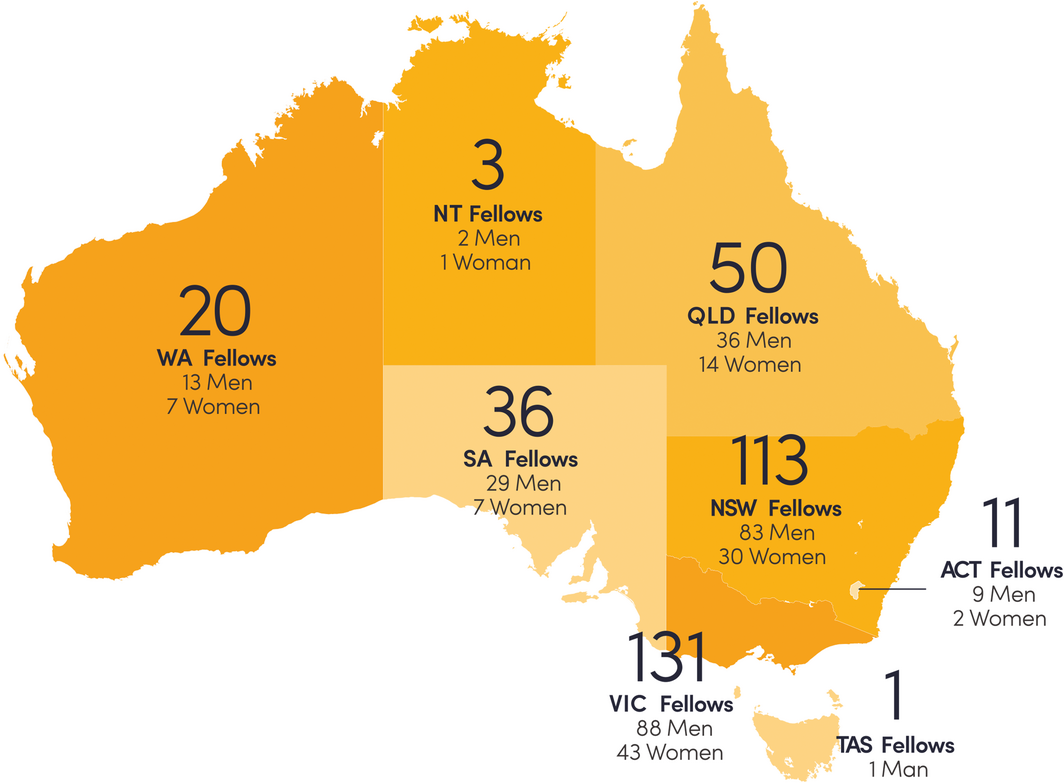
The Fellowship currently comprises 425 Fellows and includes a diverse group of leaders; 68% are clinician scientists and 32% are drawn from a wide range of disciplines including biomedical science, bioinformatics, ethics and health economics. Fellows are drawn from across the sectors, including academia, health, industry and government. Fellows work in all states and territories (Box). All Fellows are encouraged to actively participate in the Academy and its efforts, including through their state branches with active local programs such as the state‐based Life as a Clinician Scientist symposia. The Academy also has a small number of Overseas and Corresponding Fellows, based internationally, who have made a substantive contribution to the Australian health and medical research landscape. Our annual meeting rotates around the capital cities to ensure inclusion and involvement of all Fellows and to highlight the many strengths of our sector around the country.14
Since electing its first Fellows in 2015, the AAHMS has established itself as a valuable national resource, already delivering highly regarded and valued programs and initiatives. For example, the Mentorship Program targets emerging research leaders, selected through a competitive nomination process. They are matched with an Academy Fellow, not in their immediate field, to work together as a mentor–mentee pair. Mentees therefore interact with Fellows who would not usually cross their path, and can guide them in a big picture view of the challenges and strengths of their career development. To date, this 3‐year program has accepted 59 mentees, 52% of whom are women. Our annual survey of mentees has documented a “positive” or “extremely positive” impact, with 96% acknowledging that their mentor has the right skills to mentor them and that their mentor was a good match.
We also encourage generations of future research leaders through our Life as a Clinician Scientist: The Best of Both Worlds initiative — a series of 1‐day state‐based events supported by Australian universities and research institutes. The career of a clinician scientist has not been well recognised until recent years and can be challenging. These events aim to engage young doctors, registrars, consultants, nurses, allied health professionals, and medical and science students. Through this unique program, we showcase the career path of our Fellows and others, showing how research enriches clinical practice. The symposia also give potential future employers in research‐focused institutions the opportunity to highlight their work, to attract future research students and entice them to their field of interest. Each symposium attracts 100–300 attendees who report that attendance has helped them to plan, or even completely revise, their career vision to include research and consider becoming a clinician scientist. More than 2600 attendees have participated in 15 symposia between 2016 and 2020, with outstanding evaluations of the impact of the event.14
The AAHMS publishes policy documents, including a 2019 pre‐election statement15 outlining five priorities for federal government in health, research and innovation, and a position paper on the need for improved data access and linkage for health research purposes.16 The Academy is exploring the health impacts of bushfires and climate change17 and the ways in which artificial intelligence will impact health and the associated opportunities and challenges.18 The Academy is keen to engage meaningfully with the public and partnered with ABC Science to host a live recording of its Ockham’s Razor podcast.19 It also engaged with Fellows and the wider community with a forward‐looking COVID‐19‐related webinar.
The Academy is keen to reach out to members of the medical and health community in Australia. Please contact us via the AAHMS website (https://aahms.org/contact-us/) or by email (
Competing interests
Ingrid Scheffer serves/has served on the editorial boards of Annals of Neurology, Neurology, Epileptic Disorders and Epilepsy Currents; may accrue future revenue on pending patent WO2009/086591; has a patent for SCN1A testing held by Bionomics Inc and licensed to various diagnostic companies (WO/2006/133508); and has a patent for a molecular diagnostic/therapeutic target for benign familial infantile epilepsy (WO/2013/059884) with royalties paid. She has served on scientific advisory boards for UCB, Eisai, GlaxoSmithKline, BioMarin, Nutricia, RogCon, Chiesi Farmaceutici, Encoded Therapeutics, Knopp Biosciences and Xenon Pharmaceuticals; has received speaker honoraria from LivaNova, GlaxoSmithKline, UCB, BioMarin, Biocodex and Eisai; has received funding for travel from UCB, Biocodex, GlaxoSmithKline, Biomarin and Eisai; has served as an investigator for Zogenix, Zynerba Pharmaceuticals, Ultragenyx, GW Pharmaceuticals, UCB, Eisai, Epygenix, Anavex Life Sciences, Ovid Therapeutics, Encoded Therapeutics and Marinus Pharmaceuticals; and has consulted for Zynerba Pharmaceuticals, Atheneum Partners, Ovid Therapeutics and UCB. She receives/has received research support from the National Health and Medical Research Council of Australia, Medical Research Future Fund, Health Research Council of New Zealand, Citizens United for Research in Epilepsy, Australian Epilepsy Research Fund, March of Dimes and National Institutes of Health: National Institute of Neurological Disorders and Stroke.
References
- Academy of Medical Sciences. Formation of the Academy of Medical Sciences. https://acmedsci.ac.uk/about/history/formation-of-the-Academy-of-Medical-Sciences (viewed July 2020).
- Lachmann P. First steps: a personal account of the formation of the Academy of Medical Sciences. London: Academy of Medical Sciences, 2010.
- Canadian Academy of Health Sciences. About the Canadian Academy of Health Sciences. https://cahs-acss.ca/about/ (viewed July 2020).
- National Academy of Medicine. About the National Academy of Medicine. https://nam.edu/about-the-nam/ (viewed July 2020).
- Brown GV, Sorrell TC. Building quality in health — the need for clinical researchers. Med J Aust 2009; 190: 627–629. https://www.mja.com.au/journal/2009/190/11/building-quality-health-need-clinical-researchers
- Fisk NM, Wesselingh SL, Beilby JJ, et al. Academic health science centres in Australia: let’s get competitive. Med J Aust 2011; 194: 59–60. https://www.mja.com.au/journal/2011/194/2/academic-health-science-centres-australia-lets-get-competitive
- Bennett CC. A healthier future for all Australians: an overview of the final report of the National Health and Hospitals Reform Commission. Med J Aust 2009; 191: 383–387. https://www.mja.com.au/journal/2009/191/7/healthier-future-all-australians-overview-final-report-national-health-and
- National Health and Medical Research Council. National COVID-19 Health and Research Advisory Committee. https://www.nhmrc.gov.au/about-us/leadership-and-governance/committees/national-covid-19-health-and-research-advisory-committee (viewed Aug 2020).
- Lee JYH, Best N, McAuley J, et al. Validation of a single-step, single-tube reverse transcription loop-mediated isothermal amplification assay for rapid detection of SARS-CoV-2 RNA. J Med Microbiol 2020; 69: 1169–1178.
- Cuthbertson A, Drew T, Godfrey D, Subbarao K. Rapid Research Information Forum: Re-infection with SARS-CoV-2. Canberra: Australian Academy of Health and Medical Sciences and Australian Academy of Science, 2020. https://aahms.org/wp-content/uploads/2020/04/rrif-q002-covid19-reinfection-19-april-2020-3.pdf (viewed July 2020).
- Lewin S, Copolov D, Crabb B, et al. Rapid Research Information Forum: The most promising therapeutics for COVID-19. Canberra: Australian Academy of Health and Medical Sciences and Australian Academy of Science, 17 May 2020. https://aahms.org/wp-content/uploads/2020/04/RRIF-Q009-Promising-COVID-19-Treatments-17-May-2020.pdf (viewed July 2020).
- Allied Health Professions Australia. About AHPA. https://ahpa.com.au/about-ahpa/ (viewed July 2020).
- Ganesharajah C. Indigenous Health and Wellbeing: the Importance of country. Canberra: Native Title Research Unit, Australian Institute of Aboriginal and Torres Strait Islander Studies, 2009. https://aiatsis.gov.au/sites/default/files/products/report_research_outputs/ganesharajah-2009-indigenous-health-wellbeing-importance-country.pdf (viewed July 2020).
- Australian Academy of Health and Medical Sciences. Events. https://aahms.org/events/ (viewed Aug 2020).
- Australian Academy of Health and Medical Sciences. Driving prosperity and improving lives through health and medical science: statement from the Australian Academy of Health and Medical Sciences ahead of the 2019 Federal Election. Brisbane: AAHMS, 2019. https://aahms.org/wp-content/uploads/2019/01/AAHMS-pre-election-full-statement-February-2019.pdf (viewed July 2020).
- Australian Academy of Science and Australian Academy of Health and Medical Sciences. Improving accessibility and linkage of data to achieve better health outcomes for all Australians. Brisbane: AAHMS, 2019. https://aahms.org/wp-content/uploads/2019/07/linkage-data-for-better-health-outcomes_FINAL-1.pdf (viewed May 2021).
- Australian Academy of Health and Medical Sciences. The Australian bushfires: impacts on health – the evidence. Brisbane: AAHMS, 2020. https://aahms.org/wp-content/uploads/2020/04/The-Australian-Bushfires-and-the-impact-on-health_evidence-doc.pdf (viewed July 2020).
- Australian Academy of Health and Medical Sciences. Artificial intelligence in health: exploring the opportunities and challenges. Brisbane: AAHMS, 2020. https://aahms.org/wp-content/uploads/2020/06/AAHMS-AI-in-Health-roundtable_Meeting-report-1.pdf (viewed July 2020).
- Australian Academy of Health and Medical Sciences. AAHMS General and Scientific Annual Meeting 2019. https://aahms.org/events/2019-aahms-annual-meeting/ (viewed July 2020).
Provenance: Not commissioned; externally peer reviewed.
Designing Housing to Reduce Overcrowding-Related Harms: Rheumatic Heart Disease as the Canary in the Coal Mine
Simon Quilty, Veronica Matthews, Angus Baumann, James Marangou, Bo Remenyi, Gavin Wheaton, Serena Morton Nabanunga, Norman Frank Jupurrurla, Simon Robinson, Steve Mintern, Cary Duffield, Joshua R. Francis, Paul C. Memmott
Australian Climate Leadership in 2026: COP-Out or Step-Up for Health?
Catherine G. A. Pendrey, Angie Bone, Aletha Ward, Francis Nona, Michelle Isles, Paul M. Kelly, Nicholas J. Talley
The impact of the Breast Screen NSW transition from film to digital mammography, 2002–2016: a linked population health data analysis
Rachel Farber, Nehmat Houssami, Katy J L Bell
Shifting focus to adolescent wellbeing and inclusive participation in the digital age
Allyson R Todd, Elena Wang, Stephanie R Partridge
The CURE Asthma roadmap
Gary P Anderson, Anthony Flynn, Phil G Bardin, John D Blakey, Shyamali C Dharmage, Paul Foster, Peter G Gibson, Adam Jaffe, Alan James, Christine R Jenkins, Sundram Sivamalai, Peter D Sly, Guy B Marks, Vanessa M McDonald, Judy Wetttenhall
Protecting public interest journalism as a public health good
Bronwyn Fredericks, Neha Lalchandani, Melissa A Sweet, Alex Cramb, Carmel Williams