




Volume 213 - Issue 3
Australia: an island in a sea of measles
Authors: Kirsten M Williamson, Tony Merritt and David N Durrheim
Med J Aust 2020; 213 (3): 101-103.e1. || doi: 10.5694/mja2.50650
Published online: 15 June 2020
Published online: 15 June 2020
Combatting the resurgence of measles requires vigilant clinicians and sustained, high level vaccination coverage
At the beginning of 2020, Samoa was in a state of emergency due to a measles outbreak. It resulted in over 5700 cases and over 80 deaths, the majority being in children under 5 years of age.1 There were concurrent outbreaks regionally, in New Zealand, Tonga, American Samoa and Fiji. Globally, there has been a massive resurgence of measles with over 360 000 cases reported to the World Health Organization between 1 January and 31 July 2019 — almost three times the number reported over the same period for 2018. We have also seen the re‐establishment of endemic measles in some countries, such as the United Kingdom, where it was previously eliminated.2
In 2019, Australia had 285 confirmed measles cases, the highest number reported since 2014, the year that it was verified by the Regional Verification Commission for Measles Elimination in the Western Pacific to have eliminated measles.3 Most infections occurred in, or were secondary to, unimmunised or underimmunised individuals returning from countries where measles is endemic or that have active outbreaks.4 Australian doctors cannot afford to become complacent about measles, particularly while large outbreaks affect popular tourist and business destinations in the region.
Why must we care about measles?
Measles is the most highly communicable human virus known, and has a basic reproduction number (R0; the average number of secondary cases generated from a single case in a fully susceptible, freely mixing population) between 9 and 18 — double that of smallpox and quadruple that of Ebola virus.5 It can therefore result in devastating and explosive outbreaks where immunity gaps exist. It is transmitted by respiratory droplets, and aerosolised particles can remain airborne for up to 2 hours, making infection possible well after a patient has left an enclosed space such as a clinic waiting room. Cases are infectious from 24 hours before prodrome onset until 4 days after onset of rash. As the characteristic, maculopapular rash does not appear until 3–7 days into the illness (Box 1), each case may unwittingly expose hundreds of contacts by the time of diagnosis.5,6
Although the majority of patients recover from measles, up to one child in every thousand infected in wealthy countries will die, usually due to pneumonia or encephalitis.5 The immunosuppression caused by the measles infection may last months to years, and rare but devastating neurological complications include acute disseminated encephalomyelitis, measles inclusion body encephalitis and subacute sclerosing panencephalitis.5 The dramatic decrease in subacute sclerosing panencephalitis in Australia since 1990 is a testament to the impact of effective immunisation programs.7
There is no specific antiviral therapy for measles. Management remains supportive, with fluids, vitamin A, and antibiotic therapy if secondary bacterial infections arise.5 The importance of preventing measles through vaccination cannot be overstated.
Breakthrough infection
While most measles cases still occur in underimmunised individuals, some countries, including Australia, have seen a small but increasing proportion of cases occurring in adults reporting previous measles vaccination.5,8,9,10 At the time of elimination verification in Australia, the estimated efficacy of measles vaccine was 96.7% for one dose and 99.7% for two doses.11 Thus, about one in 300 fully vaccinated people who are exposed to measles are vulnerable to “breakthrough” infection, resulting from either an inadequate response at the time of vaccination or waning of immunity over time.8,9 The latter is particularly seen in post‐elimination settings where regular immune‐boosting from circulating wild strain virus is absent, and there is concern that this may become more common as the time since elimination increases.10,12 Measles should therefore be considered in all patients presenting with fever and rash, particularly if there is a history of travel, exposure to a confirmed case, or when measles is known to be circulating locally, even if the patient has received two doses of measles vaccine.
Breakthrough infections often present as modified measles with a mild to moderate rash and less pronounced prodrome.8,9,10 Virus burden and transmissibility appear to be lower in modified cases than in a typical infection; however, onward transmission may still occur, making isolation of cases and public health responses still necessary.8,10 Attenuated symptoms, alongside often undetectable IgM antibody levels, make diagnosis considerably more challenging and definitive laboratory testing using polymerase chain reaction all the more relevant.
Advances in laboratory testing
Detection of measles IgM antibodies through serological testing is a commonly used diagnostic method but relies on optimally timed specimens. IgM is detectable in 75% of cases 3 days after rash onset, and in almost 100% after one week, but may not be present early in the illness or in the setting of waning immunity.4,8 Specificity varies from 60% to 97% and serology cannot distinguish wild‐type infection from recent vaccination.13
Nucleic acid testing of respiratory and urine specimens using polymerase chain reaction has revolutionised measles diagnosis. Sensitivity and specificity approach 100% from the first day of rash but decrease after 2 weeks, at which point serology remains useful.4,13 Preliminary results may be available within 4 hours of receipt by an accredited laboratory, and can distinguish between wild‐type virus and vaccine strain (genotype A).6 Nucleic acid testing is now the preferred method of diagnosis (often in conjunction with serology), and has the additional advantage that swabs are often easier to collect than blood in young children.4 Virus genotyping enables source and cluster identification, tracking of global transmission and detection of emerging strains, and provides supportive evidence to confirm elimination of endemic measles.
For epidemiological purposes, breakthrough infections may be differentiated by avidity analysis of IgG antibodies in serum.8 Avidity is the strength with which antibodies bind to antigens. Low avidity suggests an inadequate immune response at the time of vaccination, while high avidity suggests an initially adequate response to vaccination followed by waning immunity.14
Public health management
If measles is suspected, the patient should be isolated at home or under airborne precautions in a health care facility until the diagnosis is excluded by laboratory testing or the case is no longer infectious. A public health unit should be notified on clinical suspicion of measles before laboratory confirmation is received.4
Public health management includes vaccination of susceptible contacts within 72 hours following exposure, and passive immunisation of susceptible high risk contacts (immunocompromised patients, pregnant women and infants under 12 months of age) with intramuscular normal human immunoglobulin within 144 hours of exposure.4 With such a highly transmissible virus, any delay in notification and initiation of public health actions can result in large scale outbreaks.
Vaccination importance and update
Vaccination remains the key to control and prevention of measles cases and complications. A population immunity of 95% is required to eliminate ongoing measles transmission, and every year a new, susceptible cohort is born, mandating that high quality immunisation efforts be maintained.12,15 While childhood vaccination coverage in 2019 was above 90% for all Australian states and territories, few met the 95% target for measles (Box 2).16 Further, national and state/territory rates can conceal pockets of low vaccination coverage where the introduction of a single case can be the catalyst for an outbreak.
As of April 2019, infants travelling to a high risk setting can be given measles vaccine from 6 months of age. They still require the further two doses routinely given at 12 months and 18 months of age as part of the current National Immunisation Program.4 Previously, measles vaccination was not recommended for infants aged under 12 months because of the presence of maternal antibodies, which provide protection in early life and render the vaccine less effective. This immunity now appears to wane earlier in infants born to vaccinated mothers in an elimination setting.5
In Australia, the second dose of measles vaccine was first recommended in 1993, initially for 10–16 year olds, and introduced into the National Immunisation Program for 4–5 year olds in 1998.15 Thus, adults born between 1966 and 1982 may be susceptible, being born after circulating measles began to decline but unlikely to have received two doses of vaccine. Measles vaccine should therefore be offered to anyone aged 12 months or older (or 6 months or older as detailed above), born after 1965, who does not have formal documentation of immunity or receipt of two doses of measles vaccine, particularly before travelling overseas. It is safe to give an additional dose if it is unclear whether two doses have been previously administered. Because it is a live attenuated vaccine, measles vaccine is contraindicated in pregnancy and in immunocompromised patients.4 Although vaccine hesitancy is a concern and receives substantial media attention, access to services and other practical factors remain important barriers to vaccination uptake.17
Conclusion
Measles virus is the ultimate opportunist and will capitalise on any gaps in immunity. National programs are important, but measles control cannot be achieved without effective local prevention and control measures, including diligent vaccination and prompt diagnosis by alert clinicians. With outbreaks occurring regionally, concerted effort is required to maintain Australia's elimination of measles and continue progress towards the goal of global measles eradication.
Box 1 – Typical measles rash
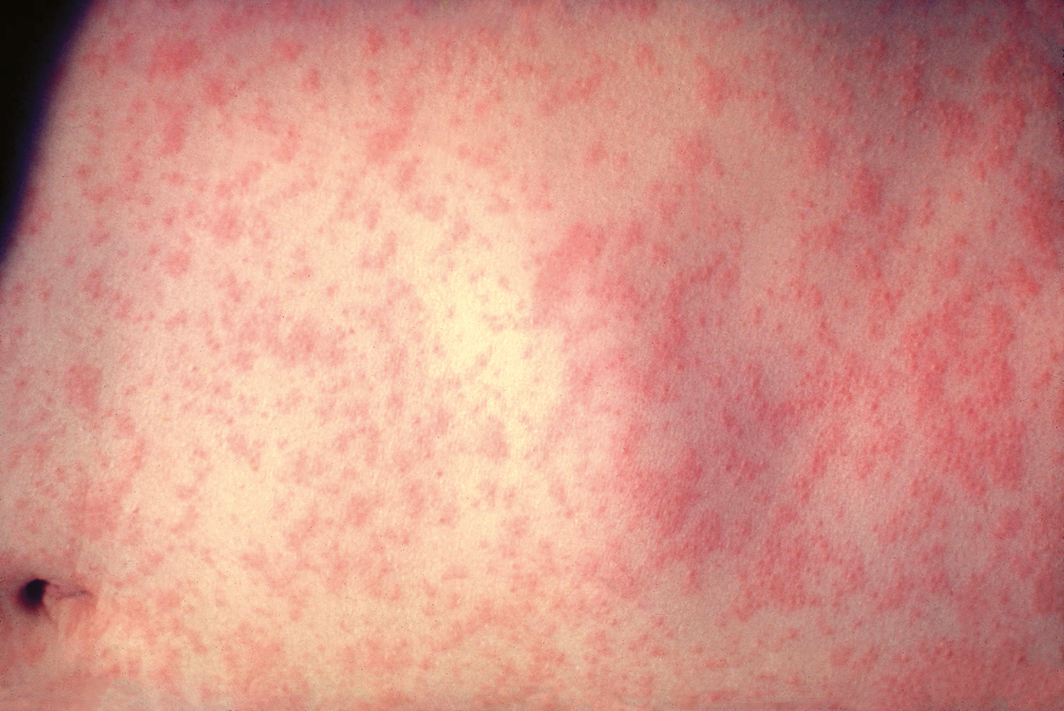
Photograph showing skin rash on a patient's abdomen 3 days after the onset of measles infection. Image captured at New York Hospital–Cornell Medical Centre. Photograph courtesy of CDC/Heinz F. Eichenwald, MD from Centers for Disease Control and Prevention Public Health Image Library ID# 3168 (https://phil.cdc.gov/details.aspx?pid=3168).
Box 2 – Australian state and territory immunisation coverage rates for 1‐year‐olds at 31 December 2019
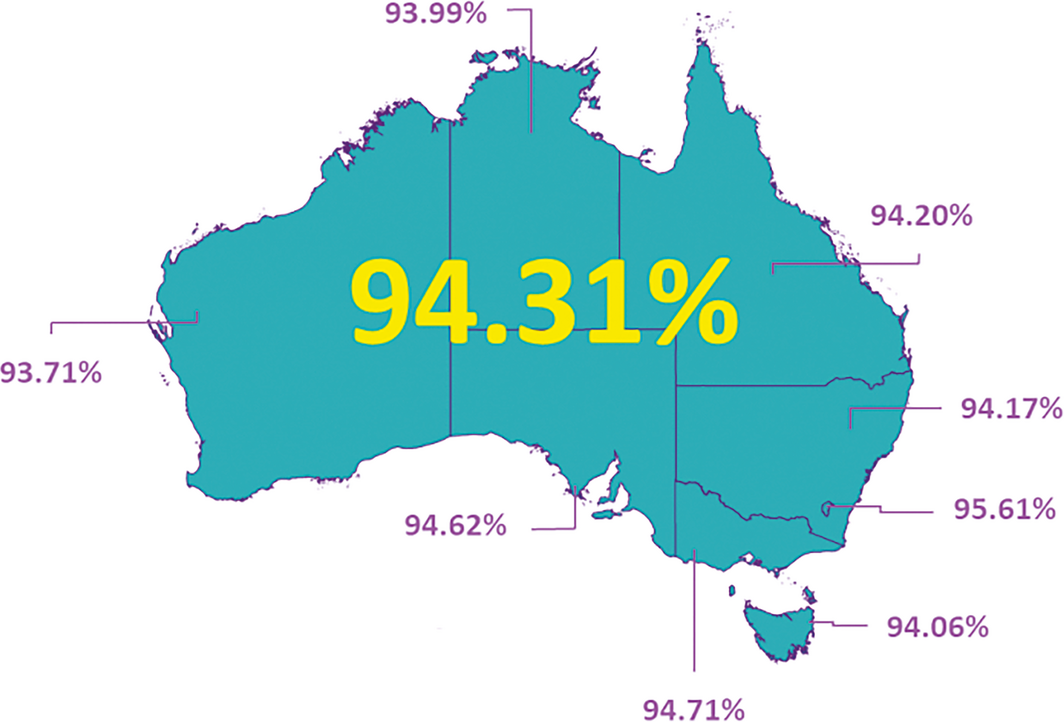
Data source: Australian Immunisation Register. Infographic courtesy of Australian Government Department of Health.16
Competing interests
No relevant disclosures.
References
- United Nations Office for the Coordination of Humanitarian Affairs. Pacific: measles outbreak – Oct 2019. Disaster description – Samoa. Geneva: OCHA, 2020. https://reliefweb.int/disaster/ep-2019-000139-wsm (viewed May 2020)
- World Health Organization. Immunisation, vaccine and biologicals. New measles surveillance data from WHO. 12 Aug 2019. Geneva: WHO, 2019. https://www.who.int/immunization/newsroom/new-measles-data-august-2019/en/ (viewed Feb 2020).
- National Notifiable Diseases Surveillance System. Number of notifications of measles, received from state and territory health authorities in the period of 1991 to 2019 and year‐to‐date notifications for 2020 (14 May). Canberra: Australian Government Department of Health, 2020. http://www9.health.gov.au/cda/source/rpt_4.cfm (viewed May 2020).
- Australian Government Department of Health. Measles: CDNA national guidelines for public health units. Canberra: DoH, 2019. https://www1.health.gov.au/internet/main/publishing.nsf/Content/cdna-song-measles.htm (viewed May 2020).
- Moss WJ. Measles. Lancet 2017; 390: 2490–2502.
- Gastañaduy PA, Banerjee E, DeBolt C, et al. Public health responses during measles outbreaks in elimination settings: strategies and challenges. Hum Vaccin Immunother 2018; 14: 2222–2238.
- Huppatz C, Durrheim DN, Levi C, et al. Etiology of encephalitis in Australia, 1990‐2007. Emerg Infect Dis 2009; 15: 1359–1365.
- Gibney KB, Attwood LO, Nicholson S, et al. Emergence of attenuated measles illness among IgG‐positive/IgM‐negative measles cases: Victoria, Australia, 2008–2017. Clin Infect Dis 2020; 70: 1060–1067.
- Sundell N, Dotevall L, Sansone M, et al. Measles outbreak in Gothenburg urban area, Sweden, 2017 to 2018: low viral load in breakthrough infections. Euro Surveill 2019; 24: 1900114.
- Cherry JD, Zahn M. Clinical characteristics of measles in previously vaccinated and unvaccinated patients in California. Clin Infect Dis 2018; 67: 1315–1319.
- Pillsbury A, Quinn H. An assessment of measles vaccine effectiveness, Australia, 2006‐2012. Western Pac Surveill Response J 2015; 6: 43–50.
- Durrheim DN, Crowcroft NS. The price of delaying measles eradication. Lancet Public Health 2017; 2: e130–e131.
- Australian Government Department of Health. Measles laboratory case definition. Page last updated 6 Aug 2010. https://www1.health.gov.au/internet/main/publishing.nsf/Content/cda-phlncd-measles.htm (viewed May 2020).
- Mercader S, Garcia P, Bellini WJ. Measles virus IgG avidity assay for use in classification of measles vaccine failure in measles elimination settings. Clin Vaccine Immunol 2012; 19: 1810–1817.
- Heywood AE, Gidding HF, Riddell MA, et al. Elimination of endemic measles transmission in Australia. Bull World Health Organ 2009; 87: 64–71.
- Australian Government Department of Health. Immunisation coverage for all children. State and territory coverage rates. Data as at 31 Dec 2019. Canberra: DoH, 2019. https://www.health.gov.au/health-topics/immunisation/childhood-immunisation-coverage/immunisation-coverage-rates-for-all-children#national-coverage-rates (viewed May 2020).
- Thomas S, Cashman P, Islam F, et al. Tailoring immunisation service delivery in a disadvantaged community in Australia; views of health providers and parents. Vaccine 2018; 36: 2596–2603.
Linked content
-
InSight+: COVID-19 lockdown suppresses measles, but beware the return
Provenance: Not commissioned; externally peer reviewed.
Costs of Delivering the Hep B PAST Model of Care in Remote Australia: A Retrospective Pre–Post Study
Hoa Nguyen, Anh Le Tuan Nguyen, Paula Binks, Melita McKinnon, Emily Vintour-Cesar, Karen Wills, Nicola Stephens, Benjamin Cowie, Joshua S. Davis, Yuejen Zhao, Peter Nihill, Julie A. Campbell, Andrew J. Palmer, Jane Davies, Barbara de Graaff
Buruli Ulcer Acquired From Ringtail Possum Rescue
Daniel P. O'Brien, Naomi Clarke, Sara Bonnici, Mohammad A. Hussain
Q Fever Visceral Abscesses After Contact With Native Australian Marsupials
Samantha J. Laws, Enzo Binotto, James Stewart, Jennifer Ho, Trent Yarwood, Josh Hanson, Simon Smith
Hospital-Admitted Injection-Related Infections Among Incarcerated People Who Inject Drugs in Australia: A Retrospective Cohort Study
Andrew Palmer, Matthew Carter, Jeremy Yeo, Cecilia Shim, Jason Connor, Jeremy Hayllar, Gerald Holtmann, Naomi Moy, Elliott G. Playford, Naomi Runnegar, Paul J. Clark
The Live Attenuated Influenza Vaccine in Australia: An Additional Tool for Influenza Prevention
Cyra Patel, Alexis Pillsbury, Tran Nguyen, Xia Wang, Helen E. Quinn, Clayton K. Chiu, Allen C. Cheng, Katie L. Flanagan, Zhicheng Wang
Reflex Testing for Hepatitis D Infection: A Unique Opportunity to Reduce Hepatitis D-Related Chronic Liver Disease Deaths in Australia
Jessica Howell, Lauren Andersson, Miriam T. Levy, James O'Beirne, Leon Adams, Katharine Irvine, Avik Majumdar, Golo Ahlenstiel, Kathy Jackson, Krispin Hajkowicz, Joseph Doyle, Jane Davies, Sarah Cherian, Wayne Dimech, Alexander J. Thompson