




Volume 212 - Issue 11
Australian residential aged care is understaffed
Authors: Kathy Eagar, Anita Westera and Conrad Kobel
Med J Aust 2020; 212 (11): 507-508.e1. || doi: 10.5694/mja2.50615
Published online: 1 June 2020
Published online: 1 June 2020
The existing system is failing to deliver the care that Australia expects
Australia's aged care has changed considerably in recent decades. In response to consumer demand, old institutional‐style nursing homes have been progressively phased out in favour of better facilities. Home‐like furnishings and decor and single bedrooms personalised with residents’ own belongings have increasingly become the norm. In the process, they have become residential aged care facilities (RACFs), and there is no longer a distinction between low and high care.1
At the same time, older people want to stay in their own homes longer and have increasingly been able to do so because more community care is now available. Along with significant accommodation bonds and other charges, this has also served government objectives of reigning in the costs of Australia's ageing population.1
Contemporary residential care is no longer a lifestyle choice, it is now primarily for people who can no longer live at home. However, funding and staffing have not kept pace with this change.1
Aged care residents’ needs
People living in RACFs now are typically very frail and have complex physical, cognitive and social care needs.
During 2018, we independently assessed 5000 people living in RACFs.2 Only 15% of residents were independently mobile, one in two (50%) required mobility assistance, and over a third (35%) were not mobile. The bedridden group was at greatest risk of pressure injuries.
People living in RACFs are vulnerable; the typical resident lacks energy and struggles with everyday activities. Most residents (> 80%) need help with activities such as showering, getting dressed or using the toilet. Moreover, many residents have memory, understanding and communication problems. Almost half of the residents find it difficult to interact with others and may become distressed when care staff try to assist them with personal hygiene, for example. Mental health problems are rife. Agitation is the most prevalent problem (43%), followed by depression (35%) and irritability (35%).3
There are about 180 000 residential care beds in Australia occupied on any one day by permanent residents.4 About 60 000 permanent residents die each year and about the same number take their place.5,6 The number of residents who die in their RACF is unclear. What is known is that many thousands are transferred to hospital due to staff not having the skills, confidence, capacity, resources or back‐up to provide the care they need.7
Neglect, the recently released interim report of the Royal Commission into Aged Care Quality and Safety, concluded that “substandard care is much more widespread and more serious than … anticipated”.7
Staffing in residential aged care facilities
To inform its work, the Royal Commission requested a research study be carried out into residential care staffing.1 This involved a review of staffing standards internationally and an assessment of current Australian staffing levels against international and national standards. Australian staffing levels were calculated based on a time and motion study we conducted in 2018.3
Residents in Australia receive on average 188 minutes of care per day, which includes 36 minutes by registered nurses, 8 minutes by allied health professionals (mostly physiotherapists) and 144 minutes by personal care assistants.1 Anecdotally, registered nurses and allied health professionals are required to spend a disproportionate amount of time on paperwork for funding purposes, leaving even less time to spend on care.
Adequate care time and staffing mix and levels
So how can we tell if a RACF is providing adequate care time and has the right mix of staff? Our Royal Commission research considered these questions.1
The international literature consistently reports that staff time requirements are driven by resident function, cognition, behaviour and technical nursing requirements, and our 2018 research confirmed that these same drivers apply in Australia.3 The clear evidence in the international literature of a direct causal relationship between staff numbers and skill mix and resident safety and quality outcomes is equally applicable to Australia.8,9,10 Over 150 studies documented in systematic reviews, primarily from the United States, Canada, the United Kingdom and northern Europe, confirm a “strong positive impact of nurse staffing on both care process and outcome measures”.11 Organisational factors, such as professional staff mix (ratio of registered nurses to total staffing levels), staff turnover rates, use of agency staff, and consistency in staffing also have an impact on quality.
We found that the five‐star rating system used in the US by the Centers for Medicare and Medicaid Services (CMS) is the most relevant system internationally for judging aged care in Australia. It has a strong evidence base and has been in widespread use for nearly 20 years.12 While it does not address allied health staffing levels, it could be developed to do so if such an approach were adopted in Australia.
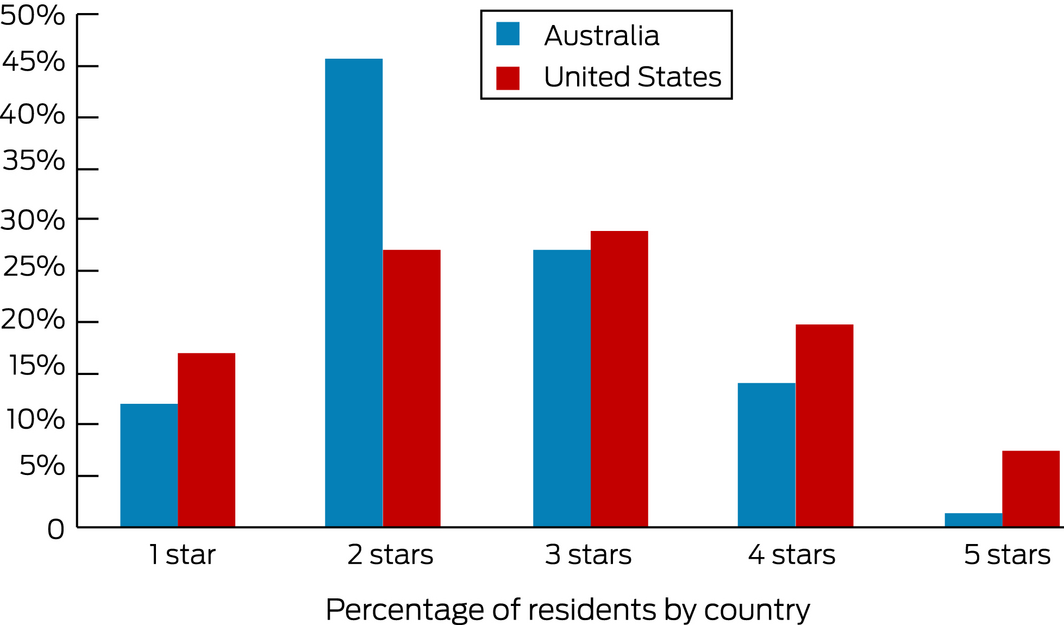
The CMS considers the amount of care time provided to residents by nursing and personal care staff and adjusts this according to the needs of residents in each home. The outcome is a rating of between one and five stars. The more stars the better. The five‐star threshold is the point at which there is no evidence of any additional quality improvements for residents (Box).12
As seen in the Box, Australian RACFs rate poorly compared with US RACFs. They also do badly compared with the standards in place in Germany and Canada and with the standards set down by the state governments of Victoria and Queensland.1
Research into the CMS system found that homes are more likely to “experience quality concerns” when staffing levels fall below a certain level.12 This threshold is equivalent to the minimum requirement for a three‐star rating (ie, 30 minutes of registered nurse time and 215 minutes of total time). Therefore, we determined that anything less than three stars is inadequate for Australian RACFs.1
Using these metrics, more than half of all Australian aged care residents (57.6%) are in RACFs that have inadequate (one or two stars) staffing levels. A little over a quarter (27.0%) are in RACFs that have three stars, 14.1% of residents are in RACFs with four stars, and 1.3% are in RACFs with five stars, which we consider best practice.1
Bringing all RACFs in Australia up to at least three stars would require an average staffing increase of 37.3% in those RACFs currently rated one or two stars, which would result in an overall increase of 20% in total care staffing across Australia. Achieving four stars would increase total staffing by 37.2% and five stars by 49.4%. Importantly, these increases are total numbers for the sector as a whole and need to be adjusted according to the mix of residents when applied to individual RACFs.1
The best international benchmark for allied health staff currently is from the Canadian province of British Columbia, which recommends a minimum of 22 minutes of allied health services per resident per day. Only 2% of Australian aged care residents currently receive this level of care. An additional 175% in allied health staffing is required to achieve this international standard.1
The evidence is clear
Our research was requested by the Royal Commission against a background of numerous examples of poor quality care experienced by older people living in RACFs.1 A recurring theme has been the lack of staffing to meet the wide‐ranging and increasingly complex needs of residents — assertions that have been supported by the results of our research.1
It is clear from our research and from the evidence presented to the Royal Commission that there is a compelling case for additional resources in RACFs. This includes improving the staffing mix and increasing staffing levels to an acceptable standard. As the Royal Commission's interim report notes,7 the existing system has failed to ensure residents receive quality care. It is no longer acceptable to describe RACFs simply as a person's home or for advocates to argue that what is required is a social model of care delivered with a wellness philosophy.13,14,15 While on the surface it sounds attractive and in line with what consumers want, the evidence from the Royal Commission is that these arguments are now being used as a justification for inadequate care.7
Conclusion
Residents in Australian RACFs have a right to be safe and to receive clinically competent and adequate care. This care needs to be provided within a non‐institutional environment that is respectful of individual choices and affords every resident the opportunity to be meaningfully engaged to the extent possible. There does not need to be a trade‐off between a social model of care and a clinically competent model. Aged care residents have a right to both and do not have the time to wait.
Competing interests
None declared.
Acknowledgements
The research summarised in this article was funded by the Royal Commission into Aged Care Quality and Safety. This funding was paid to the university and not the authors. The Royal Commission into Aged Care Quality and Safety had no role in the research or in the preparation of the manuscript.
References
- Eagar K, Westera A, Snoek M, et al. How Australian residential aged care staffing levels compare with international and national benchmarks. Centre for Health Service Development, Australian Health Services Research Institute, University of Wollongong; 2019. https://agedcare.royalcommission.gov.au/publications/Documents/research-paper-1.pdf (viewed Oct 2019).
- Eagar K, McNamee J, Gordon R, et al. AN‐ACC: A national classification and funding model for residential aged care: synthesis and consolidated recommendations. The resource utilisation and classification study: report 6. Australian Health Services Research Institute, University of Wollongong; 2019. https://www.health.gov.au/sites/default/files/documents/2019/12/resource-utilisation-and-classification-study-rucs-reports-report-6-an-acc-a-national-classification-and-funding-model-for-residential-aged-care-synthesis-and-consolidated-recommendations_0.pdf (viewed Oct 2019).
- Eagar K, McNamee J, Gordon R, et al. The Australian National Aged Care Classification (AN‐ACC). The resource utilisation and classification study: report 1. Australian Health Services Research Institute, University of Wollongong; 2019. https://www.health.gov.au/sites/default/files/documents/2019/12/resource-utilisation-and-classification-study-rucs-reports-report-1-the-australian-national-aged-care-classification-an-acc_0.pdf (viewed Oct 2019).
- Australian Institute of Health and Welfare. 2018–19 Report on the operation of the Aged Care Act 1997. Canberra: Commonwealth of Australia, 2019. https://www.gen-agedcaredata.gov.au/www_aihwgen/media/ROACA/2018-19-ROACA.pdf (viewed Oct 2019).
- Australian Institute of Health and Welfare. GEN Aged Care Data: people leaving aged care [website]. Canberra: Commonwealth of Australia, 2019. https://www.gen-agedcaredata.gov.au/Topics/People-leaving-aged-care (viewed Oct 2019).
- Australian Institute of Health and Welfare. GEN Aged Care Data: admissions into aged care [website]. Canberra: Commonwealth of Australia, 2019. https://www.gen-agedcaredata.gov.au/Topics/Admissions-into-aged-care (viewed Oct 2019).
- Royal Commission into Aged Care Quality and Safety. Neglect: interim report; volume 1. Canberra: Commonwealth of Australia, 2019; p. 5. https://agedcare.royalcommission.gov.au/publications/Pages/interim-report.aspx (viewed Oct 2019).
- Ludlow K, Churruca K, Mumford V, et al. Unfinished care in residential aged care facilities: an integrative review. Gerontologist 2019;. https://doi.org/gnz145;10.1093/geront/gnz145.
- Spilsbury K, Hewitt C, Stirk L, Bowman C. The relationship between nurse staffing and quality of care in nursing homes: a systematic review. Int J Nurs Stud 2011; 48: 732–750.
- Howe CL. Staffing ratios in nursing homes. Ariz Geriatr Soc J 2009; 15: 23–25.
- Harrington C, Schnelle JF, McGregor M, Simmons SF. Article commentary: the need for higher minimum staffing standards in US nursing homes. Health Services Insights 2016;. https://doi.org/10.4137/HSI.S38994.
- Feuerberg M. Appropriateness of minimum nurse staffing ratios in nursing homes, report to Congress: phase II final. Centers for Medicare and Medicaid Services (CMS), 2001. USA. https://phinational.org/wp-content/uploads/legacy/clearinghouse/PhaseIIVolumeIofIII.pdf (viewed Oct 2019).
- Aged Care Workforce Strategy Taskforce. A matter of care: Australia's aged care workforce strategy. Canberra: Commonwealth of Australia, 2018. https://www.health.gov.au/sites/default/files/a-matter-of-care-australia-s-aged-care-workforce-strategy.pdf (viewed Oct 2019).
- Leading Aged Services Australia. Proposal for a new residential aged care funding model. LASA, 2019. https://lasa.asn.au/wp-content/uploads/2019/06/20190530-LASA-submission-to-proposed-AN-ACC-funding-model-FINAL.pdf (viewed Oct 2019).
- Aged and Community Services Australia. Proposal for a new residential aged care funding model. ACSA; 2019. https://www.acsa.asn.au/ACSA/media/General/Documents/ACSA-Submission-RUCS-Jun-2019.pdf (viewed Oct 2019).
Linked content
-
MJA Podcast: Professor Kathy Eagar
-
InSight+: Aged care staffing: send in the forensic accountants
Provenance: Not commissioned; externally peer reviewed.
Medical Colleges Have an Obligation to Ensure Full Participation in Clinical Quality Registries
Thomas J. Hugh
Getting on the Same Page: Why Australia Needs a National Maternity Early Warning System (MEWS) Chart
Briony A. Cutts, Lucy Bowyer, Nisha Khot, Sandra Lowe, Stefan C. Kane
Data for Equity: Can Linked Administrative Data Inform Pathways to More Equitable Child Health?
Sarah Gray, Shuaijun Guo, Meredith O'Connor, Elodie O'Connor, Katrina Williams, Hannah Badland, Susan Woolfenden, Josie Dickerson, Gerry Redmond, Marnie Downes, Sharon R. Goldfeld
Specialty College Selection: Why Change is Critical to Support a Future Rural Workforce
Matthew R. McGrail, Jenny May AM, Katherine Logan
Differentiated and simplified oral HIV pre‐exposure prophylaxis (PrEP) models hold the key to virtually eliminating HIV transmission in Australia by 2030
Tyson Arapali, Sarah Warzywoda, Anthony K J Smith, Curtis Chan, Timothy R Broady, Erin Sullivan, Catherine MacPhail, Mohamed A Hammoud, Alexander Dowell‐Day, Benjamin R Bavinton
The number of cancer‐related deaths that could be attributable to spatial disparities in survival in Australia, 2010–2019: a retrospective population‐based cohort study
Charlotte K Bainomugisa, Jessica Cameron, Paramita Dasgupta, Peter Baade