




Volume 211 - Issue 4
Controversies in medicine: redefining the diagnosis of type 1 diabetes
Authors: Jennifer J Couper and Leonard C Harrison
Med J Aust 2019; 211 (4): 157-159.e1. || doi: 10.5694/mja2.50284
Published online: 19 August 2019
Published online: 19 August 2019
Diagnosis of autoimmune ?-cell disorder before end-stage clinical type 1 diabetes is a key step towards the prevention of this disease
Diagnosis of autoimmune β-cell disorder before end-stage clinical type 1 diabetes is a key step towards the prevention of this disease
The incidence of type 1 diabetes has been rising by about 3% per year in children worldwide, with some plateauing since 2005 in Australia.1 Intensive management with technological advances in insulin delivery and glucose monitoring have improved the management and eased the burden for patients with type 1 diabetes. However, most patients still do not achieve optimal blood glucose control to minimise the risk of long term vascular complications.2 Prevention remains the ultimate goal.
The diagnosis of type 1 diabetes
The classical presentation of increasing polyuria, polydipsia and weight loss over days to weeks is familiar to practitioners and leads to the diagnosis of type 1 diabetes. However, clinical diagnosis is the end stage of subclinical pathology over months to years, during which time β‐cells in the islets of the pancreas undergo autoimmune destruction. This process begins early in life and is revealed by circulating autoantibodies to islet antigens, which denote pancreatic β‐cell or islet autoimmunity. Type 1 diabetes is clinically heterogeneous but most children who develop type 1 diabetes have detectable autoantibodies before the age of 5 years to at least two islet antigens: insulin, glutamic acid decarboxylase 65 (GAD65), insulinoma antigen 2 (IA2) and/or zinc transporter 8 (ZnT8).3
Sensitivity and specificity of enzyme‐linked immunosorbent assays for islet autoantibodies are 60–80% and 95–100%, respectively. The radiobinding assay for insulin autoantibodies — detected predominantly in young children — has a similar high specificity but lower sensitivity. These assays are being superseded by the development of multiplex, ultrasensitive and low cost islet autoantibody assays, without compromise of specificity. The risk of overdiagnosis is mitigated further by first screening for multiple antibodies and confirming all positive autoantibody results.4
Progression to diabetes is faster the younger the age when autoantibodies are first detected and in children with high risk human leucocyte antigen (HLA) class II susceptibility haplotypes DR3‐DQ2 and DR4‐DQ8. Among children with two or more islet autoantibodies before age 3 years, 57% and 75% progress to diabetes by age 6 and 10 years, respectively.3
The stages of type 1 diabetes
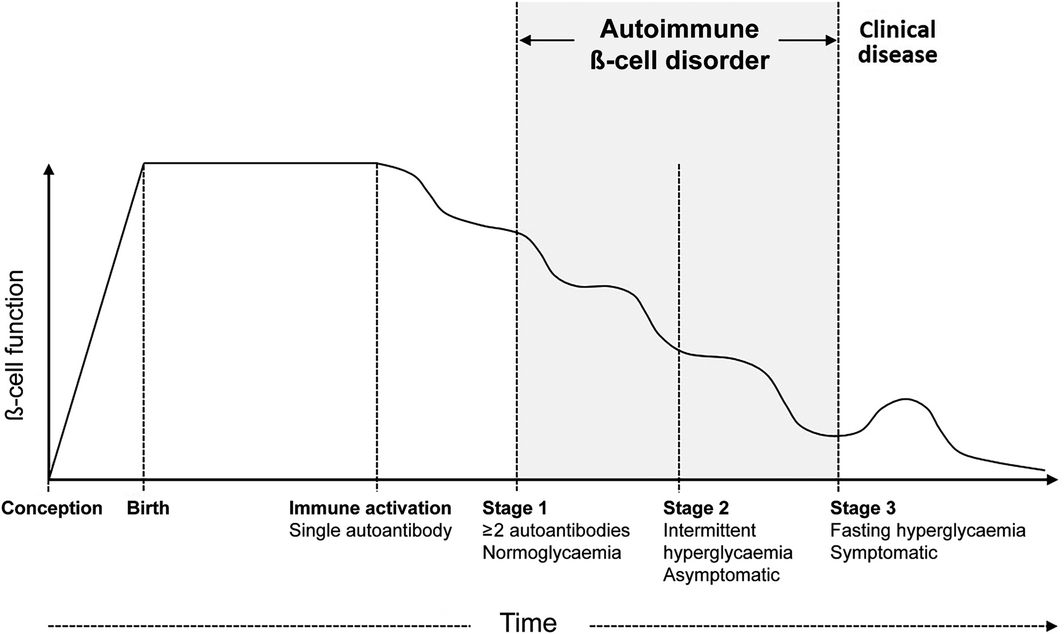
Children with two or more islet autoantibodies who are normoglycaemic and asymptomatic are defined as having stage 1 type 1 diabetes,5 encompassing the months to years of subclinical disease. Stage 2 is the intermediate stage that may last many months, when blood glucose rises transiently without symptoms, especially after food. Stage 3 is the classic presentation of type 1 diabetes with symptomatic fasting hyperglycaemia requiring insulin therapy (Box).
Islet autoantibodies are detected in several contexts: with stress hyperglycaemia associated with fever or treatment with sympathomimetic agents; in screening relatives of people with type 1 diabetes, 4% of whom have at least one islet autoantibody;6 and in screening pre‐school children in the general population, of whom 0.4% in Germany had more than one islet autoantibody.4 Screening studies remain in the research domain. Individuals with islet autoantibodies should be referred to paediatric or adult diabetologists for counselling and advice, including about current prevention trials.
Autoimmune β‐cell disorder
In other autoimmune diseases, the onset of symptoms and pathology is usually concomitant. For example, children with juvenile idiopathic arthritis or adults with rheumatoid arthritis present with painful, swollen joints when treatment with newer biological agents may favourably alter disease progression and preserve the joints. In type 1 diabetes, however, the pathology is latent until clinical presentation as a metabolic disorder in end‐stage disease. Treatment to counter autoimmunity and preserve residual β‐cell function at this stage stands less chance of success — akin to treating arthritis after it has destroyed the joints.
In order to advance our understanding of type 1 diabetes and the likelihood of its prevention, a paradigm shift would redefine type 1 diabetes as an autoimmune β‐cell disorder (ABCD) that begins with asymptomatic islet autoimmunity (stage 1) and not as a metabolic disorder resulting from end‐stage pathology (stage 3).7
The benefits of ABCD
The ABCD paradigm has important potential benefits.7 It may minimise the risk of diabetic ketoacidosis (DKA), decrease psychological stress in affected families, and lead to earlier initiation of treatment trials with a higher likelihood of preserving insulin production and preventing clinical disease.
Minimising the risk of diabetic ketoacidosis
Up to 30% of Australian children with newly diagnosed diabetes present with DKA.8,9 Prevention of DKA is an important target in the Australian National Diabetes Strategy 2016–2020.8 With access to intensive care facilities, it is now rare for a patient to have serious life‐threatening complications of DKA. However, DKA causes significant post‐traumatic stress for families. Emerging evidence indicates that children who present with DKA have worse metabolic control in the longer term.10 In an American study, glycated haemoglobin tracked 1.4% higher after severe DKA and 0.9% higher after mild or moderate DKA for up to 15 years of follow‐up after diagnosis.10 These increments are sufficient to increase the risk of long term vascular complications. Campaigns to alert primary care providers about the benefits of early diagnosis of type 1 diabetes in children have shown some impact.9 Children with islet autoimmunity followed prospectively in research studies consistently have a markedly lower risk of DKA.11,12 This is particularly apparent in young children in whom severe DKA at presentation is more common. These observations provide an impetus for general population screening for islet autoimmunity, currently underway in Europe4 and the United States.13 These research programs seek to provide evidence of cost‐effectiveness and facilitate intervention with research treatments in the asymptomatic stages of disease.
Decreasing psychological stress for families
Research studies that follow children at increased genetic risk of type 1 diabetes not surprisingly reveal heightened parental anxiety when a child is identified at increased risk by genetic or autoantibody screening. However, anxiety decreases over time and at clinical diagnosis is less, along with better coping ability, than in families in which the diagnosis was unheralded.14 General population screening in Europe includes measures of family and child anxiety,4 which may differ from those experienced by relatives of those with type 1 diabetes. Australian data are lacking but important to acquire because of cultural and regional differences.
Preventing type 1 diabetes
Interventions being investigated to preserve β‐cell function target different stages: pre‐stage 1 before islet autoimmunity (primary prevention), stages 1 and 2 after onset of islet autoimmunity and before the symptoms of diabetes (secondary prevention), and stage 3 soon after clinical diagnosis. Intervention at any stage may require combination treatments but earlier intervention is more likely to be successful.7 Screening for secondary prevention trials has been limited to first‐degree relatives but will extend to the general population. While there are yet no proven means to prevent type 1 diabetes, several agents, including antithymocyte globulin; the anti‐CD3 monoclonal antibodies, teplizumab and otelixizumab; abatacept (CTLA4‐Ig); and the anti‐CD20 monoclonal antibody, rituximab, show promise in preserving residual β‐cell function in recent‐onset clinical type 1 diabetes. Significantly, teplizumab delayed progression to type 1 diabetes in high risk participants in a recent landmark trial.15
The challenges of ABCD
Only 10% of children presenting with type 1 diabetes have an affected first‐degree relative. Therefore, most at‐risk individuals with ABCD would need to be identified by general population screening. However, unlike in relatives, the specificity, sensitivity and predictive value of islet autoantibody screening in the general population has to be established prospectively, although one study16 suggested that general population screening would be effective. This research will require consultation with public health experts, health economists and other professionals, and the diabetes and wider community to evaluate its cost–benefit ratio. At present, the costs of screening and follow‐up are likely to outweigh the savings from preventing DKA and potentially alleviating family stress. As many years may elapse before some children with multiple antibodies develop type 1 diabetes, there is a substantial obligation to provide adequate family support during follow‐up. The major personal and economic impact of screening will result when identifying ABCD in children allows for earlier intervention to prevent progression to clinical type 1 diabetes. While type 1 diabetes has been recognised as an autoimmune disease for several decades, clinical recognition of the first stage of disease as an autoimmune rather than a metabolic disorder would set the stage for expanded investment by academia, consumer bodies and industry in prevention trials, including with agents known to be efficacious in other autoimmune diseases.
Conclusion
Diagnosis of ABCD before end‐stage clinical type 1 diabetes and hyperglycaemia is a key step towards the prevention of type 1 diabetes. Screening of Australian children in the general population for islet autoimmunity as a research undertaking is likely to be well supported by advocacy consumer groups and would complement international efforts. Experience with screening at‐risk family members indicates general enthusiasm for early diagnosis and participation in intervention trials. Australia is fortunate in having robust research networks of type 1 diabetes clinicians and researchers that monitor the natural history of type 1 diabetes in genetically at‐risk families, screen for ABCD, and conduct intervention trials aiming to improve clinical outcomes. These networks — the Australasian Diabetes Data Network (www.addn.org.au), Environmental Determinants of Islet Autoimmunity (ENDIA) (www.endia.org.au), Diabetes Research Centre (www.diabetesresearchcentre.org.au) and Type 1 Diabetes TrialNet (www.trialnet.org) — are a strong foundation for population screening for ABCD and clinical trials to prevent type 1 diabetes.
Competing interests
No relevant disclosures.
Acknowledgements
We acknowledge the contributions to the manuscript of Megan Penno and the community support and perspective provided by Juvenile Diabetes Research Foundation Australia, the recipient of the Australian Research Council Special Research Initiative in Type 1 Diabetes. Leonard Harrison was supported by a National Health and Medical Research Council Senior Principal Research Fellowship (1080887).
References
- Haynes A, Bulsara MK, Bower C, et al. Regular peaks and troughs in the Australian incidence of childhood type 1 diabetes mellitus (2000–2011). Diabetologia 2015; 58: 2513–2516.
- Phelan H, Clapin H, Bruns L, et al. The Australasian Diabetes Data Network: first national audit of children and adolescents with type 1 diabetes. Med J Aust 2017; 206: 121–125. https://www.mja.com.au/journal/2017/206/3/australasian-diabetes-data-network-first-national-audit-children-and-adolescents
- Ziegler AG, Rewers M, Simell O, et al. Seroconversion to multiple islet autoantibodies and risk of progression to diabetes in children. JAMA 2013; 309: 2473–2479.
- Raab J, Haupt F, Scholz M, et al. Capillary blood islet autoantibody screening for identifying pre‐type 1 diabetes in the general population: design and initial results of the Fr1da study. BMJ Open 2016; 6: e11144.
- Insel RA, Dunne JL, Atkinson MA, et al. Staging presymptomatic type 1 diabetes: a scientific statement of JDRF, the Endocrine Society and the American Diabetes Association. Diabetes Care 2015; 38: 1964–1974.
- Colman PG, McNair P, Margetts H, et al. The Melbourne Pre‐Diabetes Study: prediction of type 1 diabetes mellitus using antibody and metabolic testing. Med J Aust 1998; 169: 81–84.
- Bonifacio E, Mathieu C, Nepom GT, et al. Rebranding asymptomatic type 1 diabetes: the case for autoimmune beta cell disorder as a pathological and diagnostic entity. Diabetologia 2017; 60: 35–38.
- Department of Health. Australian National Diabetes Strategy 2016–2020. Canberra: Commonwealth of Australia, 2015. http://www.health.gov.au/internet/main/publishing.nsf/Content/nds-2016-2020 (viewed Jan 2019).
- King BR, Howard NJ, Verge CF, et al. A diabetes awareness campaign prevents diabetic ketoacidosis in children at their initial presentation with type 1 diabetes. Pediatr Diabetes 2012; 13: 647–651.
- Duca LM, Wang B, Rewers M, Rewers A. Diabetic ketoacidosis at diagnosis of type 1 diabetes predicts poor long‐term glycemic control. Diabetes Care 2017; 4: 1249–1255.
- Winkler C, Schober E, Ziegler AG, Holl RW. Markedly reduced rate of diabetic ketoacidosis at onset of type 1 diabetes in relatives screened for islet autoantibodies. Pediatr Diabetes 2012; 13: 308–313.
- Steck AK, Larsson HE, Liu X, et al. Residual beta‐cell function in diabetes children followed and diagnosed in the TEDDY study compared with community controls. Pediatr Diabetes 2017; 18: 794–802.
- Gesualdo PD, Bautista KA, Waugh KC, et al. Feasibility of screening for T1D and celiac disease in a pediatric clinic setting. Pediatr Diabetes 2016; 17: 441–448.
- Smith LB, Liu X, Johnson SB, et al. Family adjustment to diabetes diagnosis in children: can participation in a study on type 1 diabetes genetic risk be helpful? Pediatr Diabetes 2018; 19: 1025–1033.
- Herold KC, Bundy BN, Long A, et al. An anti‐CD3 antibody, teplizumab, in relatives with type 1 diabetes. N Engl J Med 2019. https://doi.org/10.1056/nejmoa1902226. [Epub ahead of print]
- Bingley PJ, Bonifacio E, Williams AJ, et al. Prediction of IDDM in the general population: strategies based on combinations of autoantibody markers. Diabetes 1997; 46: 1701–1710.
Linked content
-
InSight+: Paradigm shift: preventing type 1 diabetes before symptoms appear
Provenance: Not commissioned; externally peer reviewed.
When ‘Liver Enzymes’ Are Not Hepatic: Late-Onset Pompe Disease
Shauna Madigan, Georgina England, Wayne Rankin
Primary Hyperparathyroidism in Adults: Recent Developments in Diagnosis and Management
Elizabeth Wootton, Sunita M. C. De Sousa, Richard L. Prince, Donald S. A. McLeod, David A. Pattison, Mathis Grossmann
Severe Hypoglycaemia Secondary to Chronic Opioid-Induced Hypothalamic–Pituitary–Adrenal Axis Suppression: An Under-Recognised Phenomenon
Michael Do, Annabelle Hayes, Malgorzata Brzozowska
Rethinking diabetes care for Indigenous Australians: the need for Indigenous‐codesigned and led diabetes models of care
Natalie Nanayakkara, Sharon Atkinson‐Briggs, Alicia J Jenkins, Neale D Cohen
The first Australian evidence‐based guidelines on male infertility
Darren J Katz, Liza O’Donnell, Robert I McLachlan, Tim J Moss, Clare V Boothroyd, Veena Jayadev, Sarah R Catford