




Volume 211 - Issue 3
Infections in pregnancy
Authors: Caitlin L Keighley, Hannah JM Skrzypek, Angela Wilson, Michael A Bonning and Gwendolyn L Gilbert
Med J Aust 2019; 211 (3): 134-141. || doi: 10.5694/mja2.50261
Published online: 5 August 2019
Published online: 5 August 2019
Routine and risk-based antenatal screening identifies some vertically transmissible infections that can be prevented or treated in pregnancy
Summary
- Infections in pregnancy represent a challenging and often underappreciated area of concern for many specialists and general practitioners and can cause serious sequelae.
- Antenatal status should be highlighted on pathology request forms, as this serves to alert the laboratory of the need to store serum for an extended period. Prior antenatal specimens can be forwarded to other laboratories to enable testing in parallel with the more recent sample.
- Women with a confirmed, potentially vertically transmissible infection should be referred to a specialist with expertise in the management of perinatal infections.
- Cytomegalovirus infection is the most common congenital infection. Women who care for young children are at greater risk of exposure to the virus. Preventive steps including hand hygiene and avoiding contact with children's urine, mucous and saliva are recommended for all pregnant women.
- The incidence of parvovirus B19 infection in pregnancy is unknown. This infection is highly contagious and may result in fetal loss; particularly in the first half of pregnancy, pregnant women should avoid contact with adults or children who may have an infection.
Infections in pregnancy represent a challenging and often underappreciated area of concern for many specialists and general practitioners and may cause serious sequelae. However, given that ambiguous laboratory findings without specific symptoms may lead to unnecessary anxiety, interpretation and judgement are required for appropriate investigation and management. This narrative review provides an update on a 2002 article highlighting infections that can affect the fetus or neonate;1 viral hepatitis, human immunodeficiency virus (HIV) infection, tuberculosis and carriage of group B streptococcus have been reviewed elsewhere.2,3,4,5,6,7,8,9,10
Methods
We used PubMed to search original and review articles published between 1980 and 2018, as well as specialist society publications and guidelines, to formulate an evidence‐based overview of the topics as applied to clinical practice.
Pre‐pregnancy testing and counselling
Patients who seek pre‐conception advice from a practitioner offer an opportunity to address preventive health topics (Box 1). In addition, online information is readily available from a number of sites.13,14
If possible, the assessment of varicella and rubella immune status and vaccination of non‐immune women should occur before conception (Box 2). As both rubella and varicella are live vaccines, pregnancy should be avoided for 4 weeks after these immunisations.18 Women who are found to be non‐immune at antenatal screening should be offered vaccination post partum.
Influenza vaccination is recommended and free for all pregnant women regardless of gestation, for women planning pregnancy and for those who are breastfeeding; pertussis vaccination is recommended between 28 and 32 weeks gestation.18,19 Vaccination confers ongoing protection to the baby for up to 6 months after birth.
Routine antenatal screening
Routine screening should occur as early as possible and include the tests outlined in Box 2 — the clinical practice guidelines were updated in 2018.20 Additional testing should be carefully considered, acknowledging the risk and ramifications of false positive results in pregnancy.21 Antenatal screening should be highlighted as such on request forms so that laboratories can identify samples that should be stored for a year from receipt.
Management of infection in pregnant women
Possible or confirmed exposure
Prompt assessment of possible exposure is key. Once the woman's susceptibility is determined, the nature of the exposure can be assessed and diagnosis confirmed in the contact. Assessment for infection may continue for many weeks and should be done in consultation with laboratories and specialists. In all cases, the possibility of false positive or false negative test results should be discussed.
Presentation with symptoms and proven infection
Infections in pregnancy usually present in the same way as in the non‐pregnant patient. An assessment of clinical symptoms and potential exposures in the context of a full medical history is followed by targeted diagnostic tests and screening for potential complications. Box 3 summarises the differential diagnoses and suggested investigations for clinical presentations.
The best serological evidence of recent primary infection is an IgG seroconversion (ie, a change from a negative to a positive IgG), which may be demonstrated in acute and convalescent sera over 2–3 weeks.1 A significant increase in IgG level between the two serum specimens tested in parallel by the same laboratory also suggests recent infection. Prior antenatal specimens can be forwarded to other laboratories to enable testing in parallel with the more recent sample. Although IgM may be due to recent infection, non‐specific, false positive or persisting IgM levels occur.1 Microbiologists at the testing laboratory can assist in guiding and interpreting serology (online Supporting Information, case study 1).
Fetal effects depend on the type of infection and the timing of infection in gestation.1,2 Women with a confirmed, potentially vertically transmissible infection should be referred to a specialist with expertise in the management of perinatal infections. Expert counselling and workup are essential before decisions about termination of pregnancy or administration of drugs for fetal benefit.1 In pregnancies complicated by possible congenital infection, neonates may need prompt paediatric review for time‐critical investigation and treatment.
Cytomegalovirus infection
Cytomegalovirus (CMV) infection is the most common intrauterine infection causing fetal and neonatal complications22,23 (Box 4). Congenital CMV affects nearly 1% of live births, and 40–50% of Australian women are at risk of primary CMV infection in pregnancy.22 Congenital infection can occur from primary infection or, less commonly, re‐infection by different CMV strains or re‐activation of dormant CMV.22,23 Further data are needed to evaluate hyperimmune gamma globulin and antivirals, and as vaccination remains on the horizon, there is no therapeutic intervention of proven benefit for pregnant women with CMV and routine screening is not recommended.23
Maternal infection is typically asymptomatic but may cause a mild influenza‐like illness and hepatitis.42 CMV is present in the blood and shed in saliva, urine (notably that of young children), genital secretions and breast milk.1,2,21,43,44 Transplacental viral transmission occurs in 30–40% of primary infections and in 1–2% of non‐primary infections.2,22,23 Fetal infection is more common in later gestation but is generally less severe.22,23
Symptomatic infection occurs in 10–15% of infected neonates at birth,22 associated with growth restriction, chorioretinitis, sensorineural hearing loss, microcephaly, brain malformations, hepatosplenomegaly, hepatitis, jaundice and thrombocytopaenia.22,23,45 In this context, 40–60% of infected neonates develop long term complications, particularly hearing impairment and neurodevelopmental difficulties.23,46 Even if symptom‐free at birth, 10–15% of neonates develop long term complications, particularly delayed onset hearing impairment,46 manifesting as late as adolescence (online Supporting Information, case study 2) — congenital CMV is the cause of 10–20% of hearing impairment in 0–18‐year‐olds.46,47 Prompt assessment of neonates and consideration of therapy may improve outcomes.22,23,46
Maternal IgG seroconversion is diagnostic of primary CMV infection and should be sought if this is suspected; IgM is present in primary infection, but can also be produced in non‐primary infections and false positives are common.2,22,23,44 IgG avidity testing is an important diagnostic tool to detect primary infection as only low to moderate avidity IgG antibodies are produced in the first 12 weeks after primary infection.2,22,23,44 Maternal blood or urine polymerase chain reaction (PCR) does not correlate well with timing of infection or neonatal outcomes.44 Amniotic fluid PCR for further investigation of maternal primary CMV or fetal abnormalities compatible with CMV on imaging is the gold standard for diagnosis of intrauterine infection and carries a low risk of miscarriage; the sensitivity is increased after 21 weeks gestation and 6 weeks after infection, though it may be done earlier for practical reasons.23,44 The input of a maternal fetal medicine unit should be sought early, and carefully considered counselling should be offered.2,23,43
Toxoplasmosis
Toxoplasma gondii is a protozoan parasite that reproduces in the intestine of cats and for which humans are an intermediary host.48 Seroprevalence in Australian women of childbearing age is 20–30% and it is widely variable in women born overseas.49,50 Congenital toxoplasmosis is uncommon and affects around 0.017% of live births in Australia (Box 4).29 Routine antenatal screening is not recommended in low prevalence countries, including Australia.28,51,52
Maternal infection may go unnoticed or produce influenza‐like symptoms.28,52 The risk of fetal infection increases from 5–15% in the first trimester to 70–80% in the third trimester, but infection in early pregnancy is associated with more severe pathology.26,27,28,30 Fetal infection may cause growth restriction, microcephaly, intracranial calcifications, hydrocephalus, hepatosplenomegaly and fetal death.51,53,54 Later complications include hearing loss, developmental delay, and up to a third of infected children will develop chorioretinitis that manifests as late as 12 years of age in more than half of children infected.26,51,53,54
Toxoplasma IgM may be present for a year or more, and false positive results occur (specificity 88–100%).52 IgG avidity testing should be interpreted according to laboratory‐specific cut‐offs.52 Women with suspected or proven toxoplasmosis should have monthly monitoring with ultrasound or magnetic resonance imaging.26 Maternal infection or abnormal imaging findings suggestive of toxoplasmosis may be further investigated with amniotic fluid PCR, which has most diagnostic utility more than 5 weeks after infection and is not affected by prior treatment.55 Spiramycin may be offered to reduce materno–fetal transmission and does not cross the placenta.28,51,52 Treatment with pyrimethamine, sulfadiazine and folinic acid, by contrast, may be offered as treatment after 18 weeks gestation to reduce the risk of serious neurological sequelae.28,30,51,56 The placenta can be sent for histopathology and Toxoplasma PCR. Neonatal testing includes serology with IgM and IgA as well as PCR on blood, cerebrospinal fluid, and urine.27,30,52 Infants should have ongoing developmental and hearing surveillance as well as ophthalmology review for several years, as chorioretinitis may be progressive.28
Rubella
While vaccination has reduced the incidence of congenital rubella syndrome (CRS), vaccination rates are low in parts of Australia and internationally — the most recent notified case of CRS in Australia was in 2015 (Box 4).57 Up to 5% of pregnant women are non‐immune, although the protective antibody level is debatable,34 and CRS in the context of reinfection has been reported.1,58 The World Health Organization has recommended an IgG level above 10 IU/mL to indicate immunity. Australian immunisation guidelines recommend repeat vaccination if standard assays do not demonstrate evidence of current immunity, and this should be assessed pre‐conception for each pregnancy.18
Infections are often mild and non‐specific. After an incubation period of 14–23 days, a cephalocaudal rash occurs in 75% of patients and lasts 2–7 days; small joint arthralgia often occurs in adult women.21 Investigation should occur if a pregnant woman is symptomatic or has had contact with a person with confirmed rubella, irrespective of a previously positive rubella IgG.1,2,21 Maternal first trimester infection is associated with fetal microphthalmia, eye abnormalities, and sensorineural deafness in 80–90% of cases and, as such, termination of pregnancy may be considered.2,21 Neither rubella‐specific nor pooled human immunoglobulin is effective in reducing CRS.59,60 Infection after 16 weeks gestation is unlikely to result in CRS and pregnancy may be monitored.1,21
Varicella
Varicella, or chickenpox, is highly contagious and has an incubation period of 10–21 days;61 the period of infectivity is from 2 days before the rash appears until all lesions have crusted over. Clinical findings strongly suggest the diagnosis and this is confirmed by PCR and/or immunofluorescence of fluid or a swab from a moist lesion. Serology is useful in establishing risk in the antepartum period and, if negative, immunisation should be offered post partum.
Fetal infection occurs in 10–15% of maternal chickenpox, is usually transient and, if symptomatic, most commonly manifests as shingles in the infant.1 Chickenpox in the first half of pregnancy is complicated by fetal varicella syndrome in about 1% of pregnancies, characterised by microcephaly, convulsions, dermatomal skin scarring and ipsilateral limb hypoplasia.35,36,61
Pregnant women are at risk of disseminated infection and varicella pneumonia.2,21 Women should be evaluated if they have had significant exposure to varicella, such as a household contact with active chickenpox or herpes zoster, or face to face contact.2 If there is no or uncertain history of past chickenpox and varicella serology is negative or unavailable within 96 hours of exposure, varicella zoster immunoglobulin should be given.2,35 Zoster immunoglobulin is more effective the earlier it is received, and is not effective after rash onset.1,2 If reviewed more than 96 hours after exposure, prophylaxis with oral acyclovir may be considered to reduce the risk of varicella pneumonia in women with underlying lung disease, smokers or women who are immunocompromised or in the second half of pregnancy.2 Should illness ensue, acyclovir can reduce the severity if started less than 24 hours after the onset of rash. Complicated infection requires treatment with intravenous therapy.2 Complicated chickenpox is characterised by respiratory, haemorrhagic or neurological complications, as well as ongoing new lesions or persistent fever after 6 days.2
Herpes simplex virus infection
Latent herpes simplex virus (HSV) types 1 and 2 infections are common.32,33,37 Primary infection occurs in 2–3% of pregnancies, although over half are subclinical (Box 4).32 Fetal HSV infection accounts for less than 5% of neonatal cases, more likely less than 20 weeks gestation and associated with miscarriage and congenital anomalies.33 The risk of neonatal infection is high (50%) in women with primary HSV infection within 6 weeks before delivery, but low (< 3%) when active recurrent genital HSV infection is present at delivery.37 Women can be unaware of a prior primary infection, and HSV serology in conjunction with a lesion swab and PCR can help characterise episodes.33 Acyclovir can be offered for active genital herpes to reduce the duration and severity of symptoms and suppressive therapy in the third trimester to reduce the chance of active lesions and viral shedding at delivery. Caesarean delivery is recommended if primary infection has occurred in the 6 weeks before labour onset to reduce the risk of neonatal disease.32 Reactivation is not a contraindication to vaginal delivery.2,32 Neonatal follow‐up is essential.
Parvovirus B19 infection
Parvovirus B19 epidemics have been reported to occur in 2‐yearly cycles (associated with school‐aged children) and, during epidemics, around 10% of pregnant women may experience acute infection.62 Exposure results in infection of 50% of susceptible household contacts,62 and about 40% of Australian women are parvovirus B19 non‐immune (Box 4).2,38,62 Parvovirus B19 infection can be asymptomatic and classically causes the common childhood illness known as erythema infectiosum or fifth disease.2,21,40,62 Diagnosis in children is dependent on phlebotomy and is likely to be under‐recognised. An acute symmetric arthropathy affecting the hands, wrists and lower limbs is more common in adults, particularly women.2,21,40,62 Once rash or arthralgia are present, people infected are typically no longer contagious.
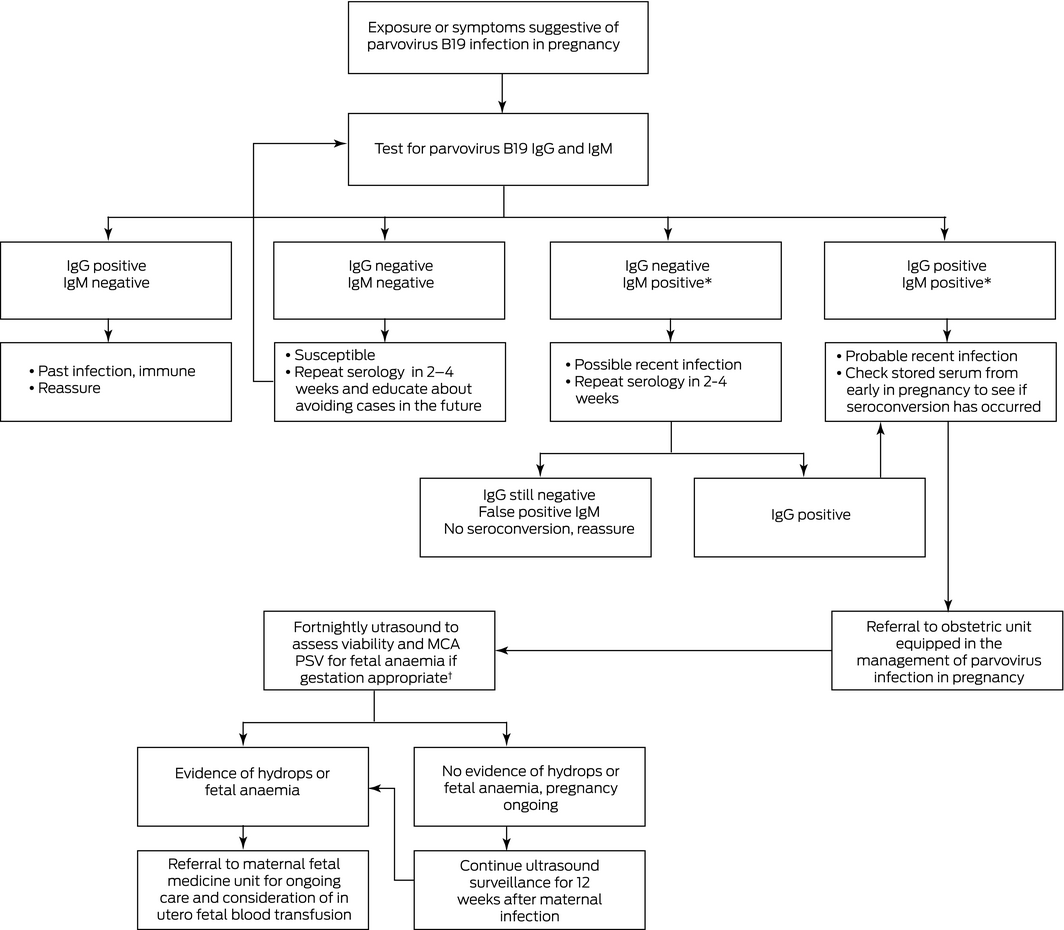
Transplacental infection occurs across the three trimesters, with greatest risk to the fetus earlier in the pregnancy.1,62 There is no intervention to prevent fetal infection. With proven maternal infection before 20 weeks of gestation, there is a 10% excess spontaneous pregnancy loss and a 3% chance of hydrops fetalis, for which monitoring should occur via a maternal fetal medicine unit.2,62 Fetal hydrops may be due to fetal anaemia or cardiomyopathy, mediated by P antigen expressed on fetal cardiomyocytes and erythrocytes.63,64,65,66 Assessment of the middle cerebral artery using Doppler ultrasound to determine peak systolic velocity and fetal blood sampling may be required to determine the need for fetal blood transfusion67 (Box 5).
Zika virus infection
The World Health Organization68 and the Centers for Disease Control and Prevention69 provide current advice on countries affected by Zika virus and travel. A mosquito vector (Aedes aegypti) is present in Australia, although no transmissions have occurred. The sexual transmission of Zika virus has been reported,70 and while after infection virus RNA is detectable in semen for up to 281 days, infectious viral shedding seems to be limited to the first few weeks.71 Zika virus infection symptoms include self‐limiting low grade fever, lethargy, headache, maculopapular rash, arthralgia, myalgia and conjunctivitis.72 Congenital Zika virus syndrome includes microcephaly; ventriculomegaly; abnormalities of thalami, brainstem, corpus callosum, vermis and eyes; and severe arthrogryposis.73 A meta‐analysis of antenatal Zika virus infection found a 0–10% rate of microcephaly.74 Significant neurodevelopmental problems can present after birth.75 There is no antiviral therapy at present, and specialist input should be sought for suspected cases.
Diagnosis is based on Zika virus IgM, seroconversion, or a fourfold rise in titre of Zika virus IgG.76,77 Cross‐reactivity of IgG (and less so IgM) to other flaviviruses, including Murray Valley encephalitis, Kunjin virus and others, which are endemic in Australia,78 is common and an important clinical history to include with laboratory requests. Providing details of dengue fever or vaccination for yellow fever or Japanese encephalitis, clinical symptoms and dates with respect to travel also assist when requesting serology.76,77 Sensitivity is imperfect and, thus, the advice to returned travellers wishing to become pregnant is to wait at least a month after return.79 Positive test results should be sent to reference laboratories for confirmation. Zika virus may be detected by PCR early in the first week of infection in blood (sensitivity 80–100%) and in urine for up to a month (sensitivity 12–60%).70,76,77
Syphilis
Syphilis is a treatable infection in pregnancy for which routine antenatal screening is recommended.2,3,80 Congenital syphilis can be prevented with penicillin treatment during pregnancy, reducing rates from around 5% to less than 0.6%.81 Neonates at risk of congenital syphilis (including those whose mothers have been treated during pregnancy) require urgent paediatric assessment and treatment.4 A syphilis outbreak predominantly affecting Indigenous young people in rural and remote areas of northern Australia has continued since 2011, with five neonatal deaths attributed to congenital syphilis (Box 4).82 New diagnoses of HIV, hepatitis B, hepatitis C, gonorrhoea and chlamydial infection are also more prevalent among Indigenous people.83
Listeriosis
Pregnant women have an increased risk of listeriosis and should receive preventive advice (Box 1).84,85,86 Listeriosis can be associated with fetal death (particularly if infection occurs before the third trimester), premature delivery, and neonatal infection.85,87 Four cases of congenital listeriosis, one of which was linked to contaminated rockmelon as well as one fetal loss, were reported in New South Wales in 2017.88 Maternal infection may present with fever, influenza‐like and gastrointestinal symptoms. Evaluation should include a recent dietary history and at least two sets of blood cultures, as a single set has a sensitivity of 50–60%.87 Further guidance may be found in the regularly updated guidelines of the Australasian Society for Infectious Diseases.2 Treatment is with intravenous ampicillin and gentamicin.2,85
Conclusion
Routine and risk‐based antenatal screening identifies some vertically transmissible infections that can be prevented or treated in pregnancy. Investigations that are not based on established screening recommendations or a defined plan of action may cause unnecessary anxiety and potentially harmful intervention. Prompt assessment and management can moderate adverse outcomes and reduce unnecessary intervention.
Box 1 – General advice to pregnant women to prevent infections*
|
Advice |
Details |
Reasoning |
|||||||||||||
|
|
|||||||||||||||
|
Protect from travel‐related infections |
Pre‐travel consultation for any travel when planning pregnancy or pregnant |
Prevention of infections, including Zika virus infection and toxoplasmosis |
|||||||||||||
|
Wash hands with soap and water or alcoholic hand rub |
Wash hands after:
|
Prevention of toxoplasmosis, listeriosis, salmonellosis |
|||||||||||||
|
Reduce contact with saliva and urine from babies and young children |
|
Prevention of CMV |
|||||||||||||
|
Avoid unpasteurised (raw) milk and derived foods |
Do not eat (unless pasteurised) soft cheese (eg, feta, Brie, queso fresco) |
Prevention of listeriosis |
|||||||||||||
|
Avoid unwashed or pre‐cut fruit and vegetables |
|
Prevention of listeriosis |
|||||||||||||
|
Do not touch or change dirty cat litter |
If necessary to change cat litter, wear gloves and wash hands afterwards |
Prevention of toxoplasmosis |
|||||||||||||
|
Practise safe sex |
|
Treatment and prevention of vertical STI transmission |
|||||||||||||
|
Talk to your health care provider about vaccinations |
Some vaccinations are recommended before pregnancy and some during pregnancy |
Live vaccines before pregnancy; whooping cough and influenza during pregnancy |
|||||||||||||
|
Avoid people who have an infection |
Avoid contact with people who are symptomatic |
Prevention of rubella, chickenpox, parvovirus B19 infection |
|||||||||||||
|
|
|||||||||||||||
|
CMV = cytomegalovirus; STI = sexually transmissible infection. * Adapted from the Centers for Disease Control and Prevention11 and NSW Food Authority.12 |
|||||||||||||||
Box 2 – Recommended routine antenatal screening for infections in Australia
|
Test |
Reasoning |
Action/amplifying comments |
|||||||||||||
|
|
|||||||||||||||
|
Rubella IgG status |
Antibody titre can decline after immunisation |
If non‐immune, give MMR vaccine ideally before pregnancy or wait until post partum* |
|||||||||||||
|
Hepatitis B serology |
Surface antigen to detect chronic carriers |
Chronic carriers of hepatitis B virus should have an assessment of their liver function and viral load (ie, HBV DNA level and HBeAg status) performed, and be referred for specialist support. If positive, administer hepatitis B immunoglobulin to infant at birth in addition to vaccine |
|||||||||||||
|
Hepatitis C serology† |
Interventions that increase the risk of transmission to the baby can be avoided, including fetal scalp blood sampling, internal electronic fetal scalp electrode |
Hepatitis C positive women should have an assessment of liver function and viral load (ie, HCV RNA PCR). Specialist support and post partum follow‐up and treatment are recommended |
|||||||||||||
|
Curative treatment can be offered post partum for chronically infected women identified by screening |
|||||||||||||||
|
HIV serology (Ab and Ag) |
Testing should be offered to all women regardless of risk factors |
HIV positive women are recommended to receive specialist support; antiretroviral therapy for the mother significantly reduces vertical transmission |
|||||||||||||
|
Syphilis serology |
Women at high risk should also be tested in the third trimester and at delivery in addition to initial assessment in pregnancy |
If positive on TPHA or TPPA, seek specialist support and treat with appropriate penicillin course. A postnatal paediatric review may be indicated |
|||||||||||||
|
Varicella IgG‡ |
Check varicella antibodies, ideally when planning pregnancy, when there is no definite history of chickenpox |
If non‐immune, give varicella vaccine before pregnancy (delaying conception one month after vaccination) or post partum if already pregnant. Vaccination is contraindicated in pregnancy* |
|||||||||||||
|
MCS urine |
Anatomical changes increase the risk of urinary tract infection and pregnancy complications |
Current guidelines suggest treating asymptomatic bacteriuria during pregnancy due to an increased risk of pyelonephritis and pre‐term labour |
|||||||||||||
|
HPV |
Cervical screening (HPV DNA testing) is recommended at the first antenatal visit for any woman whose regular screening, according to cervical screening guidelines, would fall during the pregnancy |
There is no evidence to suggest that cervical screening in pregnancy is harmful (a Cytobrush [CooperSurgical] should not be inserted into the cervix). If positive, referral for colposcopic examination should be made |
|||||||||||||
|
Chlamydial infection, gonorrhoea, trichomoniasis |
Transmission to neonate and maternal complications (eg, pelvic inflammatory disease) can occur |
Investigate high risk and symptomatic women |
|||||||||||||
|
|
|||||||||||||||
|
Ab = antibody; Ag = antigen; HBeAg = hepatitis B e antigen; HBV = hepatitis B virus; HCV = hepatitis C virus; HIV = human immunodeficiency virus; HPV = human papilloma virus; MCS = microscopy, culture and sensitivities; MMR = measles, mumps, rubella; PCR = polymerase chain reaction; TPHA = Treponema pallidum haemagglutination assay; TPPA = Treponema pallidum particle agglutination. * There is no evidence that inadvertent administration of live vaccines during pregnancy adversely affects the fetus and is therefore not an indication for termination. † With new, effective HCV treatments, known chronic carriers should be offered treatment before conception. ‡ Varicella testing is not mentioned in the recently published Pregnancy care guidelines,15 although it remains in the recent Royal Australian and New Zealand College of Obstetricians and Gynaecologists (RANZCOG) guidelines.16 NB: Routine screening for group B streptococcus at 35–37 weeks gestation with combination low vaginal with our without anorectal swab or a clinical risk factor‐based approach are both acceptable strategies dependent on local health jurisdiction practices. Table adapted from the Department of Health17 and RANZCOG.16 |
|||||||||||||||
Box 3 – Differential diagnosis and investigation of a symptomatic infective illness during pregnancy*
|
Presentation |
Possible diagnoses |
Tests |
|||||||||||||
|
|
|||||||||||||||
|
Influenza or glandular fever‐like illness (lethargy, fever, malaise, myalgia, with or without headache, with or without lymphadenopathy) |
|
|
|||||||||||||
|
Maculopapular rash with or without fever, with or without arthritis or arthralgia |
|
|
|||||||||||||
|
Vesicular rash |
|
|
|||||||||||||
|
Genitourinary symptoms (frequency, dysuria, genital ulcer, vaginal discharge) |
|
|
|||||||||||||
|
Intrapartum fever or fever in the setting of ruptured membranes or pre‐term labour |
|
|
|||||||||||||
|
|
|||||||||||||||
|
CMV = cytomegalovirus; PCR = polymerase chain reaction. * Adapted from Gilbert.1 |
|||||||||||||||
Box 4 – Incidence of congenital infection
|
Infection |
Incidence |
||||||||||||||
|
|
|||||||||||||||
|
|||||||||||||||
|
|||||||||||||||
|
|||||||||||||||
|
|||||||||||||||
|
|||||||||||||||
|
|||||||||||||||
|
Listeriosis2 |
|
||||||||||||||
|
|||||||||||||||
|
|||||||||||||||
|
|
|||||||||||||||
|
|
|||||||||||||||

Competing interests
No relevant disclosures.
References
- Gilbert GL. Infections in pregnant women. Med J Aust 2002; 176: 229–236. https://www.mja.com.au/journal/2002/176/5/1-infections-pregnant-women
- Palasanthiran P, Starr M, Jones C, Giles M; editors. Management of perinatal infections. Sydney: Australasian Society for Infectious Diseases, 2014. https://www.asid.net.au/documents/item/368 (viewed Nov 2018).
- Public Health Laboratory Network. Laboratory case definitions for diagnosis of communicable diseases. Canberra: Commonwealth of Australia, 2017. http://www.health.gov.au/internet/main/publishing.nsf/Content/Laboratory%2Bcase%2Bdefinitions-1 (viewed Nov 2018).
- Communicable Diseases Network Australia. CDNA national guidelines for public health units: syphilis. Canberra: Department of Health, 2015. http://www.health.gov.au/internet/main/publishing.nsf/content/B2ECD660086F7FCBCA257C94001BFB4B/$File/syphilis-SoNG2018.pdf (viewed Aug 2018).
- Royal Australian and New Zealand College of Obstetricians and Gynaecologists. Management of hepatitis C in pregnancy. RANZCOG, 2016. https://www.ranzcog.edu.au/RANZCOG_SITE/media/RANZCOG-MEDIA/Women's%20Health/Statement%20and%20guidelines/Clinical-Obstetrics/Maternal-Group-BStreptococcus-in-pregnancy-screening-andmanagement-(C-Obs-19)-Review-March-2016.pdf?ext=.pdf (viewed Sep 2018).
- Visvanathan K, Dusheiko G, Giles M, et al. Managing HBV in pregnancy. Prevention, prophylaxis, treatment and follow‐up: position paper produced by Australian, UK and New Zealand key opinion leaders. Gut 2016; 65: 340–350.
- Panel on Treatment of Pregnant Women with HIV Infection and Prevention of Perinatal Transmission. Recommendations for Use of Antiretroviral Drugs in Transmission in the United States. AIDSinfo, 2018. http://aidsinfo.nih.gov/contentfiles/lvguidelines/PerinatalGL.pdf (viewed May 2018).
- Royal Australian and New Zealand College of Obstetricians and Gynaecologists. Maternal group B streptococcus in pregnancy: screening and management. RANZCOG, 2016. https://www.ranzcog.edu.au/RANZCOG_SITE/media/RANZCOG-MEDIA/Women's%20Health/Statement%20and%20guidelines/Clinical-Obstetrics/Maternal-Group-B-Streptococcus-in-pregnancy-screening-and-management-(C-Obs-19)-Review-March-2016.pdf?ext=.pdf (viewed June 2018).
- Loto OM, Awowole I. Tuberculosis in pregnancy: a review. J Pregnancy 2012; 2012: 379271.
- Gilbert GL, Hewitt MC, Turner CM, Leeder SR. Epidemiology and predictive values of risk factors for neonatal group B streptococcal sepsis. Aust N Z J Obstet Gynaecol 2002; 42: 497–503.
- Centers for Disease Control and Prevention. 10 tips for preventing infections before and during pregnancy. Atlanta: CDC, 2018. https://www.cdc.gov/pregnancy/infections.html (viewed July 2018).
- NSW Food Authority. Foods to eat or avoid when pregnant. Sydney: NSW Food Authority, 2016. http://www.foodauthority.nsw.gov.au/foodsafetyandyou/life-events-and-food/pregnancy/foods-to-eat-or-avoid-when-pregnant (viewed Nov 2018).
- Royal Women's Hospital. Health information: A–Z facts. [website]. https://www.thewomens.org.au/health-information/fact-sheets (viewed May 2019).
- Mercy Hospital for Women. Planning your pregnancy [website]. https://mercyperinatal.com/for-patients-and-families/planning-your-pregnancy (viewed May 2019).
- Department of Health. Pregnancy care guidelines. Canberra: Commonwealth of Australia, 2018. https://beta.health.gov.au/resources/pregnancy-care-guidelines (viewed Nov 2018).
- Royal Australian and New Zealand College of Obstetricians and Gynaecologists. Routine antenatal assessment in the absence of pregnancy complications. RANZCOG, 2016. https://www.ranzcog.edu.au/RANZCOG_SITE/media/RANZCOG-MEDIA/Women%27s%20Health/Statement%20and%20guidelines/Clinical-Obstetrics/Routine-Antenatal-Assessment-(C-Obs-3(b))-Review-July-2016.pdf?ext=.pdf (viewed Nov 2018).
- Department of Health. Clinical practice guidelines: pregnancy care. Canberra: Commonwealth of Australia, 2018. https://beta.health.gov.au/resources/publications/pregnancy-care-guidelines (viewed Nov 2018).
- Australian Technical Advisory Group on Immunisation. Australian immunisation handbook. Canberra: Commonwealth of Australia, 2018. https://Immunisationhandbook.health.gov.au (viewed Oct 2018).
- Royal Australian and New Zealand College of Obstetricians and Gynaecologists. Influenza vaccination during pregnancy (and in women planning pregnancy). RANZCOG, 2017. https://www.ranzcog.edu.au/RANZCOG_SITE/media/RANZCOG-MEDIA/Women%27s%20Health/Statement%20and%20guidelines/Clinical-Obstetrics/Influenza-vaccination-in-pregnancy-(C-Obs-45)-Review-March-2017.pdf?ext=.pdf (viewed May 2018).
- National Health and Medical Research Council. Clinical practice guidelines: pregnancy care. Canberra: NHMRC; 2018. https://www.clinicalguidelines.gov.au/portal/2589/clinical-practice-guidelines-pregnancy-care-2018-edition (viewed Oct 2018).
- Gilbert GL. Infectious diseases in pregnancy and newborn infant. Switzerland: Harwood Academic Publications, 1991.
- Naing ZW, Scott GM, Shand A, et al. Congenital cytomegalovirus infection in pregnancy: a review of prevalence, clinical features, diagnosis and prevention. Aust N Z J Obstet Gynaecol 2016; 56: 9–18.
- Rawlinson WD, Boppana SB, Fowler KB, et al. Congenital cytomegalovirus infection in pregnancy and the neonate: consensus recommendations for prevention, diagnosis, and therapy. Lancet Infect Dis 2017; 17: e177–e188.
- Bright A, Dups J. Infectious and congenital syphilis notifications associated with an ongoing outbreak in northern Australia. Commun Dis Intell Q Rep 2016; 40: E7–E10.
- Ward JS, Guy RJ, Arke SP, et al. Epidemiology of syphilis in Australia: moving toward elimination of infectious syphilis from remote Aboriginal and Torres Strait Islander communities? Med J Aust 2011; 194: 525–529. https://www.mja.com.au/journal/2011/194/10/epidemiology-syphilis-australia-moving-toward-elimination-infectious-syphilis.
- Berrebi A, Assouline C, Bessieres MH, et al. Long‐term outcome of children with congenital toxoplasmosis. Am J Obstet Gynecol 2010. 203: 552.e1–e6.
- Bessieres MH, Berrebi A, Rolland M, et al. Neonatal screening for congenital toxoplasmosis in a cohort of 165 women infected during pregnancy and influence of in utero treatment on the results of neonatal tests. Eur J Obstet Gynecol Reprod Biol 2001; 94: 37–45.
- Chaudhry SA, Gad N, Koren G. Toxoplasmosis and pregnancy. Can Fam Physician 2014; 60: 334–336.
- Jayamaha JC, Robertson P, Rawlinson WD. Congenital toxoplasmosis over 10 years in a low‐incidence population. Med J Aust 2012; 196: 443–444. https://www.mja.com.au/journal/2012/196/7/congenital-toxoplasmosis-over-10-years-low-incidence-population
- Thiebaut R, Leproust S, Chene G, Gilber T; Syrocot Study Group. Effectiveness of prenatal treatment for congenital toxoplasmosis: a meta‐analysis of individual patients’ data. Lancet 2007; 369: 115–122.
- Deverell M, Phu A, Zurynski Y, Elliott E. Australian Paediatric Surveillance Unit annual report, 2016. Commun Dis Intell Q Rep 2017; 41: E288–E293. http://www.health.gov.au/internet/main/publishing.nsf/Content/72090ED4D53F6ED8CA2581FD00198DE8/$File/CDI4103-n.pdf (viewed Nov 2018).
- Westhoff GL, Little SE, Caughey AB. Herpes simplex virus and pregnancy: a review of the management of antenatal and peripartum herpes infections. Obstet Gynecol Surv 2011; 66: 629–638.
- Straface G, Selmin A, Zanardo V, et al. Herpes simplex virus infection in pregnancy. Infect Dis Obstet Gynecol 2012; 2012: 385697.
- Sintchenko V, Field PR, Gilbert GL. Rubella antibody in antenatal clinic patients. Aust N Z J Med 1999; 29: 284–285.
- Trotta M, Borchi B, Niccolai A, et al. Epidemiology, management and outcome of varicella in pregnancy: a 20‐year experience at the Tuscany Reference Centre for Infectious Diseases in Pregnancy. Infection 2018; 46: 693–699.
- Tan HF, Chang CK, Tseng HF, Lin W. Evaluation of the National Notifiable Disease Surveillance System in Taiwan: an example of varicella reporting. Vaccine 2007; 25: 2630–2633.
- Pinninti SG, Kimberlin DW. Management of neonatal herpes simplex virus infection and exposure. Arch Dis Child Fetal Neonatal Ed 2014; 99: F240–F244.
- Kelly HA, Siebert D, Hammond R, et al. The age‐specific prevalence of human parvovirus immunity in Victoria, Australia compared with other parts of the world. Epidemiol Infect 2000; 124: 449–457.
- Wong SF, Chan FY, Cincotta RB, Tilse M. Human parvovirus B19 infection in pregnancy: should screening be offered to the low risk population? Aust N Z J Obstet Gynaecol 2002; 42: 347–351.
- Lamont RF, Sobel JD, Valsbuch E, et al. Parvovirus B19 infection in human pregnancy. BJOG 2011; 118: 175–186.
- Pomar L, Malinger G, Benoist G, et al. Association between Zika virus and fetopathy: a prospective cohort study in French Guiana. Ultrasound Obstet Gynaecol 2017; 49: 729–736.
- Leruez‐Ville M, Ville Y. Fetal cytomegalovirus infection. Best Pract Res Clin Obstet Gynaecol 2017; 38: 97–107.
- Hui L, Wood G. Perinatal outcome after maternal primary cytomegalovirus infection in the first trimester: a practical update and counseling aid. Prenat Diagn 2015; 35: 1–7.
- Hughes BL, Gyamfi‐Bannerman C; Society for Maternal–Fetal Medicine. Diagnosis and antenatal management of congenital cytomegalovirus infection. Am J Obstet Gynecol 2016; 214: B5–B11.
- Kagan KO, Hamprecht K. Cytomegalovirus infection in pregnancy. Arch Gynecol Obstet 2017; 296: 15–26.
- Bartlett AW, McMullan B, Rawlinson WD, Palansanthiran P. Hearing and neurodevelopmental outcomes for children with asymptomatic congenital cytomegalovirus infection: a systematic review. Rev Med Virol 2017. https://doi.org/10.1002/rmv.1938. [Epub ahead of print]
- Goderis J, De Leenheer E, Smets K, et al. Hearing loss and congenital CMV infection: a systematic review. Pediatrics 2014; 134: 972–982.
- Robert‐Gangneux F. It is not only the cat that did it: how to prevent and treat congenital toxoplasmosis. J Infect 2014; 68 (Suppl): S125–S133.
- Karunajeewa H, Siebert D, Hammond R, et al. Seroprevalence of varicella zoster virus, parvovirus B19 and Toxoplasma gondii in a Melbourne obstetric population: implications for management. Aust N Z J Obstet Gynaecol 2001; 41: 23–28.
- Pappas G, Roussos N, Falagas ME. Toxoplasmosis snapshots: global status of Toxoplasma gondii seroprevalence and implications for pregnancy and congenital toxoplasmosis. Int J Parasitol 2009; 39: 1385–1394.
- Paquet C, Trois‐Rivieres QC, Yudin MH; Society of Obstetricians and Gynaecologists of Canada. Toxoplasmosis in pregnancy: prevention, screening, and treatment. J Obstet Gynaecol Can 2013; 35: 78–81.
- Pomares C, Montoya JG. Laboratory diagnosis of congenital toxoplasmosis. J Clin Microbiol 2016; 54: 2448–2454.
- Faucher B, Garcia‐Meric P, Franck J, et al. Long‐term ocular outcome in congenital toxoplasmosis: a prospective cohort of treated children. J Infec 2012; 64: 104–109.
- Salviz M, Montoya JG, Nadol JB, Satnos F. Otopathology in congenital toxoplasmosis. Otol Neurotol 2013; 34: 1165–1169.
- de Oliveira Azevedo CT, do Brasil PE, Guida L, Lopes Moreira ME. Performance of polymerase chain reaction analysis of the amniotic fluid of pregnant women for diagnosis of congenital toxoplasmosis: a systematic review and meta‐analysis. PLoS ONE 2016; 11: 0149938.
- Gras L, Wallon M, Pollak A, Cortina‐Borja M, et al. Association between prenatal treatment and clinical manifestations of congenital toxoplasmosis in infancy: a cohort study in 13 European centres. Acta Paediatr 2005; 94: 1721–1731.
- National Notifiable Diseases Surveillance System. Number of notifications of rubella congenital, received from state and territory health authorities in the period of 1991 to 2017 and year‐to‐date notifications for 2018. Canberra: Commonwealth of Australia, 2018. http://www9.health.gov.au/cda/source/rpt_4.cfm (viewed Apr 2018).
- LeBaron CW, Forghani B, Beck C, et al. Persistence of mumps antibodies after 2 doses of measles‐mumps‐rubella vaccine. J Infect Dis 2009; 199: 552–560.
- Best JM. Rubella. Semin Fetal Neonatal Med 2007; 12: 182–192.
- Cradock‐Watson JE, Ridehalgh MK, Anderson MJ, Pattison JR. Outcome of asymptomatic infection with rubella virus during pregnancy. J Hyg (Lond) 1981; 87: 147–154.
- Ahn KH, Park YJ, Hong SC, et al. Congenital varicella syndrome: a systematic review. J Obstet Gynaecol 2016; 36: 563–566.
- Gilbert GL. Parvovirus B19 infection and its significance in pregnancy. Commun Dis Intell 2000; 24 (Suppl): 69–71.
- Bascietto F, Liberati M, Murgano D, et al. Outcome of fetuses with congenital parvovirus B19 infection: systematic review and meta‐analysis. Ultrasound Obstet Gynecol 2018; 52: 569–576.
- Enders M, Klingel K, Weidner A, et al. Risk of fetal hydrops and non‐hydropic late intrauterine fetal death after gestational parvovirus B19 infection. J Clin Virol 2010; 49: 163–168.
- Verduin EP, Lindenburg IT, Smits‐Wintiens VE, et al. Long‐term follow up after intra‐uterine transfusions; the LOTUS study. BMC Pregnancy Childbirth 2010; 10: 77–84.
- Giorgio E, De Oronzo MA, Iozza I, et al. Parvovirus B19 during pregnancy: a review. J Prenat Med 2010; 4: 63–66.
- Rodis JF, Borgida AF, Wilson M, et al. Management of parvovirus infection in pregnancy and outcomes of hydrops: a survey of members of the Society of Perinatal Obstetricians. Am J Obstet Gynecol 1998; 179: 985–988.
- World Health Organization. Information for travellers vising Zika affected countries. WHO, 2017. https://www.who.int/csr/disease/zika/information-for-travelers/en (viewed Oct 2018).
- Centers for Disease Control and Prevention. Zika travel information. CDC, 2019. https://wwwnc.cdc.gov/travel/page/zika-travel-information (viewed May 2019).
- Paz‐Bailey G, Rosenberg ES, Doyle K, et al. Persistence of Zika virus in body fluids — preliminary report. N Engl J Med 2017; 379: 1234–1243.
- Mead PS, Duggal NK, Hook SA, et al. Zika virus shedding in semen of symptomatic infected men. N Engl J Med 2018; 378: 1377–1385.
- Brasil P, Pereira JP, Moreira ME, et al. Zika virus infection in pregnant women in Rio de Janeiro. N Engl J Med 2016; 375: 2321–2334.
- Alvarado‐Socarras JL, Idrovo AJ, Contreras‐Garcia GA. Congenital microcephaly: a diagnostic challenge during Zika epidemics. Travel Med Infect Dis 2018; 23: 14–20.
- Coelho AV, Crovella S. Microcephaly prevalence in infants born to Zika virus‐infected women: a systematic review and meta‐analysis. Int J Mol Sci 2017; 18: 1714–1724.
- Reynolds MR, Jones AM, Petersen EE, et al. Vital signs: update on Zika virus‐associated birth defects and evaluation of all US infants with congenital Zika virus exposure — US Zika Pregnancy Registry, 2016. MMWR Morb Mortal Wkly Rep 2017; 66: 366–373.
- Singh RK, Dhama K, Karthik K, et al. Advances in diagnosis, surveillance, and monitoring of Zika virus: an update. Front Microbiol 2017; 8: 2677.
- Basile K, Kok J, Dwyer DE. Zika virus: what, where from and where to? Pathology 2017; 49: 698–706.
- Hawkes RA, Pamplin J, Boughton CR, Naim HM. Arbovirus infections of humans in high‐risk areas of south‐eastern Australia: a continuing study. Med J Aust 1993; 159: 159–162.
- Department of Health. Zika virus — information for clinicians and public health practitioners: advice to travellers. Canberra: Commonwealth of Australia, 2018. http://www.health.gov.au/internet/main/publishing.nsf/content/ohp-zika-health-practitioners.htm#travellers (viewed July 2018).
- Morshed MG, Singh AE. Recent trends in the serologic diagnosis of syphilis. Clin Vaccine Immunol 2015; 22: 137–147.
- Hong FC, Wu XB, Yang F, et al. Risk of congenital syphilis (CS) following treatment of maternal syphilis: results of a CS control program in China. Clin Infect Dis 2017; 65: 588–594.
- Multijurisdicional Syphilis Outbreak Working Group (MJSO) of the Communicable Diseases Network of Australia. Infectious syphilis outbreak. Canberra: Commonwealth of Australia, 2018. http://www.health.gov.au/internet/main/publishing.nsf/Content/ohp-infectious-syphilis-outbreak.htm (viewed May 2018).
- Jamil MS, Gunaratnam P, McManus H, et al. HIV, viral hepatitis and sexually transmissible infections in Australia: annual surveillance report 2017. Sydney: Kirby, 2017 https://kirby.unsw.edu.au/sites/default/files/kirby/report/SERP_Annual-Surveillance-Report-2017_compressed.pdf (viewed May 2018).
- Goulet V, Hebert M, Hedbert C, et al. Incidence of listeriosis and related mortality among groups at risk of acquiring listeriosis. Clin Infect Dis 2012; 54: 652–660.
- Madjunkov M, Chaudhry S, Ito S. Listeriosis during pregnancy. Arch Gynecol Obstet 2017; 296: 143–152.
- Pouillot R, Hoelzer K, Jackson KA, et al. Relative risk of listeriosis in Foodborne Diseases Active Surveillance Network (FoodNet) sites according to age, pregnancy, and ethnicity. Clin Infect Dis 2012; 54 (Suppl): S405–S410.
- Charlier C, Perrodeau E, Leclercq A. Clinical features and prognostic factors of listeriosis: the MONALISA national prospective cohort study. Lancet Infect Dis 2017; 17: 510–519.
- NSW Department of Primary Industries. Listeria outbreak investigation: summary report for the melon industry; October 2018. Sydney: NSW DPI, 2018. http://www.foodauthority.nsw.gov.au/_Documents/foodsafetyandyou/listeria_outbreak_investigation.pdf (viewed Nov 2018).
Provenance: Commissioned; externally peer reviewed.
Forty Years in the Making: Reporting on the Co-Creation of a National Roadmap for Birthing on Country Services for the Best Start to Life
Res McCalman, Anneka J. Bowman, Roianne West, Kristie Watego, Jyai Allen, Claire Clack, Sue Kildea, Sue Kruske, Melanie Briggs, Cleone Wellington, Rebecca Coddington, Yu Gao, Isabella Garti, Sascha Kowalenko, Sarah Ireland, Catherine Austin, John D. Boffa, Marah Prior, Kelsie Kahl, Bettina Chaseling, Sarah Khaw, Emily Armstrong, Donna Hartz, Yvette Roe
Temporal Trends in Preterm Birth Associated With Hypertensive Disorders of Pregnancy in Victoria, Australia: A Population-Based Interrupted Time-Series Study
Melvin Marzan, Heng Jiang, Daniel Lorber Rolnik, Joanne M. Said, Lisa Hui
Linguistic Manoeuvres: Obstetric Violence Camouflages Harm and Loss of Consent From Birth
Liz Sutton, Harsha Ananthram, Rebecca Matthews
Linguistic Manoeuvres: Obstetric Violence Camouflages Harm and Loss of Consent From Birth
Bashi Kumar-Hazard, Andrew M. Bisits, Sharon L. Settecasse, Jenny Gamble, Hazel Keedle, Hannah G. Dahlen
Linguistic Manoeuvres: Obstetric Violence Camouflages Harm and Loss of Consent From Birth
Wendy Pollock, Alissa Fleming, Ensieh Fooladi, Joy Kloester, Anne Tremayne, Yasmin Zisin, Bethany Carr, Kym Davey, Suzanne Willey, Jenny Gamble
Getting on the Same Page: Why Australia Needs a National Maternity Early Warning System (MEWS) Chart
Briony A. Cutts, Lucy Bowyer, Nisha Khot, Sandra Lowe, Stefan C. Kane