




Volume 211 - Issue 2
From locum‐led outposts to locally led continuous rural training networks: the National Rural Generalist Pathway
Authors: Paul S Worley, Belinda O'Sullivan and Rose Ellis
Med J Aust 2019; 211 (2): 57-59.e1. || doi: 10.5694/mja2.50225
Published online: 8 July 2019
Published online: 8 July 2019
Training doctors through regional teaching health service networks may help deliver sustainable high quality health care closer to home for rural Australians
Training doctors through regional teaching health service networks may help deliver sustainable high quality health care closer to home for rural Australians
The principle of universal health coverage is passionately espoused by the global community and linked to developing the right workforce, with the right skills, in the right place.1,2 But Australia has already achieved this through Medicare and state‐funded hospitals which can deliver higher than average life expectancy and minimise maternal and neonatal morbidity. Right? Wrong!
We may have universal health insurance and world class hospitals, but without a health workforce that is appropriately skilled and distributed for equitable access in rural areas, universal health care is not a reality in our country. A pervasive, elusive problem, hidden within the use of averages in Australian health statistics, is that there is inequity of access to health care in many of Australia's rural communities and for many Aboriginal and Torres Strait Islander Australians. This underlies real disparities in health outcomes for these communities.3 This problem is significantly impeding progress on national health goals and reinforcing an unrelenting gap in social and economic opportunities for many rural communities.
In response, Australia's first Rural Health Commissioner was appointed by Parliament in 2017.4 The Commissioner will provide advice on broad‐scale solutions in rural health care, working with rural communities, all levels of government, and the rural health sector. The first task is to develop the National Rural Generalist Pathway — a training program to produce more rural generalist doctors, skilled in providing comprehensive and high quality medical care specific to the needs of rural and remote Australians (Box 1).
To understand the rationale for the National Rural Generalist Pathway, let us consider the rural health service as a patient.
Symptoms
Our “patient” recounts that they feel unstable, significantly impeding their productivity and satisfaction.5 There can be a crisis when a doctor is ill, needs a break, retires or moves. Consequently, our patient depends on short term, costly locums. This affects their ability to plan, achieve stable high quality multidisciplinary teams, and invest in areas of broader community need. This results in people missing out on health care, using regular aeromedical retrievals,6,7 and travelling, usually at great cost, particularly for managing longstanding chronic illnesses.8 This engenders a norm of no or late presentation and disrupted, discontinuous health care.
Signs
Examination of our patient demonstrates a significant disparity in health outcomes compared with health service outcomes in the cities.9,10 In particular, people who cannot afford ongoing travel and accommodation, time away from local self‐employed businesses, and who want to be treated “on country” and “in community” are likely to miss out.10 There is a confirmed maldistribution of the medical workforce.11 Rural doctors and their families are under strain. Higher doctor turnover in communities with populations of less than 15 00012 locks many smaller rural communities out of social and economic growth.
Medical history
Reviewing the notes reveals a number of previous diagnoses for our patient, including “graduateopenia” and rural “studentopenia”. However, these are not explanatory given the recent exponential growth in domestic medical students, many with rural backgrounds, wanting to join the rural medical community. There is also evidence that various governments have made well intentioned changes, but the challenge of integrating these interventions might contribute to the persistent malaise.11
Further investigations
To better understand the patient's medical history, we investigated with more recent tests.13 These show that rural general practitioner numbers have increased, ruling out “aGPosis” (relative absence of GPs) as a cause. Likewise, regional specialist hubs, outreach and telemedicine services are building regionally networked professional opportunities.14
Our assessment
Despite multiple symptomatic treatments, the underlying pathology has remained untouched. It is as if our patient has had treatment for their hypertension, thus preventing a stroke (abrupt closure of health service), but these treatments have not prevented the development of chronic renal failure. Our patient now relies on “dialysis” — the advice and care of benevolent and well intentioned city‐based systems, locum services and overseas‐trained doctors. Our patient is deeply grateful for this dialysis, but is sure that there is a better way.
Although rural training opportunities have increased, rural communities are often being used as rotational outposts from city centres.15 This is not developing skilled rural doctors who can work across the range of comprehensive primary care and other care areas that rural communities need. It is not facilitating the trainee's connection to place, particularly at a time when they are setting up their lives and their families. It produces exactly what its design would suggest — city‐focused subspecialists, unsuited to the breadth of specialist skills required for rural practice.16,17
One of the key underlying pathological processes that has not been addressed is the locus of control. It is time for rural communities to lead their own workforce production for doctors and other health professionals who are highly effective in their context.
Management plan
Evidence‐based treatment options that treat the pathology are readily available. These include communities being involved in longer term and distributed basic and vocational medical education in their region, and recruiting students with experience and connections to regions.18,19,20,21
With improvements in transport and communications, smaller rural communities now have stronger links with regional centres and there is the potential for clinical, teaching and research networks of significant scale. Contemporary learning theories show that rural networks enable relationship‐based, meaningful clinical learning that has many advantages over learning in high throughput large hospital environments.22
High quality clinical learning requires not just knowledge but also the development of wisdom, passed down through supervision and imprinted by relevant patient interactions within a context. Regionally networked training, with generalist supervision, produces strong and skilled clinicians who practise safe, community‐ and patient‐oriented medicine.23,24
National Rural Generalist Pathway
The National Rural Generalist Pathway is a training and workforce framework which can provide a return on previous government investments in rural clinical and regional medical schools and regional GP training organisations, regional training hubs and existing rural doctors.
The Pathway can deliver rural‐based training in regionally networked rural teaching health services. This would strengthen the articulation between all stages of medical education — medical school, pre‐vocational and vocational training, and continuing professional development (Box 2). Multiple exit and entry points are possible. In‐reach to regional and metropolitan centres for particular skills training or upskilling can be a part of the Pathway where needed.
Based in rural communities that need rural generalists, the Pathway can enable students, junior doctors and registrars to call rural communities home for their entire training. A rural base and a training position with secure funding are critical for allowing doctors to settle and connect with other rural people. The continuous training pathway alone has the potential to contribute at least a decade of immediate economic value to rural communities for each doctor trained.
Rural generalist‐based medical services
The leaders of the Royal Australian College of General Practitioners and the Australian College of Rural and Remote Medicine demonstrated considerable professional statesmanship when they agreed on the training outcomes for a rural generalist via the historic Collingrove Agreement (http://www.acrrm.org.au/rsrc/documents/misc/the-collingrove-agreement.pdf), which provides the National Rural Generalist Pathway with the necessary educational goalposts (Box 1). As an educational framework, it also provides a basis for considering recognition of prior learning and lateral entry options into rural generalist practice.
The Collingrove Agreement articulates how a rural generalist bridges the siloes of primary, secondary and tertiary care. The Pathway can therefore be a conduit for meeting the growing demand for coordinated care for rural people, including comprehensive primary care, psychiatry, palliative care, indigenous health and aged care services, as well as for maintaining high quality rural services in areas like obstetrics, anaesthetics and surgery. Close collaboration with relevant other specialty colleges will help to achieve the right fit of generalist training to complement regional non‐GP specialists.
The adaptable skills of rural generalists mean they can move around and work in different ways. Their model of work is both cost‐effective for patients and rural health services, adjustable to practitioner interests, and sustainable in various sized communities. The Pathway can contribute to a better‐distributed rural medical workforce and more rural generalists to ensure more sustainable workloads, thereby improving retention. This may re‐invigorate local entrepreneurship and innovation in rural primary care. Also, by building these services closer to communities, bed block in regional centres and urban hospitals may be alleviated. We need great GPs. We need other great rural specialists. Atop of this, rural Australia needs great rural generalists.
Conclusion
Australia faces the dual dilemma of persistent health inequalities for its rural citizens and oversupply of city‐based specialties. The current medical education system, focused on metropolitan tertiary hospitals, means that rural communities need to rely on a downstream trickle of doctors. We can learn from the success of urban teaching hospitals and intentionally re‐imagine our rural health services as locally led continuous rural teaching health service networks, developing their own doctors, creating relevant evidence for best practice, and producing high quality, cost‐effective and sustainable health care. A National Rural Generalist Pathway is good for rural communities. Healthy rural communities are productive rural communities. Productive rural communities are great for our nation as a whole.
Box 1 – Collingrove Agreement*
A rural generalist “is a medical practitioner who is trained to meet the specific current and future health care needs of Australian rural and remote communities, in a sustainable and cost‐effective way, by providing both comprehensive general practice and emergency care, and required components of other medical specialist care in hospital and community settings as part of a rural health care team”.*http://www.acrrm.org.au/rsrc/documents/misc/the-collingrove-agreement.pdfBox 2 – National Rural Generalist Pathway*
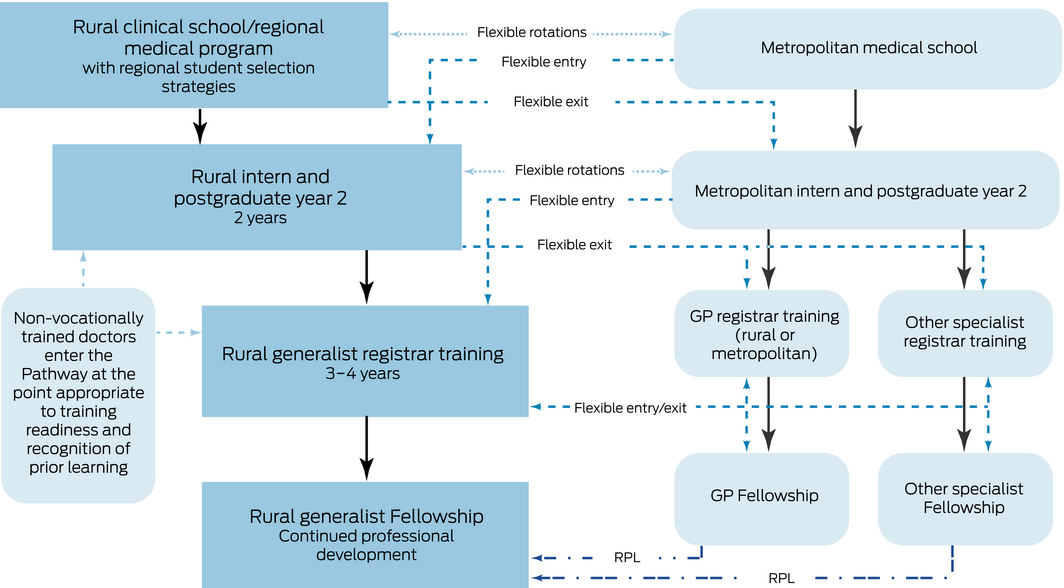
GP = general practitioner. RPL = recognition of prior learning. *The dark blue boxes depict the four stages of the National Rural Generalist Pathway. Timeframes vary by full or part time training and achievement of entrustable professional activities. The Pathway allows for flexible entry and exit and rotations to metropolitan sites for training as required. Current rural training capacity varies by jurisdiction and more rural training capacity will be built over time. Prospective rural generalists may join the Pathway at any stage, appropriate to training readiness and RPL.
Competing interests
Paul Worley is the National Rural Health Commissioner, and Belinda O'Sullivan and Rose Ellis are employed in the Office of the National Rural Health Commissioner. The National Rural Health Commissioner is an independent statutory officer. The views expressed in this article are those of the authors and do not represent an official position of the Commonwealth Department of Health or the Australian Government.
References
- World Health Organization. Universal health coverage. http://www.who.int/universal_health_coverage/en/ (viewed Oct 2018).
- World Health Organization. Increasing access to health workers in remote and rural areas through improved retention: global policy recommendations. Geneva: WHO, 2010. http://apps.who.int/iris/bitstream/10665/44369/1/9789241564014_eng.pdf (viewed July 2017).
- Australian Institute of Health and Welfare. Rural and remote health. https://www.aihw.gov.au/reports/rural-health/rural-remote-health/contents/rural-health (viewed Oct 2018).
- House of Representatives. Health Insurance Amendment (Rural Health Commissioner) Bill 2017. Canberra: Parliament of the Commonwealth of Australia, 2017. http://parlinfo.aph.gov.au/parlInfo/download/legislation/bills/r5796_aspassed/toc_pdf/17004b01.pdf (viewed Oct 2018).
- Worley P. Always one doctor away from a crisis! Rural Remote Health 2004; 4: 317.
- Garne D, Perkins D, Boreland F, Lyle D. Frequent users of the Royal Flying Doctor Service primary clinic and aeromedical services in remote New South Wales: a quality study. Med J Aust 2009; 191: 602–604. https://www.mja.com.au/journal/2009/191/11/frequent-users-royal-flying-doctor-service-primary-clinic-and-aeromedical
- Peiris D, Wirtanen C, Hall J. Aeromedical evacuations from an east Arnhem Land community 2003‐2005: the impact on a primary health care centre. Aust J Rural Health 2006; 14: 270–274.
- Rankin SL, Hughes‐Anderson W, House AK, et al. Costs of accessing surgical specialists by rural and remote residents. ANZ J Surg 2001; 71: 544–547.
- Australian Institute of Health and Welfare. Rural, regional and remote health: indicators of health status and determinants of health (Cat. No. PHE 97; Rural Health Series No. 9). Canberra: AIHW, 2008. https://www.aihw.gov.au/reports/rural-remote-australians/rural-regional-remote-health-indicators/contents/table-of-contents (viewed Oct 2018).
- Kildea SKS, Barclay L, Tracy S. ‘Closing the Gap’: how maternity services can contribute to reducing poor maternal infant health outcomes for Aboriginal and Torres Strait Islander women. Rural Remote Health 2010; 10: 1383.
- Walters LK, McGrail MR, Carson DB, et al. Where to next for rural general practice policy and research in Australia? Med J Aust 2017; 207: 56–58. https://www.mja.com.au/journal/2017/207/2/where-next-rural-general-practice-policy-and-research-australia
- McGrail MR, Humphreys JS. Geographical mobility of general practitioners in rural Australia. Med J Aust 2015; 203: 92–97. https://www.mja.com.au/journal/2015/203/2/geographical-mobility-general-practitioners-rural-australia
- Mason J. Review of Australian government health workforce programs. Canberra: Department of Health and Ageing, 2013. https://www.health.gov.au/internet/main/publishing.nsf/Content/D26858F4B68834EACA257BF0001A8DDC/$File/Review%20of%20Health%20Workforce%20programs.pdf (viewed Oct 2018).
- O'Sullivan BG, Stoelwinder JU, McGrail MR. Specialist outreach services in regional and remote Australia: key drivers and policy implications. Med J Aust 2017; 207: 98–99. https://www.mja.com.au/journal/2017/207/3/specialist-outreach-services-regional-and-remote-australia-key-drivers-and
- O'Sullivan BG, McGrail MR, Russell D, et al. A review of characteristics and outcomes of Australia's undergraduate medical education rural immersion programs. Hum Res Health 2018; 16: 1–10.
- Strasser RP. Will Australia have a fit‐for‐purpose medical workforce in 2025? Med J Aust 2018; 208: 198–199. https://www.mja.com.au/journal/2018/208/5/will-australia-have-fit-purpose-medical-workforce-2025.
- McGrail MR, Russell DJ. Australia's rural medical workforce: supply from its medical schools against career stage, gender and rural‐origin. Aust J Rural Health 2017; 25: 298–305.
- O'Sullivan B, McGrail M, Russell D, et al. Duration and setting of rural immersion during the medical degree relates to rural work outcomes. Med Educ 2018; 52: 803–815.
- McGrail MR, Russell DJ, Campbell DG. Vocational training of general practitioners in rural locations is critical for Australian rural medical workforce supply. Med J Aust 2016; 205: 216–221. https://www.mja.com.au/journal/2016/205/5/vocational-training-general-practitioners-rural-locations-critical-australian.
- Strasser R. Delivering on social accountability: Canada's Northern Ontario School of Medicine. Asia Pacific Scholar 2016; 1: 2–7.
- McGrail M, O'Sullivan B, Russell D. Rural training pathways: the return rate of doctors to work in the same region as their basic medical training. Hum Res Health 2018; 16: 56.
- Walters L, Greenhill J, Richards J, et al. Outcomes of longitudinal integrated clinical placements for students, clinicians and society. Med Educ 2012; 46: 1028–1041.
- Worley P, Strasser R, Prideaux D. Can medical students learn specialist disciplines based in rural practice: lessons from students’ self reported experience and competence. Rural Remote Health 2004; 4: 338.
- Campbell AM, Brown J, Simon DR, et al. Leading the rebirth of the rural obstetrician. Med J Aust 2014; 201: 667–670. https://www.mja.com.au/journal/2014/201/11/leading-rebirth-rural-obstetrician.
Linked content
-
MJA Podcast: Emeritus Professor Paul Worley
-
InSight+: National Rural Generalist Pathway a lifeline for general practice
Provenance: Commissioned; externally peer reviewed.
Shifting focus to adolescent wellbeing and inclusive participation in the digital age
Allyson R Todd, Elena Wang, Stephanie R Partridge
The clinical presentation, investigation, and management of women diagnosed with endometriosis in Australian general practices, 2011–2021: an open cohort study
Danielle Mazza, Kailash Thapaliya, Sharinne B Crawford, Alissia Hui, Maryam Moradi, Luke E Grzeskowiak
The impact of the Breast Screen NSW transition from film to digital mammography, 2002–2016: a linked population health data analysis
Rachel Farber, Nehmat Houssami, Katy J L Bell
Non‐technical errors associated with deaths in surgical care, Australia, 2012–2019, by surgical specialty (Australian and New Zealand Audit of Surgical Mortality): a retrospective cohort study
Jesse Ey, Victoria Kollias, Octavia Lee, Kelly Hou, Matheesha Herath, John B North, Ellie Treloar, Suzanne Edwards, Martin Bruening, Adam J Wells, Guy J Maddern
The CURE Asthma roadmap
Gary P Anderson, Anthony Flynn, Phil G Bardin, John D Blakey, Shyamali C Dharmage, Paul Foster, Peter G Gibson, Adam Jaffe, Alan James, Christine R Jenkins, Sundram Sivamalai, Peter D Sly, Guy B Marks, Vanessa M McDonald, Judy Wetttenhall
Evidence from Australian cohort studies about asthma trajectories and transitions across the life course: a narrative review
Caroline Lodge, Xin Dai, Ingrid A. Laing, Michael P Menden, Anthony Flynn, Gary P Anderson, Sarath Ranganathan, Shyamali C Dharmage