




Volume 211 - Issue 10
The ethics approval process for multisite research studies in Australia: changes sought by the Australian Genomics initiative
Authors: Matilda A Haas, Tiffany F Boughtwood and Michael CJ Quinn, on behalf of Australian Genomics
Med J Aust 2019; 211 (10): 440-444.e1. || doi: 10.5694/mja2.50397
Published online: 18 November 2019
Published online: 18 November 2019
Australian Genomics is calling for a change in research ethics and governance frameworks
Australian Genomics is calling for a change in research ethics and governance frameworks
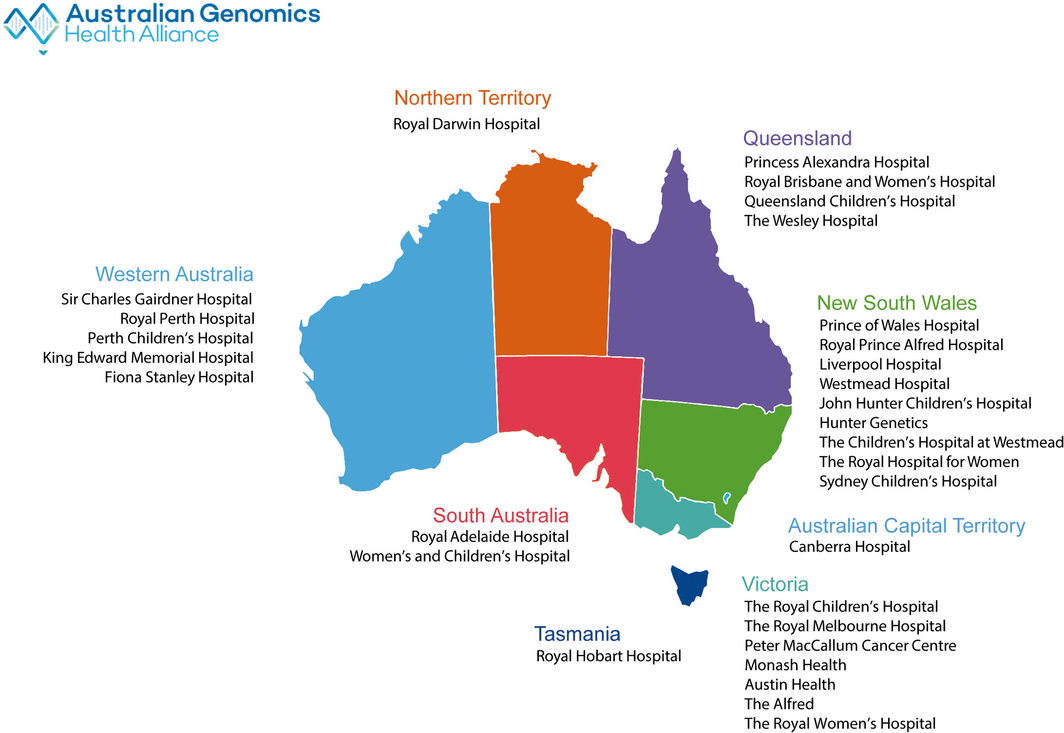
Australian Genomics is a national initiative building evidence to ensure the effective implementation of genomic medicine into Australian health care (www.australiangenomics.org.au). The research program is embedded in clinical practice, with 5000 patients with rare diseases and cancers being prospectively recruited for genomic testing into clinical flagship projects through 31 hospitals across Australia (Box 1). Achieving national recruitment will ensure that the clinical, diagnostic and research pathways are developed through the infrastructure and workforce in each jurisdiction. We initiated the research ethics and governance approval process for our multisite human research project, which was eligible for single ethical review by one Human Research Ethics Committee under the Australian National Mutual Acceptance (NMA) framework (Box 2), and recorded details relating to our experience in navigating the research ethics and governance system. This included any site‐specific assessment (SSA) requirements, review time, personnel costs, and causes of delay.
When NMA was introduced, it was envisaged that the reform would consolidate a nationalised ethics review system.1 Internationally, Australia's NMA ethics review process has been lauded as a streamlined system, leading the way for other countries.2,3 In the United States and Canada, the institutional review board system requires researchers to apply to each institution in a multicentre study. Researchers report little harmonisation in application requirements, considerable expense and time to prepare applications, and a lack of consistency in institutional review board response to projects in multicentre studies.2 However, Canada and the US have initiated single multisite review systems. Implementation in Canada will be relevant to Australia's situation, as they share a similar federated model of government. Until recently, in the United Kingdom, multicentre studies were served by Research Ethics Committees, with local Research Ethics Committees charged with subsequently reviewing projects for local issues. Three years after the introduction of this system in 1997, one study, in which a multicentre Research Ethics Committee‐approved project was then propagated to 125 local Research Ethics Committees, found that while approval times had improved, 67% of changes requested by local Research Ethics Committees were considered non‐local and thus outside their prerogative. Issues also remained around costs to prepare applications and transparency of information for researchers.4 These issues resonate with our experience of NMA in Australia. In 2015, a new Health Research Authority run by the National Health Service and backed by new legislation was introduced in the UK to manage ethics approvals nationally, in a model reform Australia could consider. The Human Heredity and Health in Africa initiative is undertaking the ethics review process for genomic studies across Africa. A recent report on the challenges faced by this initiative suggested that the main barrier to ethics approval is a lack of genomic expertise within ethics committees.5 With increasing international data sharing efforts, internationally compatible solutions to research ethics issues need to be developed. The Global Alliance for Genomics and Health has developed an ethics review recognition policy,6 and Australia could continue to demonstrate leadership internationally if remaining challenges to multijurisdictional research were addressed.
The Australian Genomics experience
The review undertaken by a Human Research Ethics Committee is an essential process to ensure that research is conducted in an ethical manner and to protect the wellbeing of human research participants. The Human Research Ethics Committee application and scientific and ethical review of the project was robust and progressed in a clear, structured and timely manner. We found the SSA application requirements less clear, and they differed significantly from site to site (Supporting Information, table 1). In many instances, sites undertook a process that recapitulated the scientific and ethical review already conducted by the Human Research Ethics Committee under NMA, with site approval sometimes conditional upon site‐specific changes. This is unnecessary duplication as there is no evidence that multiple ethical reviews increase the quality of evaluation or correlate with improved participant protection.2,3,7
From May 2016 to June 2018, we applied to five separate Human Research Ethics Committees and managed the SSA and governance process to the point of approval for study recruitment in 28 of the 31 planned recruitment sites. We submitted eight amendments to the lead Human Research Ethics Committee which were subsequently submitted to individual sites for governance review. An estimated 3.2 full time equivalent staff were dedicated to gaining ethics and site approvals, at a cost of $831 850 (Box 3, A). The median SSA application to approval time was 59 days across the 28 established sites (minimum 4 days, maximum 221 days) (Box 3, B).
Site‐specific legal review of Research Collaboration Agreements was identified by us, and others,8,9 as the component of SSA that takes the greatest time. To expedite these processes, a standard Medicines Australia Collaborative or Cooperative Research Group was developed; however, legal review and negotiation of study‐specific schedule information took 5 months, which resulted in times to SSA approval of 166 and 221 days for two sites. A multi‐institute agreement involving the 37 institutions that were party to the original Australian Genomics grant (fully executed in 7 weeks in 2016) included six recruitment sites. Where sites were already party to this multi‐institute agreement, the research governance process was significantly more efficient (25 days compared with 75 days; P = 0.001) (Box 3, C).
At three sites, delays in obtaining approvals resulted in reallocation of funding for genomic sequencing to already approved sites in order to meet recruitment targets and study timelines. Therefore, patients from sites granting approval slowly were unable to benefit from genomic testing through the research program.
We also experienced changes to online ethics management systems during the life of the Australian Genomics program. For example, Western Australia introduced an online Research Governance System that requires sequential collection of electronic signatures by research and organisation staff, causing delays as signatures cannot be sought concurrently. In 2018, New South Wales, Victoria and Queensland also introduced their own online management systems. The introduction of new systems is another barrier, as they undergo improvements and are gradually implemented.
Our recommendations
We have developed a series of recommendations that, if adopted, could facilitate improvement in research ethics and governance processes in Australia (Box 4).
Many of our recommendations relate to implementing intended National Health and Medical Research Council (NHMRC) NMA policies that have not yet been achieved; for example, expanding NMA to non‐participating states. We also recommend enforcing adherence to the principles of the NMA framework, such as rules around duplication of ethics review.
Other recommendations we suggest are built upon new policy and research. The Productivity Commission report on data availability and use in Australia10 gives examples in which Australian researchers experienced up to 6‐year periods from applying for health data to receiving them. This is a critical barrier to performing population‐based health studies and cost analysis for new health and medical services. The report put forward a series of well considered recommendations, which we support, such as the appointment of a national data custodian to oversee jurisdictional data collections.
Sharing de‐identified patient genomic and health data across state and national borders has major benefits for individual patient care by increasing diagnostic rates and accuracy and facilitating targeted and more effective interventions.11,12,13 Australian Genomics commissioned legal advice on the Australian jurisdictional privacy laws to map health data sharing capabilities across Australia. The report found that, with appropriate informed consent, there should be no barriers to sharing data if different jurisdictions have equivalency in privacy laws, which Australian states and territories have.
The Global Alliance for Genomics and Health has addressed multijurisdictional ethics review through its Ethics Review Recognition Policy, the goal being to “foster recognition of extra‐jurisdictional ethics reviews and improve the consistency thereof, as well as to promote efficient and responsible health‐related data sharing for human health and wellbeing”.6 The policy points out that despite the evolution of large, international data sharing research initiatives, there has been no co‐evolution of research ethics processes. Mapping equivalency in international privacy laws and ethical standards will be important to achieving this goal.
The Council of Australian Governments is supporting the development of a National Clinical Trials Governance Framework in an effort to encourage more clinical trials in Australia. The Framework, which has been the subject of national consultation in 2019, is anticipated to facilitate expedition of research ethics and governance processes for clinical trials. The principles of the Framework may be applied to other multisite clinical research studies.
Conclusion
Before the introduction of the NMA, Australia's research ethics and governance review systems for multisite projects were scrutinised,1,9,14 and many of the challenges remain working within the NMA framework.15 While we support the continued development and implementation of NMA, it must be recognised that it is not yet functioning to its potential efficiency. Most NHMRC‐funded research would not have the time or financial resources to build this national approach to patient recruitment, which limits the capabilities of health research in Australia. Research ethics and governance processes need to be flexible, devoid of repetition and administrative burden if Australia is to keep the health systems informed by research and remain competitive on the global research stage.
Box 1 – Australian map showing the clinical sites across all jurisdictions where Australian Genomics sought ethics and governance approvals for participant recruitment
Box 2 – A generalised representation of the process in Australia for review of multisite human research studies under the National Mutual Acceptance scheme, where ethics review is undertaken by a single Human Research Ethics Committee (HREC) and subsequent site‐specific assessment (SSA) is performed by Research Governance Offices (RGOs)*
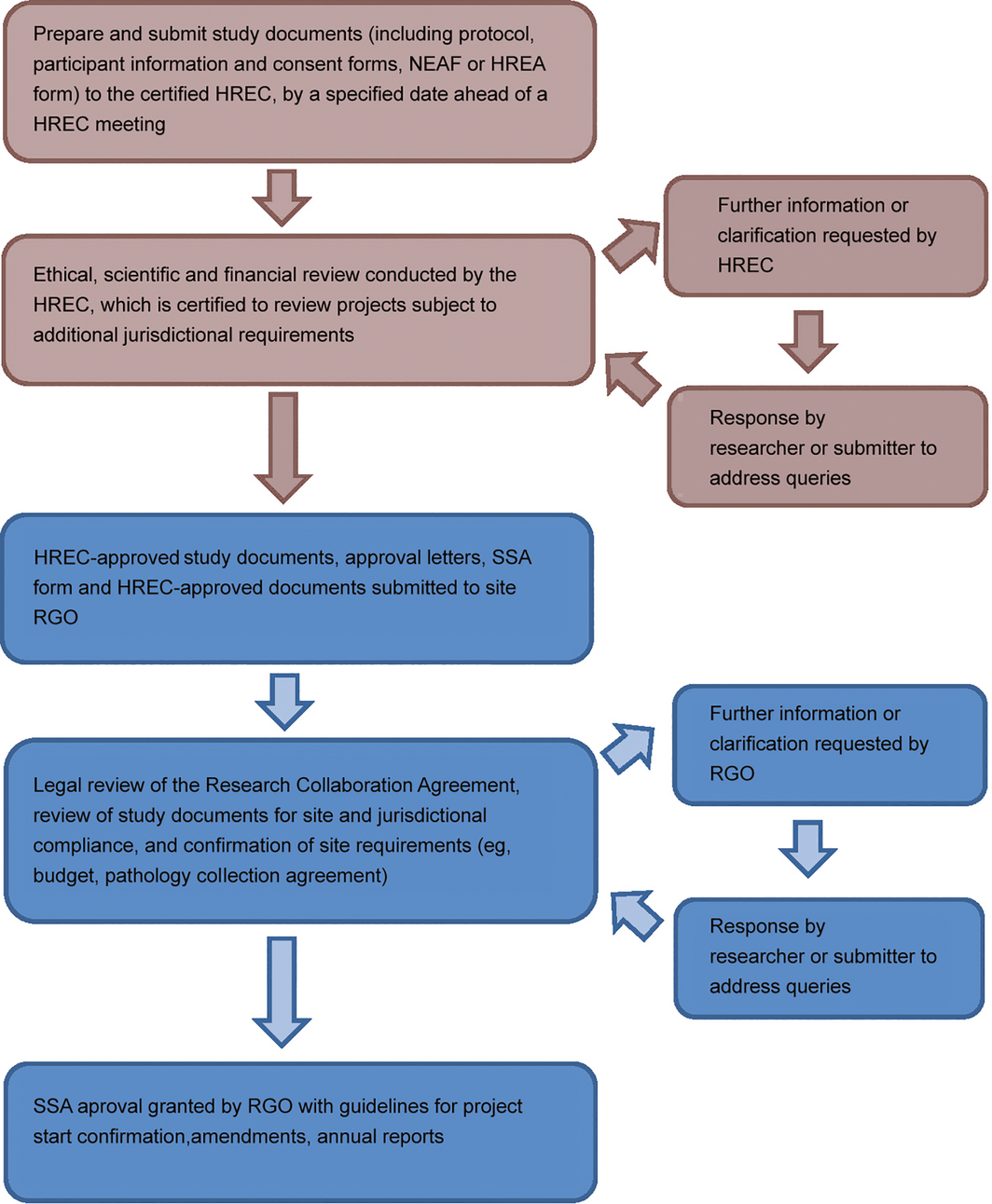
HREA = Human Research Ethics Application; NEAF = National Ethics Application Form. * HREC processes are outlined in red, and SSA processes in blue. The review cycle indicated on the right for HREC and SSA can occur multiple times.
Box 3 – Investment in personnel by Australian Genomics to achieve ethics and governance approvals calculated by time spent by each project coordinator or officer between May 2016 and June 2018 on an anual salary of $127 000 including oncosts, reported in full‐time equivalent (FTE) (A). Time to achieve governance at individual recruitment sites in Australia, from date of application submission to when the approval letter was received (B). The effect of legal review of the Research Collaboration Agreement (RCA) on length of time to achieve site‐specific assessment (SSA) approval (C)*
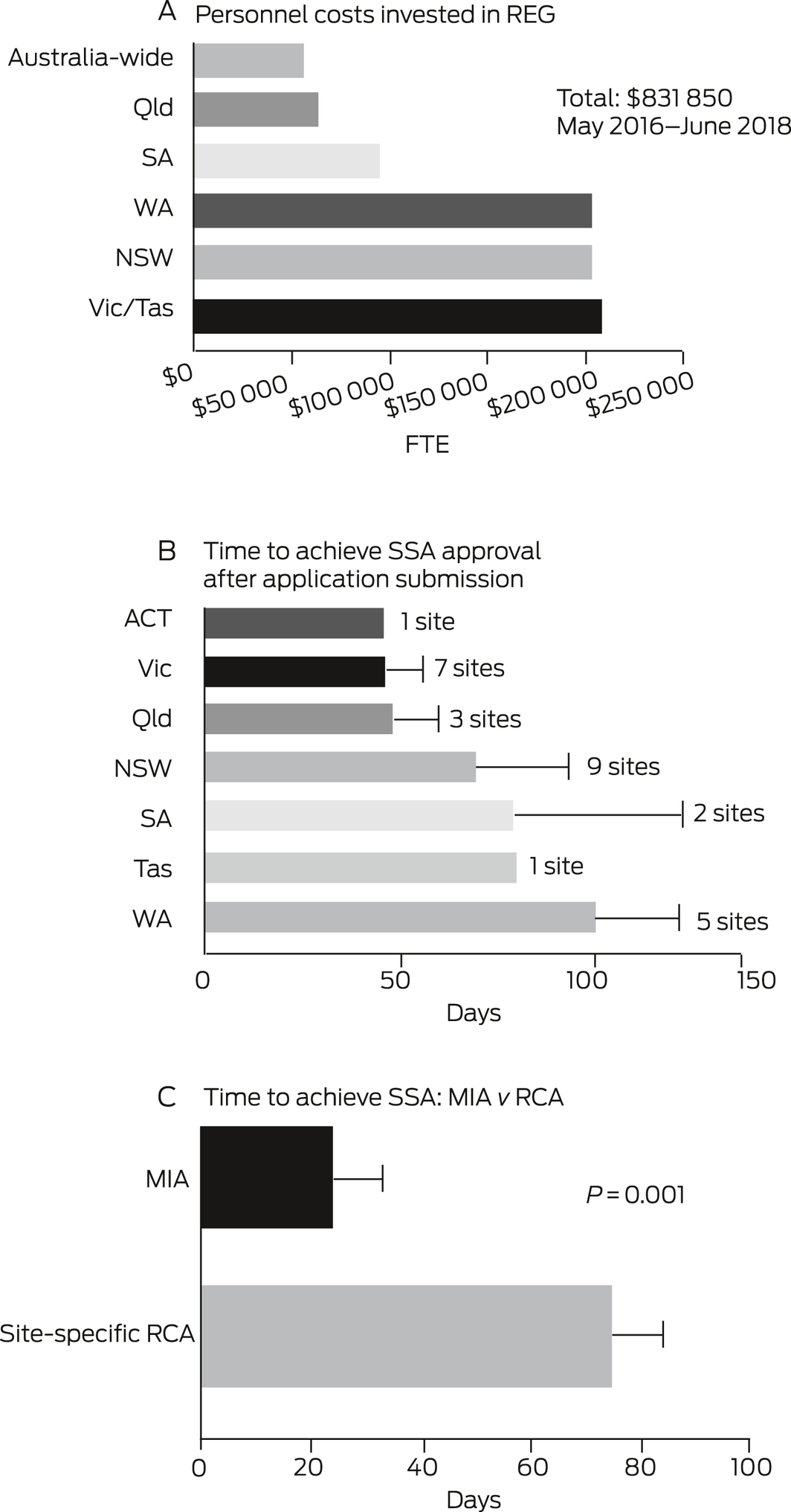
ACT = Australian Capital Territory; FTE = full‐time equivalent; MIA = multi‐institute agreement; NSW = New South Wales; Qld = Queensland; SA = South Australia; Tas = Tasmania; Vic = Victoria; WA = Western Australia. * Sites already party to the previously executed multi‐institute agreement experienced more rapid approval times (P = 0.001).
Box 4 – Recommendations to improve research ethics and governance (REG) processes in Australia, drawing from the Australian Genomics experience, the Productivity Commission report on data availability and use10, and reports and policies developed by the Global Alliance for Genomics and Health (GA4GH)
1.1 National Mutual Acceptance (NMA) framework |
|||||||||||||||
|
|||||||||||||||
1.2 Site‐specific assessment (SSA) framework |
|||||||||||||||
|
|||||||||||||||
1.3 Administration |
|||||||||||||||
|
|||||||||||||||
1.4 Implementation of policy and guidelines |
|||||||||||||||
|
|||||||||||||||
GA4GH = Global Alliance for Genomics and Health; HREC = Human Research Ethics Committee; NHMRC = National Health and Medical Research Council; RGO = Research Governance Office. | |||||||||||||||
Competing interests
No relevant disclosures.
Acknowledgements
The Australian Genomics Health Alliance is funded by a National Health and Medical Research Council grant (Grant Reference No. 1113531) and the Australian Government's Medical Research Future Fund. Members of the Australian Genomics Health Alliance who also supported and contributed to the publication of this work: Andrea M Belcher, Peta Phillips, Zornitza Stark, Adam Jaffe, Christopher Barnett, Julie McGaughran, Christopher Semsarian, Richard J Leventer, Katherine Howell, Andrew J Mallett, Aron Chakera, Chirag Patel, Cathy Quinlan, Amali Mallawaarachchi, Tony Roscioli, Kristi Jones, Matthew Cook, David R Thorburn, Paul J Lockhart, Cas Simons, Sebastian Lunke, Denise Howting, Clara Gaff, Deborah White, Marcel Dinger, Stephen Fox, Nigel Laing, Jozef Gecz, Ingrid E Scheffer, John Christodoulou, Andrew Sinclair and Kathryn N North. We thank Nikolajs Zeps and Craig Willers for their insightful comments on the manuscript.
References
- De Smit E, Kearns LS, Clarke L, et al. Heterogeneity of Human Research Ethics Committees and Research Governance Offices across Australia: an observational study. Australas Med J 2016; 9: 33–39.
- Dove ES, Knoppers BM, Zawati MH. Towards an ethics safe harbor for global biomedical research. J Law Biosci 2014; 1: 3–51.
- Townend D, Dove ES, Nicol D, et al. Streamlining ethical review of data intensive research. BMJ 2016; 354: i4181.
- Tully J, Ninis N, Booy R, Viner R. The new system of review by multicentre research ethics committees: prospective study. BMJ 2000; 320: 1179–1182.
- Adebamowo SN, Francis V, Tambo E, et al. Implementation of genomics research in Africa: challenges and recommendations. Glob Health Action 2018; 11: 1419033.
- Global Alliance for Genomics and Health. Ethics Review Recognition Policy. Global Alliance for Genomics and Health, 2017. https://www.ga4gh.org/wp-content/uploads/GA4GH-Ethics-Review-Recognition-Policy.pdf (viewed Oct 2019).
- Abbott L, Grady C. A systematic review of the empirical literature evaluating IRBs: what we know and what we still need to learn. J Empir Res Hum Res Ethics 2011; 6: 3–19.
- Clay‐Williams R, Taylor N, Braithwaite J. Potential solutions to improve the governance of multicentre health services research. Med J Aust 2018; 208: 152–154. https://www.mja.com.au/journal/2018/208/4/potential-solutions-improve-governance-multicentre-health-services-research
- Vajdic CM, Meagher NS, Hicks SC, et al. Governance approval for multisite, non‐interventional research: what can Harmonisation of Multi‐Centre Ethical Review learn from the New South Wales experience? Intern Med J 2012; 42: 127–131.
- Productivity Commission. Data availability and use [Report No. 82]. Canberra: Commonwealth of Australia, 2017. https://www.pc.gov.au/inquiries/completed/data-access/report/data-access.pdf (viewed Oct 2019).
- Aronson SJ, Rehm HL. Building the foundation for genomics in precision medicine. Nature 2015; 526: 336–342.
- Scollen S, Page A, Wilson J. From the data on many, precision medicine for “one”: the case for widespread genomic data sharing. Biomedicine Hub 2017; 2(Suppl): 104–110.
- The 1000 Genomes Project Consortium, Auton A, Brooks LD, Durbin RM, et al. A global reference for human genetic variation. Nature 2015; 526: 68–74.
- Boult M, Fitzpatrick K, Maddern G, Fitridge R. A guide to multi‐centre ethics for surgical research in Australia and New Zealand. ANZ J Surg 2011; 81: 132–136.
- Foot H, Scott IA, Russell GM, et al. Ethics and site‐specific governance approvals for multi‐centre, inter‐sector health care research. Med J Aust 2018; 209: 175–176. https://www.mja.com.au/journal/2018/209/4/ethics-and-site-specific-governance-approvals-multi-centre-inter-sector-health.
Provenance: Not commissioned; externally peer reviewed.
Mending the Road: A Way Forward From Silence and Silencing
Ayman Hamdan, Anisa J. N. Jafar
Seven Vessel Spontaneous Coronary Artery Dissection and Concurrent Transient Global Amnesia After an Emotional Trigger
Michael J. Stewart, Tom R. Sutherland
Seven Vessel Spontaneous Coronary Artery Dissection and Concurrent Transient Global Amnesia After an Emotional Trigger
Virginia Barbour
Research Priority Setting Is Not Research: A Call for Ethical Clarity in Australia
Bec Jenkinson, Gordon McGurk, Jonathan Quicke, Janelle Bowden, Nadine E. Foster
Organ Donation After Oral Ingestion of a Voluntary Assisted Dying Substance
Joanne Kantianis, Helen I. Opdam, Rohit L. D'Costa
Equity, Diversity and Inclusion From the Start: Reforming Australia's Research Infrastructure for Inclusive Participation
Danielle M. Muscat, Kirsten J. McCaffery, Heather L. Shepherd, Marguerite Tracy