




Volume 208 - Issue 4
Potential solutions to improve the governance of multicentre health services research
Authors: Robyn Clay-Williams, Natalie Taylor and Jeffrey Braithwaite
Med J Aust 2018; 208 (4): 152-154. || doi: 10.5694/mja16.01268
Published online: 5 March 2018
Published online: 5 March 2018
We need to improve bureaucratic behaviour in health services research
Building bridges between research groups and the health system will facilitate the production of non-clinical studies
Obtaining institutional consent to conduct health services research in Australia has become onerous and time-consuming,1-8 and thus we present potential solutions to the challenges encountered when seeking approval for large multicentre non-clinical studies. These ideas have been synthesised from what is already known and from our experience obtaining ethics and governance approvals for 60 large public hospitals participating in the Deepening our Understanding of Quality in Australia (DUQuA) study. DUQuA9 is a 3-year Australia-wide, cross-sectional study funded by the National Health and Medical Research Council (NHMRC). This study aims to assess how hospital quality management systems, leadership and culture are related to care delivery and patient outcomes for acute myocardial infarction, stroke and hip fracture.
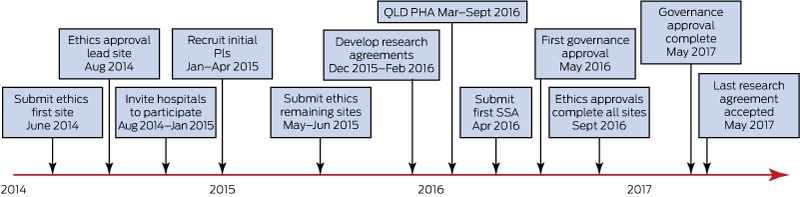
Based on previous experience with complex research, we expected to obtain institutional consent for DUQuA within 6 months. Instead, the lack of an Australia-wide mutual acceptance of ethics approvals for health services research created extensive duplication of effort. There was not much knowledge of the processes for non-clinical trials within state and hospital governance organisations and a variation in opinion as to whether DUQuA was a low or high risk project. Moreover, additional approvals were required to access national databases, the states and territories had widely differing site-specific assessment requirements, and many hospitals demanded a legal research agreement to commence data collection, which significantly delayed the approvals. The institutional consent system (comprising ethics, governance and regulatory processes) for health services research in Australia is complex and confusing, resulting in the expenditure of months of valuable research time (Box 1) and millions of dollars of research funds; for example, in 2015–2016, the direct research cost alone associated with institutional consent processes for this study was $263 750.
Demanding ethics approval processes
Each hospital is aligned with one of the about 200 human research ethics committees across Australia.10 To enable a single review of multicentre human research, the NHMRC developed the National Approach to Single Ethical Review of Multi-centre Research.11 The Human Research Ethics Application (formerly known as the National Ethics Application Form) is an interactive, web-based tool. Despite the aim of the National Ethics Application Form to increase consistency across sites,12 multisite researchers found discrepancies across human research ethics committees as to whether the National Ethics Application Form or low or negligible risk processes applied to their study.2
In 2015, the scope of the National Mutual Acceptance Scheme (in Victoria, South Australia, Queensland and New South Wales) was expanded from clinical trials to include all human research. While the Australian Capital Territory joined the agreement in 2016, and Western Australia signed the National Mutual Acceptance Scheme memorandum in July 2017, there is still no single review process in Australia that includes the Northern Territory and Tasmania.1,6,13,14
There are still variations in the required documentation, submission processes and media (ie, paper or electronic), and a large variation in panel turnaround time.2,4,8 Although each human research ethics committee accepted the National Ethics Application Form (DUQuA took place before the introduction of the Human Research Ethics Application), customisation was required for each state, including the completion of additional forms for five human research ethics committees. These committees were generally inexperienced with health services research and unnecessarily required mandatory clinical trials forms to be submitted with the application, which often led to convoluted wording to generate viable responses on forms that were incompatible with the type of research conducted. With divergent version control and submission requirements, the study documents and data collection instruments differed for each state. As each of these applications was considered by a different committee, the outcome of the reviews varied, prompting numerous minor modifications to the study design and documentation.
Burdensome governance requirements
After obtaining ethics approval, research projects are submitted to research governance offices for site-specific assessment. Governance structures vary by site; while some research governance offices review applications for multiple hospitals within one health service or district, most offices review applications for one hospital only.
The site-specific assessment form only allows for one principal investigator to be nominated and that investigator must be a hospital employee,6,7 potentially compromising the independence of the research. Where the principal investigator role is shared, additional investigators can only be nominated as associate investigators on the site-specific assessment form. In DUQuA, research governance officers did not consider university investigators as principal investigators, which negated our collaborative efforts and prevented us from hedging against primary principal investigators leaving — 27 principal investigators (52%) did so. In addition, as DUQuA lead researchers were associate investigators, we were not recognised as the approving authority for amendments and, frequently, we were not in receipt of the correspondence from the research governance office. Several problems ensued; amendments were submitted without our knowledge, for example, and despite having received the site-specific assessment approval, some hospital employees did not recognise that the project was run by the university and therefore refused to provide data to us.
Like other researchers,4,7,8 we found considerable variation in submission requirements and significant duplication across human research ethics committee submissions.4 Despite prior endorsement of the project by senior hospital executives, on average, each site-specific assessment application required the signature of eight different hospital heads of departments (about 320 signatures in total), which were very time-consuming to obtain. The site-specific assessment forms frequently have additional jurisdictional and local requirements, such as state level approvals for reviewing medical records where patient consent is waived. The Queensland Public Health Act 2005, for example, requires the signature of data custodians at each participating hospital, with the caveat that all these custodians endorse the application before submission to a centralised office for approval. For DUQuA, this process alone took 6 months. Some jurisdictions required the generation and submission of additional forms that were similar to the site-specific assessment ones, with content that overlapped significantly with the formal site-specific assessment submission.
As documented in other studies,4,7,8 the majority of participating hospitals required individualised legal research agreements for DUQuA. Therefore, in consultation with a university lawyer experienced in research contracts, we developed a standardised agreement for the DUQuA study, but this agreement was not accepted by over one-fifth of participating hospitals (21%). Hospital agreements included demanding terms, such as publication pre-review, which may adversely affect research independence; ownership of intellectual property; and the requirement for university-based principal investigators to undergo research training. Insisting that all external researchers have an honorary appointment effectively stops them from conducting independent research, thus introducing additional unwarranted potential bias.
Static processes for dynamic systems
The current processes are designed for a system that remains constant from the time of application until the completion of data collection. In reality, health care is dynamic and, for large studies, both key hospital-based investigators and hospital processes will likely change over the life of the project. Even though onsite principal investigators, for example, frequently change employment, resulting in the need for continual re-recruitment and submission of amendments to the human research ethics committee, there is no consistent process across ethics committees for changing investigators. These committees require the documentation of every detail and variation, but unlike controlled laboratory studies, in observational studies of real-world environments it is impossible to know all the variations until the research commences. Therefore, the lack of governance flexibility hampers timely project completion and efficiency.
Moreover, the current system is biased toward public hospitals. While DUQuA included only public hospitals, the literature documents evidence that ethics and governance approvals may take significantly longer to obtain when private hospitals participate.4,8 These delays mean that private hospitals could be unfairly precluded from taking part in health services research studies.
Proposed solutions
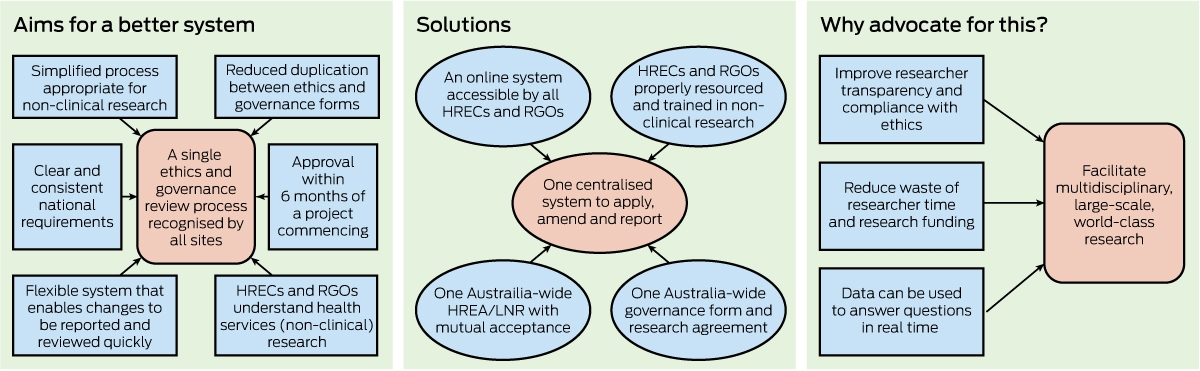
To produce world class research, we need a system that facilitates large scale health services research, rather than putting virtually insurmountable and costly barriers in place. Other researchers have urged that processes be streamlined,2,6,8 but do not suggest how to resolve this system-wide. We propose a framework that includes a single ethics and governance review process recognised by all states, coupled with a centralised system to apply for, amend and report on research governance (Box 2). Such centralised arrangement would comprise one Australia-wide Human Research Ethics Application and low or negligible risk process and one Australia-wide governance and research agreement form. In addition, our proposed centralised arrangement would have an online submission system accessible by all human research ethics committees and research governance offices and would also provide resources and ongoing training for human research ethics committees and research governance office staff about health services research. Moreover, the different departments of health need to lead research governance, site-specific assessment requirements, legal agreements and honorary appointments. There should be no requirement that principal investigators be employees of the participating institution, or that external researchers be honorary staff of participating hospitals. There should be, as an addendum to the site-specific assessment, an Australia-wide health services research contract describing legal requirements. Altogether, these measures would facilitate a better use of research funding, improve research transparency and compliance with ethics requirements, enhance the willingness of clinicians to participate, and provide more timely access to research outcomes. As health systems are dynamic, a pragmatic approach would allow flexibility in modifying projects, with guidelines as to when a change would require fresh approval or governance review. Influential organisations should assist in actively pursuing a more streamlined process, as without their support, the current fragmented system is unlikely to improve.
Fixing the current complex situation may require a cultural change around the relationship between research and health service delivery. The inefficient and bureaucratic behaviour we encountered implies that research (even hard-to-secure NHMRC-funded research) is an encumbrance that needs controls at every step. Instead, we need to agree that health services research is a boon to understanding, and necessary to underpin systems improvement, and that there are benefits to analysing how health systems work. We need more bridges and fewer obstacles between research groups and the health system.
Competing interests
No relevant disclosures.
Acknowledgements
DUQuA was funded by the NHMRC Program Grant APP1054146 (CI Braithwaite).
References
- Boult M, Fitzpatrick K, Maddern G, Fitridge R. A guide to multi-centre ethics for surgical research in Australia and New Zealand. ANZ J Surg 2011; 81: 132-136.
- De Smit E, Kearns LS, Clarke L, et al. Heterogeneity of human research ethics committees and research governance offices across Australia: an observational study. Australas Med J 2016; 9: 33-39.
- Jamrozik K. Research ethics paperwork: what is the plot we seem to have lost? BMJ 2004; 329: 286-287.
- Smith-Merry JL, Walton MM. Research governance as a facilitator for ethical and timely research? Learning from the experience of a large government-funded multisite research project. Aust Health Rev 2014; 38: 295-300.
- Studdert DM, Vu TM, Fox SS, et al. Ethics review of multisite studies: the difficult case of community-based indigenous health research. Med J Aust 2010; 192: 275-280.
- Thompson SC, Sanfilippo FM, Briffa TG, Hobbs MST. Towards better health research in Australia — a plea to improve the efficiency of human research ethics committee processes. Med J Aust 2009; 190: 652.
- Vajdic CM, Meagher NS, Hicks SC, et al. Governance approval for multisite, non-interventional research: what can Harmonisation of Multi-Centre Ethical Review learn from the New South Wales experience? Intern Med J 2012; 42: 127-131.
- White V, Bibby H, Green M, et al. Inconsistencies and time delays in site-specific research approvals hinder collaborative clinical research in Australia. Intern Med J 2016; 46: 1023-1029.
- Taylor N, Clay-Williams R, Hogden E, et al. Deepening our Understanding of Quality in Australia (DUQuA): a study protocol for a nationwide, multilevel analysis of relationships between hospital quality management systems and patient factors. BMJ Open 2015; 5: e010349.
- National Health and Medical Research Council. List of Human Research Ethics Committees registered with NHMRC. Canberra: NHMRC; 2016. https://www.nhmrc.gov.au/_files_nhmrc/file/health_ethics/human/list_of_hrecs_registered_with_nhmrc_october_2016.pdf (viewed Nov 2017).
- National Health and Medical Research Council. National Approach to Single Ethical Review of Multi-centre Research. Canberra: NHMRC. https://www.nhmrc.gov.au/health-ethics/national-approach-single-ethical-review (viewed Nov 2017).
- National Health and Medical Research Council. National Ethics Application Form (NEAF). Canberra: NHMRC. https://www.nhmrc.gov.au/health-ethics/national-ethics-application-form-neaf (viewed Nov 2017).
- National Health and Medical Research Council. Research governance handbook: guidance for the national approach to single ethical review, December 2011. Canberra: NHMRC; 2011. https://www.nhmrc.gov.au/_files_nhmrc/file/guidelines/ethics/human_research/12._research_governance_handbook_120203_0.pdf (viewed Nov 2017).
- Department of Health Western Australia. Multi-centre research [website]. https://rgs.health.wa.gov.au/Pages/Multi-centre-Research.aspx (viewed Dec 2017).
Linked content
-
MJA Podcast: Dr Robyn Clay-Williams
Provenance: Not commissioned; externally peer reviewed.
Capturing the Benefits of Clinical Quality Registries
Taryn Bessen, Stephen McDonald
Medical Colleges Have an Obligation to Ensure Full Participation in Clinical Quality Registries
Thomas J. Hugh
Getting on the Same Page: Why Australia Needs a National Maternity Early Warning System (MEWS) Chart
Briony A. Cutts, Lucy Bowyer, Nisha Khot, Sandra Lowe, Stefan C. Kane
Data for Equity: Can Linked Administrative Data Inform Pathways to More Equitable Child Health?
Sarah Gray, Shuaijun Guo, Meredith O'Connor, Elodie O'Connor, Katrina Williams, Hannah Badland, Susan Woolfenden, Josie Dickerson, Gerry Redmond, Marnie Downes, Sharon R. Goldfeld
Specialty College Selection: Why Change is Critical to Support a Future Rural Workforce
Matthew R. McGrail, Jenny May AM, Katherine Logan
Differentiated and simplified oral HIV pre‐exposure prophylaxis (PrEP) models hold the key to virtually eliminating HIV transmission in Australia by 2030
Tyson Arapali, Sarah Warzywoda, Anthony K J Smith, Curtis Chan, Timothy R Broady, Erin Sullivan, Catherine MacPhail, Mohamed A Hammoud, Alexander Dowell‐Day, Benjamin R Bavinton