




Volume 210 - Issue 7
Primary care in disasters: opportunity to address a hidden burden of health care
Authors: Penelope L Burns, Kirsty A Douglas and Wendy Hu
Med J Aust 2019; 210 (7): 297-299.e1. || doi: 10.5694/mja2.50067
Published online: 15 April 2019
Published online: 15 April 2019
General practitioners provide a flexible response to the changed needs of the disasteraffected population
General practitioners provide a flexible response to the changed needs of the disaster‐affected population
In Australia, “a land … of droughts and flooding rains,”1 disasters affect our lives annually, the majority of which are weather‐related.2 They are a part of the landscape, taking the form of cyclones, floods, bushfires, droughts and other phenomena. Cyclone Debbie, which hit northern Queensland in 2017, the Tathra bushfires, which affected the south coast of New South Wales in 2018, and the thunderstorm asthma event in Melbourne in 2016 are just a few recent examples. Such catastrophic events affect rural and urban communities and coastal and inland locations. No community in Australia is exempt, which is reflected in the recent shift in focus by national and international disaster management policy to prioritise improving local community capacity to respond and recover.3,4
For health care, this new focus is putting general practitioners in the spotlight. Central to the provision and coordination of patient health care at the community level, GPs provide an important contribution to local health care during disasters. However, evidence to support a clear understanding of that contribution has been lacking until recently.
Emerging evidence from academic literature and experience from the field show a consistent pattern of primary health care needs presenting in disasters.5,6,7,8,9,10,11,12 This major burden of care is yet to be incorporated into disaster management systems. Strong messages from peak bodies, such as the World Health Organization and the World Organization of Family Doctors, advocate addressing this high burden of primary health care need.13
A 2018 MJA–Lancet report highlights the significant impact of climate change on the health of Australians and their existing vulnerability. The authors call for a “suite of health and wellbeing‐related responses” to address a gap in health management.14 GPs have a strong contribution to make in delivering holistic strategies for good health and wellbeing.
There is an opportunity for Australia to accelerate and systematise the existing patchwork integration of GPs in disaster health care systems and policy. Current Australian and global policy on disaster management focuses on risk reduction at the community level, building resilience through improving local capacity to respond.3 GPs have important contributions to make within the current national and international frameworks of disaster management — all hazard; all agencies; comprehensive prevention, preparedness, response and recovery; and the prepared community — and should be included in disaster management across all these phases (Box).
Prevention and preparedness
In the prevention phase, a GP's role is to optimise patient wellness. In the preparedness phase, the GPs’ understanding of the health characteristics of the local community supports very specific activities for patients relevant to their medical conditions within their local context. Each patient can be supported to maintain a medical history summary, either portable or via the new My Health Record, and advised of the need for ready‐to‐go packs with medications, medical equipment and medical contact numbers. Over the past decade, there has been some development of guidelines for roles and business continuity15,16,17 focusing on the preparedness and early response phases.
Response and recovery
In recent years, informed by disaster‐experienced GPs and research studies,5,6,7,8,9,10,11,12 we have developed a greater understanding of the key aspects of GPs’ role in the response and recovery phases. GPs are likely to be among the zero responders — those on the ground addressing problems when a catastrophe strikes.
We know people will seek help from local general practices, pharmacies and hospitals. Following bushfires in Australia, GPs have described patients waiting on their doorsteps for the medical practice to open the morning after a fire wanting medications and assistance. They have reported waiting rooms full of distressed community members, shocked by loss and abrupt change to their lives, seeking a safe place and connection with known and trusted health care professionals.
The majority of GPs contribute most effectively by opening their general practices and seeing people who present for assistance; they provide a flexible response to the changed needs of the disaster‐affected population. This response includes modifying their practice operating hours, extending consultation lengths to accommodate widespread distress, postponing routine health care, and engaging in active outreach to high risk patients. Less frequently, it includes working outside the usual medical practice in evacuation centres or community buildings, in rural hospital emergency departments or in temporary clinics, or attending on‐site at the incident.
GPs’ strongest contribution capacity, however, is in the recovery phase. A GP's role in the recovery phase is to manage the physical, psychosocial and social determinants of health effects that will continue long after other responders have left. They have strong public health roles in surveillance as the eyes and ears of the community.
There is now a growing body of epidemiological research on the health consequences of disasters relevant to primary health care which will be encountered in the response and recovery phases,5,6,7,8,9,10,11,12 with management of chronic disease being the major burden.11 Many similar health effects are described, regardless of whether the hazard is flood, earthquake, storm or bushfire. Despite the evidence, guidelines for GPs over the response and recovery periods are very limited both in Australia and internationally. This evidence suggests increases in the prevalence and incidence of disease,6,7 the deterioration of pre‐existing conditions,8,9 and new emergent diagnoses10 in association with disasters.
Alongside acute injury, early effects reported include respiratory effects from dust or smoke and dermatological effects from sunburn and animal or insect bites. Significant increases in acute exacerbations of chronic diseases can overwhelm medical facilities, as patients present with diabetes, hypertension, chronic bronchitis, mental health conditions, prescription refills, and drug dependence.7
In the weeks after disasters, increased incidence of high blood pressure and acute myocardial infarction6 may be compounded by cerebrovascular accidents,12 with carbon monoxide poisoning,5 falls and dermatitis also seen. Infective conditions may start to present, such as acute respiratory infections, sinusitis and pneumonia.
Months and years after disasters, deterioration in pre‐existing conditions such as diabetes, hypertension and hyperlipidaemia as well as emerging mental health conditions, such as acute and post‐traumatic stress symptoms or traumatic grief, become particularly relevant.8 This broad range of health problems affecting people after a disaster creates a critical role for GPs, who are already responsible for such activities and who remain in the area in the months and years after a disaster.
Next steps
About 36 000 GPs work in communities across Australia. They see 2–3 million presentations every week and manage the health of over 21.7 million Australians every year.18 They predominantly manage mental health and chronic conditions.19 When a disaster strikes, GPs are involved personally or professionally — or both. GPs’ contributions should be a continuation and enhancement of their existing roles and responsibilities in mental and physical health and chronic disease management, alongside preventive care and support of general wellbeing within the local community context and its unique characteristics.
The recovery period after disasters is an important time for GPs to connect with and assess their patients. Conducting a brief post‐disaster health check provides an opportunity to assess the effect of the disaster and the level of distress created by the event. It offers an opportunity to personalise health and wellness recommendations as well as determine when additional medical support is required. Practitioners can assess acute conditions and review chronic conditions (eg, a need for medication adjustment in evacuations in relation to altered physical activity or diet that may affect control of diabetes).
In accordance with the Sendai Framework for Disaster Risk Reduction,20 GPs have an opportunity to contribute their expertise from their ongoing health care activities to help reduce the health effects of catastrophes across all phases of prevention, preparedness, response and recovery of disaster management.
In order to support and inform GPs in this process, it is important to:
-
develop clinical guidelines targeted at the epidemiological pattern of health consequences from disaster, with timelines for presentation and follow‐up in the days, months and years after the event, and
-
increase connectivity between GPs and other health professionals involved in the recovery space. At a minimum, this requires awareness and respect for the contribution of all health professionals, but ultimately, it should be standardised through formal policies and integrated pathways.
Conclusion
The involvement of GPs will help unify disaster health management of people in the community context across all levels of health service provision and biopsychosocial domains. This involvement will help change the paradigm of disaster management so that it is centred on the experience of the people at the heart of communities during a disaster and in the years that follow.
Box – Roles of general practitioners across the prevention, preparedness, response and recovery phases of disaster management
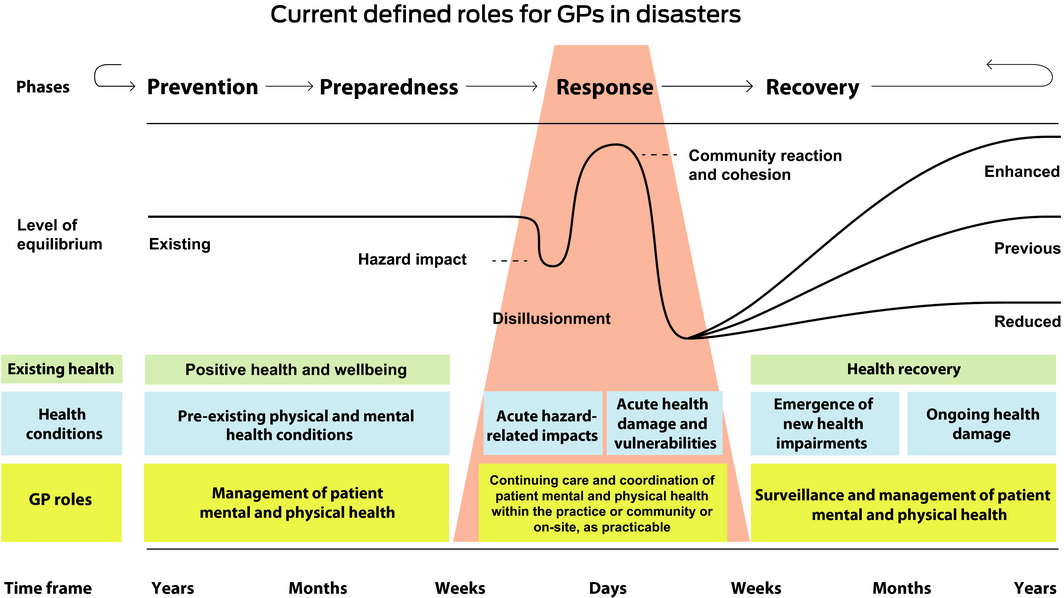
Adapted and updated from: Burns PL, Aitken PJ, Raphael B. Where are general practitioners when disaster strikes? 2015 Med J Aust 2015; 202: 356‐358. https://www.mja.com.au/journal/2015/202/7/where-are-general-practitioners-when-disaster-strikes ◆
Competing interests
No relevant disclosures.
Acknowledgements
We thank the Royal Australian College of General Practitioners Foundation for their support on some early work in this field.
References
- Mackellar D. My country and other poems. Ringwood: Viking, 1993.
- Centre for Research on the Epidemiology of Disasters. Economic losses, poverty and disasters: 1998–2017. Brussels, Belgium: CRED, 2018. https://www.unisdr.org/we/inform/publications/61119 (viewed Feb 2019).
- Australian Emergency Management Institute. National strategy for disaster resilience: community engagement framework. Handbook 6. Canberra: Commonwealth of Australia, 2013. https://www.emergency.nsw.gov.au/Documents/publications/National-Strategy-for-Disaster-Resilience-Community-Engagement-Framework.pdf (viewed Feb 2019).
- Council of Australian Governments. National strategy for disaster resilience. Canberra: Commonwealth of Australia, 2011. https://archive.homeaffairs.gov.au/emergencymanagement/Documents/national-strategy-disaster-resilience.pdf (viewed Feb 2019).
- Mitchell RD, Aitken P, Franklin RC. The physical health impacts of tropical cyclones. Annals ACTM 2014; 15: 2–8.
- Steptoe A. The impact of natural disasters on myocardial infarction. Heart 2009; 95: 1972–1973.
- Lee DC, Gupta VK, Carr BG, et al. Acute post‐disaster medical needs of patients with diabetes: emergency department use in New York City by diabetic adults after Hurricane Sandy. BMJ Open Diabetes Res Care 2016; 4: e000248.
- Fonseca VA, Smith H, Kuhadiya N, et al. Impact of a natural disaster on diabetes: exacerbation of disparities and long‐term consequences. Diabetes Care 2009; 32: 1632–1638.
- Ng JM, Thorpe J, Walton C, et al. The effect of extensive flooding in Hull on the glycaemic control of diabetes patients. Diabet Med 2010; 1: 108.
- Chan C, Elliott J, Troughton R, et al. Acute myocardial infarction and stress cardiomyopathy following the Christchurch earthquakes. PLoS One 2013; 8: e68504.
- Arrieta MI, Foreman RD, Crook ED, Icenogle ML. Providing continuity of care for chronic diseases in the aftermath of Katrina: from field experience to policy recommendations. Disaster Med Public Health Prep 2009; 3: 174–182.
- Lin S, Gomez MI, Gensburg L, et al. Respiratory and cardiovascular hospitalizations after the World Trade Center disaster. Arch Environ Occup Health 2010; 65: 12–20.
- World Health Organization. Thirteenth general programme of work, 2019–2030: report by the Director‐General. Geneva: WHO, 2018. https://www.who.int/about/what-we-do/gpw-thirteen-consultation/en/ (viewed Feb 2019).
- Zhang Y, Beggs PJ, Bambrick H, et al. The MJA‐Lancet Countdown on health and climate change: Australian policy inaction threatens lives. Med J Aust 2018; 209: 474. https://www.mja.com.au/journal/2018/209/11/mja-lancet-countdown-health-and-climate-change-australian-policy-inaction
- Healthpoint ANZ. Emergency response planning tool: emergency preparedness, response and recovery. Auckland: Healthpoint ANZ, 2014. https://www.racgp.org.au/running-a-practice/practice-management/managing-emergencies-and-pandemics/emergency-response-planning-tool (viewed Feb 2019).
- Royal Australian College of General Practitioners. Managing emergencies in general practice. Melbourne: RACGP, 2017. https://www.racgp.org.au/running-a-practice/practice-management/managing-emergencies-and-pandemics (viewed Feb 2019).
- Rural Doctors Association of Australian, Australian College of Rural and Remote Medicine. Position statement the role of the rural GP in disaster response and pre‐hospital care. Brisbane: RDAA, ACRRM; 2016. https://www.rdaa.com.au/documents/item/61 (viewed Feb 2019).
- Australian Institute of Health and Welfare. Australia's Health 2018 (Cat. No. AUS 221; Australia's Health Series No. 16). Canberra: AIHW, 2018. https://www.aihw.gov.au/getmedia/7c42913d-295f-4bc9-9c24-4e44eff4a04a/aihw-aus-221.pdf.aspx?inline=true (viewed Feb 2019).
- Royal Australian College of General Practitioners. General practice health of the nation 2018. Melbourne: RACGP, 2018. https://www.racgp.org.au/general-practice-health-of-the-nation (viewed Feb 2019).
- United Nations Office for Disaster Risk Reduction. Sendai Framework for Disaster Risk Reduction, 2015–2030. Geneva: UNISDR, 2015. https://www.unisdr.org/files/43291_sendaiframeworkfordrren.pdf (viewed Feb 2019).
Linked content
-
MJA Editorial: Resilient health systems: preparing for climate disasters and other emergencies
-
InSight+: Australia’s healthcare system: can it cope with climate change?
Provenance: Commissioned; externally peer reviewed.
Shifting focus to adolescent wellbeing and inclusive participation in the digital age
Allyson R Todd, Elena Wang, Stephanie R Partridge
The clinical presentation, investigation, and management of women diagnosed with endometriosis in Australian general practices, 2011–2021: an open cohort study
Danielle Mazza, Kailash Thapaliya, Sharinne B Crawford, Alissia Hui, Maryam Moradi, Luke E Grzeskowiak
The impact of the Breast Screen NSW transition from film to digital mammography, 2002–2016: a linked population health data analysis
Rachel Farber, Nehmat Houssami, Katy J L Bell
Non‐technical errors associated with deaths in surgical care, Australia, 2012–2019, by surgical specialty (Australian and New Zealand Audit of Surgical Mortality): a retrospective cohort study
Jesse Ey, Victoria Kollias, Octavia Lee, Kelly Hou, Matheesha Herath, John B North, Ellie Treloar, Suzanne Edwards, Martin Bruening, Adam J Wells, Guy J Maddern
The CURE Asthma roadmap
Gary P Anderson, Anthony Flynn, Phil G Bardin, John D Blakey, Shyamali C Dharmage, Paul Foster, Peter G Gibson, Adam Jaffe, Alan James, Christine R Jenkins, Sundram Sivamalai, Peter D Sly, Guy B Marks, Vanessa M McDonald, Judy Wetttenhall
Evidence from Australian cohort studies about asthma trajectories and transitions across the life course: a narrative review
Caroline Lodge, Xin Dai, Ingrid A. Laing, Michael P Menden, Anthony Flynn, Gary P Anderson, Sarath Ranganathan, Shyamali C Dharmage