




Volume 209 - Issue 6
Virtual medicine: how virtual reality is easing pain, calming nerves and improving health
Author: Brennan MR Spiegel
Med J Aust 2018; 209 (6): 245-247. || doi: 10.5694/mja17.00540
Published online: 21 May 2018
Published online: 21 May 2018
Virtual reality has been used to help treat anxiety, control pain, support physical rehabilitation and distract patients during wound care
Virtual reality is thought to create an immersive distraction that restricts the mind from processing pain
Not so far in the future, doctors might prescribe a virtual beach vacation to calm aches and pains, in lieu of pharmacotherapy. Insurance companies might offer scenic tours of Icelandic fjords to lower blood pressure, instead of doubling up on drugs. Psychiatrists might treat social phobia by inviting patients to a virtual dinner party. Hospitals may immerse children in a fantastical playland while they receive chemotherapy.
These advances are beginning to occur because of virtual reality (VR) — the mind-bending computer technology that nudges our brains into thinking we are somewhere else. Users of VR wear a pair of goggles with a close-proximity screen that creates a sensation of being transported into lifelike, three-dimensional worlds (Box 1). For readers who have not yet tried VR, it may be hard to imagine how convincing the technology can be.
For decades, scientists have been studying the health benefits of VR for ailments ranging from burn injuries to stroke to post-traumatic stress disorder.1,2 Literature from pioneers such as Hoffman,3-6 Rizzo,7 Rothbaum8-10 and Bordnick,11-13 among many others, reveals that VR has the potential to reduce pain, manage anxiety and improve mental health across a range of conditions.1,2 However, the technology has been too expensive, unreliable and unwieldy for the research to translate beyond the pages of academic journals and doctoral dissertations. This is now changing with the availability of low cost, portable and high quality VR headsets and software, all of which is supporting a new discipline called therapeutic VR. This brief review describes how VR is being used as a drug-free therapeutic intervention across a range of clinical scenarios and summarises the evolving evidence supporting its impact on patient outcomes.
Distraction therapy for pain
VR provides an immersive, multisensory and three-dimensional environment that enables users to have modified experiences of reality.14 To date, VR has been used in numerous clinical settings to help treat anxiety disorders, control pain, support physical rehabilitation and distract patients during wound care.1,2,15-18 For example, VR coupled with medication is effective in decreasing pain during bandage changes for severe burns.5,15 Similarly, VR reduces pain and provides positive distraction during routine procedures, such as intravenous line placements18 and dental procedures.16 Other studies reveal that VR helps manage chronic pain conditions, including complex regional pain syndrome19 and chronic neck pain.20 By stimulating the visual, auditory and proprioception senses, VR may act as a distraction to limit the user’s processing of nociceptive stimuli.14 However, the existing literature is limited by varying control groups, heterogeneous quality, and often small sample sizes.
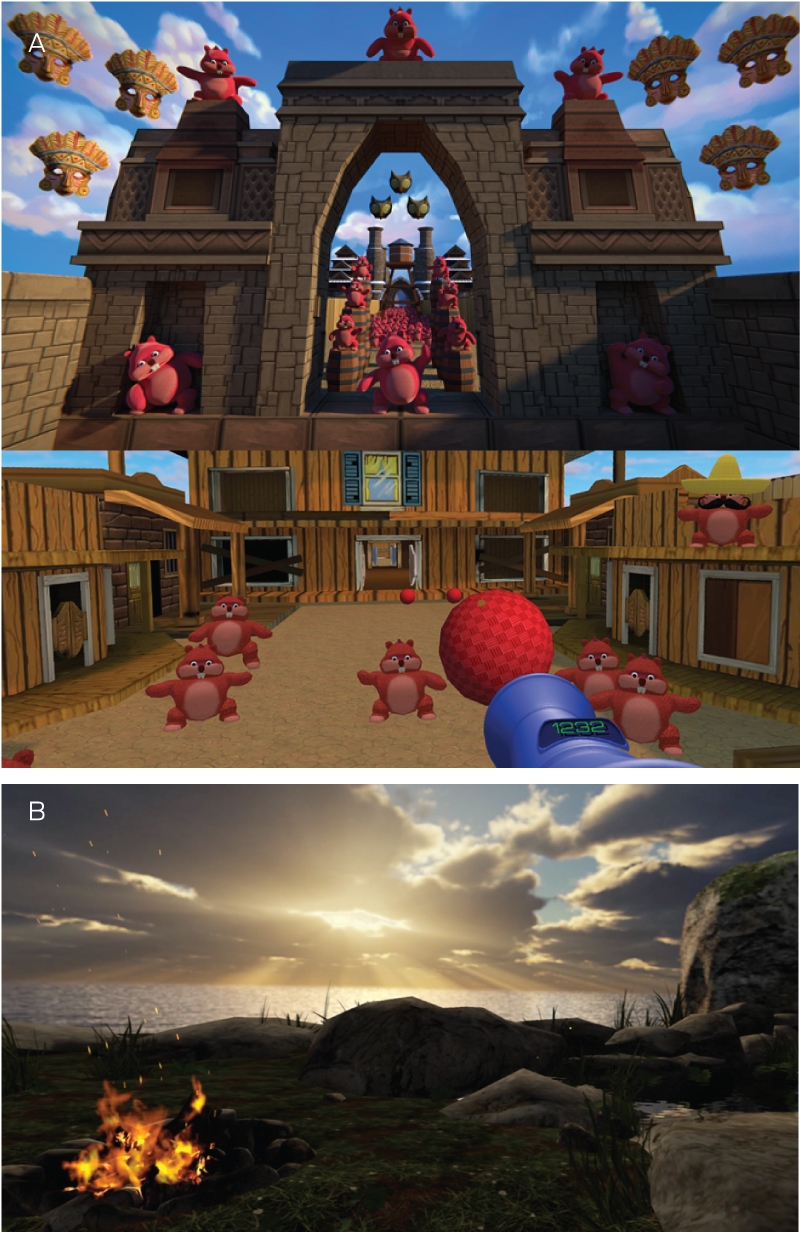
In a recent study, our group at Cedars-Sinai Medical Center in Los Angeles evaluated the role of VR in hospitalised patients with pain.21 We selected VR because our hospital is seeking ways to reduce pain while also reducing the need for additional pharmacotherapy, such as opioids. For this reason, we conducted a study to compare a three-dimensional VR pain distraction experience versus a two-dimensional high definition nature video in a cohort of diverse patients with a pain intensity of three or over out of ten (n = 50 subjects per group). Patients watched a 15-minute VR experience called Pain RelieVR, specifically designed to treat pain in patients who are bedbound or have limited mobility (appliedVR, Los Angeles, CA; https://appliedvr.io) (Box 2). Pain RelieVR is an immersive, 360°, gamified experience that takes place in a fantasy world where users attempt to shoot balls at a wide range of moving objects by manoeuvring their head towards the targets. The mean pain reduction in the VR cohort was greater than in controls (−1.3 v −0.6 points, respectively; P = 0.008). Sixty-five percent of VR patients achieved a clinically significant pain response versus 40% of controls (n = 50 per group; P = 0.01; number needed to treat = 4). We found that the effect of VR was independent of the reason for hospitalisation or primary cause of pain, including both somatic and visceral pain, suggesting that VR has benefits across a variety of conditions. Importantly, we did not document adverse events from VR during the trial, although temporary vertigo and nausea have been described in a subset of users, particularly when wearing headsets with suboptimal processor speeds.
It remains unknown exactly how VR works to reduce pain perception. Most proposed mechanisms attribute the benefit to simple distraction.14 When the mind is deeply engaged in an immersive experience, it becomes difficult, if not impossible, to perceive stimuli outside of the field of attention.22 By “hijacking” the auditory, visual and proprioception senses, VR is thought to create an immersive distraction that restricts the mind from processing pain.14 Additional research is underway to study the neurobiological mechanisms of VR across pain conditions and to measure whether its benefits extend beyond the immediate VR treatment period. For example, we are currently conducting a larger, randomised controlled trial to evaluate long term pain outcomes and resource utilisation related to therapeutic VR (ClinicalTrials.gov NCT02887989). In addition, we are measuring salivary cortisol levels before and after VR treatment compared with a control condition; we will report our findings as they become available in the future.
In a recent meta-analysis of randomised controlled VR trials, we identified 11 studies comparing VR versus a control condition in diverse populations.1 The studies addressed burn dressing changes, obesity management, cancer pain, physical trauma, stroke rehabilitation and traumatic brain injury. VR was effective in most of these studies and well tolerated in all reports. However, the studies were generally small and of heterogeneous quality. We concluded that the VR literature will benefit from larger, higher quality studies, but in the meantime, the existing literature is supportive of VR as a broadly effective therapy.
Psychotherapeutic applications of virtual reality
Much of the therapeutic VR research has focused on using the technology to manage phobias, anxiety and related conditions through VR-enabled meditation and exposure therapy. For example, Rizzo and colleagues7 have studied the role of VR for treating soldiers mentally scarred by the calamity of war. By virtually placing veterans into the thick of battle using a VR program called Bravemind (http://medvr.ict.usc.edu/projects/bravemind), Rizzo and colleagues7 recreate the visceral, full-body experience of war, complete with the vibration of rolling Humvees, the thick scent of burning oil and the sound of concussive blasts. Data reveal that soldiers repeatedly exposed to the program may achieve a form of inoculation against triggers of post-traumatic stress and, in many instances, achieve improved quality of life.7 However, this work requires further validation and reproduction in other laboratories before it can be considered standard of care for managing post-traumatic stress disorder. VR is also being used by investigators such as Rothbaum and colleagues8,10 for patients with phobias to literally face their fears (eg, spiders for arachnophobia, dizzying height for acrophobia etc) while in the relative safety of a VR headset.
VR has potential to disrupt the client–therapist relationship. Traditionally, therapists and clients sit face-to-face and engage in talk therapy. With VR, clients can meet their therapist from anywhere in the world through virtual tele-psychiatry. Using this approach, clients and therapists view each other’s avatar in tailored therapeutic environments. For example, a person with alcoholism might hold a session in a bar, triggering brainstem cravings not otherwise possible during typical therapy.12
Neurocognitive applications of virtual reality
Researchers are now exploring the intersection between VR and neuroscience by studying the role of VR in stroke rehabilitation, autism and dementia. For example, using a program called MindMaze (www.mindmaze.com), patients recovering from a stroke can practice fine motor tasks and steadily regain control over their body and mind by rehabilitating in virtual worlds. Similarly, a program called Brain Power (www.brain-power.com) is being used to teach children with autism how to emotionally decode body language by superimposing facial interpretations over actual faces through a process of augmented reality — a variant of VR in which virtual images are blended with the surrounding, real world environment. In the United Kingdom, geriatricians are using VR in nursing homes to awaken the spirits of older people with dementia. By transporting patients to exotic destinations and engaging them with immersive games, researchers are uncovering latent personality traits and even compelling patients with dementia to sing joyously from the moribund depths of bewilderment (www.youtube.com/watch?v=N3ywcoqR4Co).
The future of therapeutic virtual reality
Despite increasing awareness about VR and its potential benefits, it remains unclear whether and how best to scale this technology in everyday clinical practice. There are also open questions about whether some patients are willing to accept VR in the first place. We previously assessed the acceptability of VR in hospitalised patients and found that most patients found VR to be a positive and pleasant experience that eases anxiety and provides an escape from the confines of a distressful illness experience.23 Most patients reported a willingness to use VR again if given the opportunity. However, we also found that younger patients are more willing to use VR than older patients; that some patients found the technology uncomfortable, intrusive or confusing to use; and that patients occasionally reported that the headsets were difficult to operate or of unclear benefit. In short, our research suggests that introducing VR into clinical practice requires careful thought, consideration of patient preferences and an understanding of the advantages and disadvantages of this emerging technology.23
Finally, if VR is truly a therapy, then the next step is to develop a “VR pharmacy”. Just as doctors prescribe the right dose of a medicine, “virtualists” are now prescribing the right VR experiences at the right time for the right patients. In many ways, a VR headset is a similar to a syringe: both are merely devices that deliver a therapy. The device itself is unimportant; it is what passes through the device that matters. The challenge now is to develop and rigorously test the clinical benefits of VR in a variety of clinical disorders, and then to determine cost-effective approaches for delivering VR to the front lines of care.
Box 1 – Patients using virtual reality (VR): a patient hospitalised with a sickle cell pain crisis flies over Icelandic fjords in a helicopter to combat pain through distraction therapy (A);* and a patient with Crohn’s disease is transported back to his own living room, where a VR camera has been placed to transmit 360° images to his hospital room (B)†
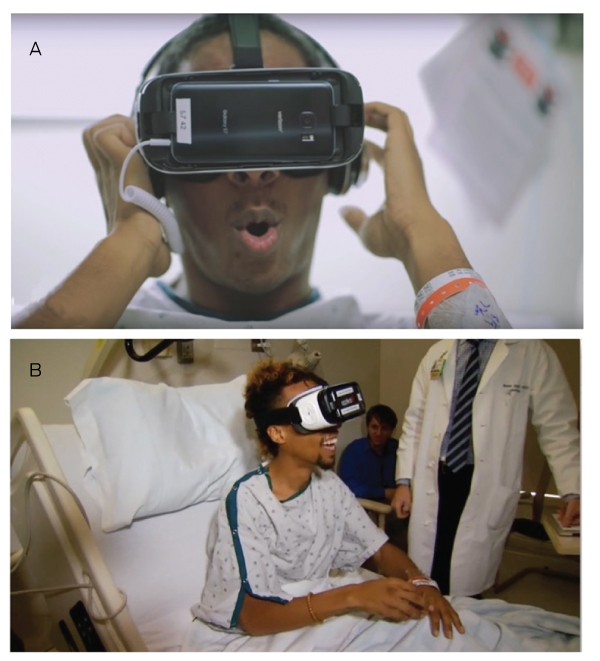
Images and videos obtained with the patients’ permission. * Full video available at https://www.youtube.com/watch?v=vo9bAHAxPyY. † Full video available at https://www.youtube.com/watch?v=o6nwSLdiJ7E&feature=youtu.be.
Competing interests
I have received a research grant, administered by Cedars-Sinai Health Services, from appliedVR (Los Angeles, CA). I have no equity, royalty, board positions or other relevant financial relationships to disclose with appliedVR or any other company with a product or service mentioned in this article.
Acknowledgements
Support for this work is provided by the Marc and Sheri Rapaport Fund for Digital Health Sciences and Precision Health.
References
- Dascal J, Reid M, IsHak WW, et al. Virtual reality and medical inpatients: a systematic review of randomized, controlled trials. Innov Clin Neurosci 2017; 14: 14-21.
- Malloy KM, Milling LS. The effectiveness of virtual reality distraction for pain reduction: a systematic review. Clin Psychol Rev 2010; 30: 1011-1018.
- Hoffman HG, Doctor JN, Patterson DR, et al. Virtual reality as an adjunctive pain control during burn wound care in adolescent patients. Pain 2000; 85: 305-309.
- Hoffman HG, Garcia-Palacios A, Patterson DR, et al. The effectiveness of virtual reality for dental pain control: a case study. Cyberpsychol Behav 2001; 4: 527-535.
- Hoffman HG, Patterson DR, Carrougher GJ. Use of virtual reality for adjunctive treatment of adult burn pain during physical therapy: a controlled study. Clin J Pain 2000; 16: 244-250.
- Hoffman HG, Patterson DR, Carrougher GJ, Sharar SR. Effectiveness of virtual reality-based pain control with multiple treatments. Clin J Pain 2001; 17: 229-235.
- Rizzo AA, Difede J, Rothbaum BO, et al. VR PTSD exposure therapy results with active duty OIF/OEF combatants. Stud Health Technol Inform 2009; 142: 277-282.
- Maples-Keller JL, Bunnell BE, Kim SJ, Rothbaum BO. The use of virtual reality technology in the treatment of anxiety and other psychiatric disorders. Harv Rev Psychiatry 2017; 25: 103-113.
- Maples-Keller JL, Price M, Rauch S, et al. Investigating relationships between PTSD symptom clusters within virtual reality exposure therapy for OEF/OIF veterans. Behav Ther 2017; 48: 147-155.
- Maples-Keller JL, Yasinski C, Manjin N, Rothbaum BO. Virtual reality-enhanced extinction of phobias and post-traumatic stress. Neurotherapeutics 2017; 14: 554-563.
- Bordnick PS, Traylor AC, Carter BL, Graap KM. A feasibility study of virtual reality-based coping skills training for nicotine dependence. Res Soc Work Pract 2012; 22: 293-300.
- Bordnick PS, Traylor A, Copp HL, et al. Assessing reactivity to virtual reality alcohol based cues. Addict Behav 2008; 33: 743-756.
- Bordnick PS, Graap KM, Copp HL, et al. Virtual reality cue reactivity assessment in cigarette smokers. Cyberpsychol Behav 2005; 8: 487-492.
- Li A, Montaño Z, Chen VJ, Gold JI. Virtual reality and pain management: current trends and future directions. Pain Manag 2011; 1: 147-157.
- Carrougher GJ, Hoffman HG, Nakamura D, et al. The effect of virtual reality on pain and range of motion in adults with burn injuries. J Burn Care Res 2009; 30: 785-791.
- Furman E, Jasinevicius TR, Bissada NF, et al. Virtual reality distraction for pain control during periodontal scaling and root planing procedures. J Am Dent Assoc 2009; 140: 1508-1516.
- Garrett B, Taverner T, Masinde W, et al. A rapid evidence assessment of immersive virtual reality as an adjunct therapy in acute pain management in clinical practice. Clin J Pain 2014; 30: 1089-1098.
- Gold JI, Kim SH, Kant AJ, et al. Effectiveness of virtual reality for pediatric pain distraction during i.v. placement. Cyberpsychol Behav 2006; 9: 207-212.
- Sato K, Fukumori S, Matsusaki T, et al. Nonimmersive virtual reality mirror visual feedback therapy and its application for the treatment of complex regional pain syndrome: an open-label pilot study. Pain Med 2010; 11: 622-629.
- Sarig-Bahat H, Weiss PL, Laufer Y. Neck pain assessment in a virtual environment. Spine (Phila Pa 1976) 2010; 35: E105-E112.
- Tashjian VC, Mosadeghi S, Howard AR, et al. Virtual reality for management of pain in hospitalized patients: results of a controlled trial. JMIR Ment Health 2017; 4: e9.
- McCaul KD, Malott JM. Distraction and coping with pain. Psychol Bull 1984; 95: 516-533.
- Mosadeghi S, Reid MW, Martinez B, et al. Feasibility of an immersive virtual reality intervention for hospitalized patients: an observational cohort study. JMIR Ment Health 2016; 3: e28.
Linked content
-
MJA InSight: Is Australian health care ready for virtual medicine?
Provenance: Commissioned; externally peer reviewed.
Using generative artificial intelligence in clinical practice: a narrative review and proposed agenda for implementation
Ian A Scott, Sandeep Reddy, Tanya Kelly, Tim Miller, Anton Vegt
The CURE Asthma roadmap
Gary P Anderson, Anthony Flynn, Phil G Bardin, John D Blakey, Shyamali C Dharmage, Paul Foster, Peter G Gibson, Adam Jaffe, Alan James, Christine R Jenkins, Sundram Sivamalai, Peter D Sly, Guy B Marks, Vanessa M McDonald, Judy Wetttenhall
CURE Asthma: a unique opportunity for Australia
Anthony Flynn, Wendy Edmondson, Alan James, Caroline Lodge, Vanessa M McDonald, Christine R Jenkins, John Blakey, Gary P Anderson
Evidence from Australian cohort studies about asthma trajectories and transitions across the life course: a narrative review
Caroline Lodge, Xin Dai, Ingrid A. Laing, Michael P Menden, Anthony Flynn, Gary P Anderson, Sarath Ranganathan, Shyamali C Dharmage
Technological advances in the search for a CURE for asthma
Sara Quon, Timothy M Johanson, Ridhima Wadhwa, Alen Faiz, Anthony Flynn, Gary P Anderson, Amanda J Cox, Nicholas P West, Michael P Menden, Rhys S Allan
Protecting public interest journalism as a public health good
Bronwyn Fredericks, Neha Lalchandani, Melissa A Sweet, Alex Cramb, Carmel Williams