




Volume 208 - Issue 2
Gas gangrene of the eye: endogenous Clostridium perfringens endophthalmitis
Authors: Ali S Haider, Harkiran Manku and Peter McCluskey
Med J Aust 2018; 208 (2): 64. || doi: 10.5694/mja17.00366
Published online: 5 February 2018
Published online: 5 February 2018
A 59-year-old woman presented with gas gangrene of the leg and no perception of light in her right eye
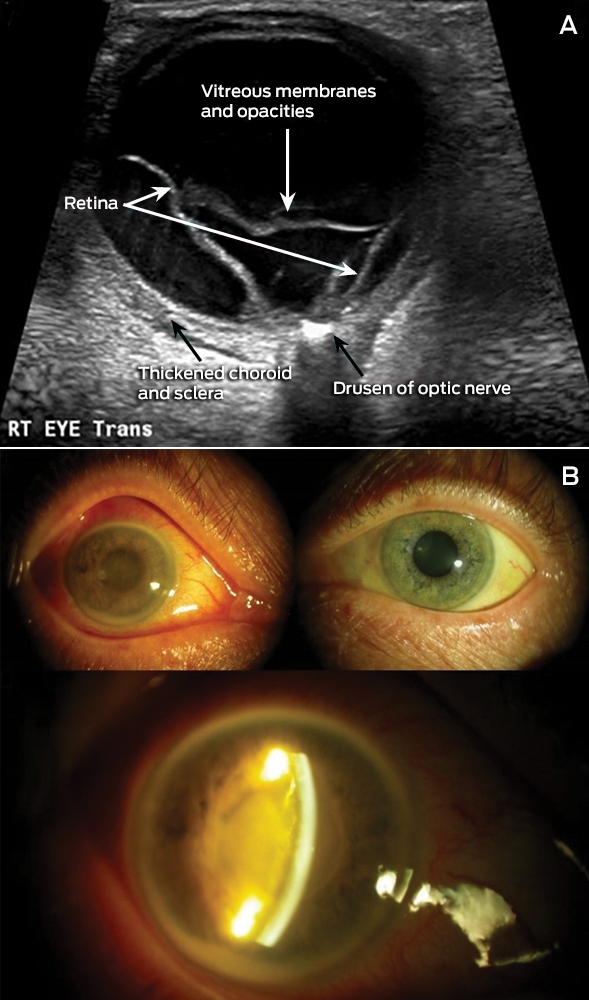
A 59-year-old woman presented with gas gangrene of the leg and no perception of light in her right eye. Ultrasound showed right eye wall thickening and septations within the vitreous chamber indicative of endogenous endophthalmitis and retinal detachment (Figure, A). Intravitreal tap yielded a gaseous haemoserous sample and injection of ceftazidime and vancomycin was performed. Clostridium perfringens was isolated from the vitreous tap and the leg amputated. Slit lamp examination revealed right corneal oedema, anterior chamber shallowing secondary to a dense fibrin plaque overlying the pupil and a streak hypopyon (Figure, B). The patient responded to systemic piperacillin–tazobactam, intravitreal and topical therapy with the right eye retained and vision unchanged.
Endogenous C. perfringens endophthalmitis is blinding and has invariably led to surgical removal of the globe.1,2 Our case highlights the importance of rapid vitreous microscopy and intravitreal antibiotic therapy as a globe saving measure. Metastatic endophthalmitis should be considered in patients with necrotising soft tissue infections and ocular complaints.
Competing interests
No relevant disclosures.
References
- Frantz JF, Lemp MA, Font RL, et al. Acute endogenous panophthalmitis caused by Clostridium perfringens. Am J Ophthalmol 1974; 78: 295-303.
- Crock GW, Heriot WJ, Janakiraman P, Weiner JM. Gas gangrene infection of the eyes and orbits. Br J Ophthalmol 1985; 69: 143-148.
A Diagnostic Headache
Thomas Glynn, Michelle T. Leech, Stacy K. Goergen, Emily Lin, Nadeem Toodayan, Ralph Junckerstorff
Neisseria meningitidis: an uncommon cause of conjunctivitis
Chloe Story, Tina Marinelli, Simeon Crawford, Amrita Ronnachit
Dismantling barriers to research and clinical care for individuals with a vision impairment
Eden G Robertson, Kate Hetherington, Meredith Prain, Julia Hall, Leighton Boyd AM, Rosemary Boyd OAM, Emily Shepard, Hollie Feller, Sally Karandrews, Fleur O'Hare, Kanae Yamamoto, Matthew P Simunovic, Robyn V Jamieson, Alan Ma, Lauren Ayton AM, Anai Gonzalez‐Cordero
The New South Wales Pharmacy Trial for herpes zoster: on the nose?
Christian P Pappas, Timothy R Holmes, Minas T Coroneo
Skin fragility disorder misdiagnosed as child abuse: a cautionary tale
Heather G Mack, Fred K Chen, John R Grigg
Health economic aspects of inherited retinal diseases: looking for cost‐effective treatments
Benjamin Kamien, Rachael Heath Jeffery, Fred K Chen