




Volume 208 - Issue 11
Population attributable fractions of perinatal outcomes for nulliparous women associated with overweight and obesity, 1990–2014
Authors: Jodie Bailie, Jacqueline A Boyle and Ross S Bailie
Med J Aust 2018; 208 (11): 505-506. || doi: 10.5694/mja18.00263
Published online: 18 June 2018
Published online: 18 June 2018
To the Editor:
We congratulate Cheney and colleagues1 for throwing light on the contributions of overweight and obesity on adverse birth outcomes by analysing data from a teaching hospital in central Sydney.1 Around 16% of the women presenting between 2010 and 2014 were overweight, while 7% were obese. Furthermore, despite obesity being an important risk factor for adverse pregnancy outcomes, their study showed a lack of recording of body mass index (BMI) in patients’ records.
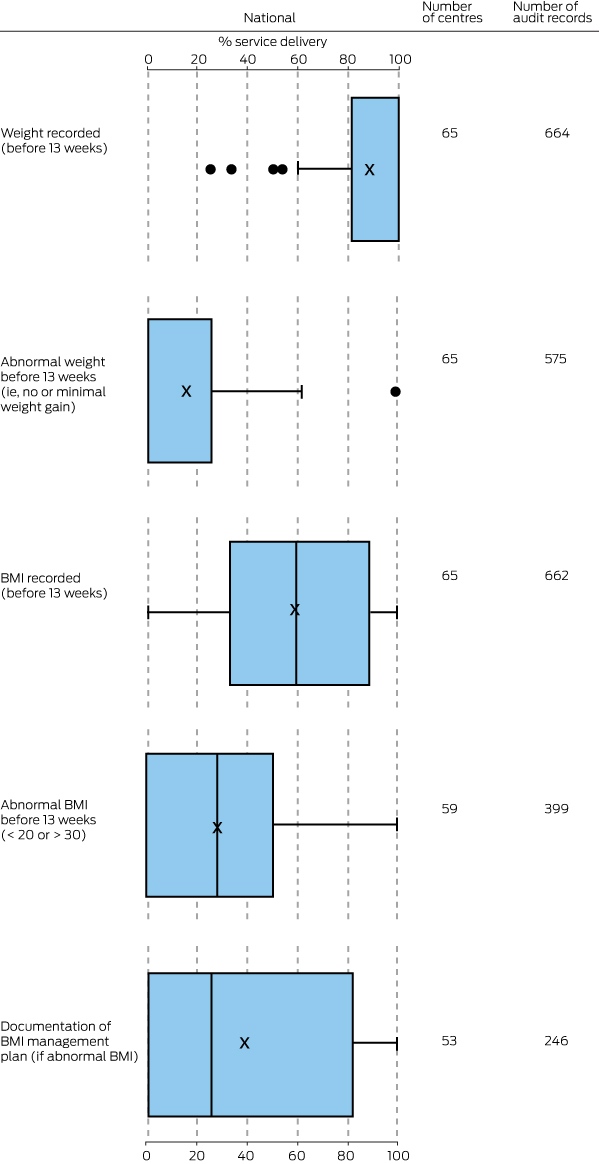
Adverse pregnancy outcomes are more common among Indigenous Australian women than non-Indigenous women;2 obesity levels are high in pre-conception and in pregnancy, and the subsequent adverse impact on increased metabolic health in offspring is likely contributing to early onset of diabetes and chronic disease in Indigenous Australians. Hence, we want to extend the debate to report on what is happening in primary health care (PHC) settings for Indigenous women. We have analysed continuous quality improvement data from audits of adherence to evidence-based guidelines for maternal care in 65 Indigenous PHC centres (1091 patient records) across Australia during 2012–2014.3 The majority of women at most PHC centres had the first trimester weight recorded (mean, 90%; range, 60–100%), but there was wide variation in recording of BMI (mean, ∼ 60%; range, 0–100%) (Box). This indicates that most barriers to BMI recording are more to do with clinicians’ understanding of the value of and ability to calculate BMI than around women’s willingness to be weighed. For women with an abnormal BMI (mean, ∼ 30%; range, 0–100%), there was wide variation in documented BMI management plans (mean, ∼ 40%; range, 0–100%). Dealing with these generally low levels of recording and wide variation in recording between PHC centres is a vital early step in limiting the contribution of obesity to adverse pregnancy outcomes and improving long term health outcomes for the mother and baby.
Women attending PHCs that had participated in continuous quality improvement activities were more likely to receive recommended pregnancy care related to screening and brief interventions for modifiable lifestyle-related risk factors, such as obesity.4,5 These findings support the incorporation of continuous quality improvement activities into the delivery of maternal care.
Box – Record of scheduled maternal care services received by Indigenous women at Indigenous primary health care centres, 2012–2014*
BMI = body mass index. * More information on how to interpret box plots is available in Gibson-Helm et al,3 page 21.
Competing interests
No relevant disclosures.
Acknowledgements
The National Health and Medical Research Council funded the Centre of Research Excellence in Integrated Quality Improvement (Grant ID #1078927). We thank the founding members and new partners and collaborators of the Centre of Research Excellence in Integrated Quality Improvement in Indigenous Primary Health Care for their support, enthusiasm and commitment in the preparation of this manuscript.
References
- Cheney K, Farber R, Barratt AL, et al. Population attributable fractions of perinatal outcomes for nulliparous women associated with overweight and obesity, 1990–2014. Med J Aust 2018; 208: 119-125.
- Thrift AP, Callaway LK. The effect of obesity on pregnancy outcomes among Australian Indigenous and non-Indigenous women. Med J Aust 2014; 201: 592-595.
- Gibson-Helm M, Bailie J, Matthews V, et al. Priority evidence-practice gaps in maternal health care for Aboriginal and Torres Strait Islander people: final report. Brisbane: Menzies School of Health Research; 2016.
- Gibson-Helm ME, Rumbold AR, Teede HJ, et al. Improving the provision of pregnancy care for Aboriginal and Torres Strait Islander women: a continuous quality improvement initiative. BMC Pregnancy Childbirth 2016; 16: 118.
- Gibson-Helm ME, Bailie J, Matthews V, et al. Identifying evidence-practice gaps and strategies for improvement in Aboriginal and Torres Strait Islander maternal health care. PLoS One 2018; 13: e0192262.
Forty Years in the Making: Reporting on the Co-Creation of a National Roadmap for Birthing on Country Services for the Best Start to Life
Res McCalman, Anneka J. Bowman, Roianne West, Kristie Watego, Jyai Allen, Claire Clack, Sue Kildea, Sue Kruske, Melanie Briggs, Cleone Wellington, Rebecca Coddington, Yu Gao, Isabella Garti, Sascha Kowalenko, Sarah Ireland, Catherine Austin, John D. Boffa, Marah Prior, Kelsie Kahl, Bettina Chaseling, Sarah Khaw, Emily Armstrong, Donna Hartz, Yvette Roe
Temporal Trends in Preterm Birth Associated With Hypertensive Disorders of Pregnancy in Victoria, Australia: A Population-Based Interrupted Time-Series Study
Melvin Marzan, Heng Jiang, Daniel Lorber Rolnik, Joanne M. Said, Lisa Hui
Linguistic Manoeuvres: Obstetric Violence Camouflages Harm and Loss of Consent From Birth
Liz Sutton, Harsha Ananthram, Rebecca Matthews
Linguistic Manoeuvres: Obstetric Violence Camouflages Harm and Loss of Consent From Birth
Bashi Kumar-Hazard, Andrew M. Bisits, Sharon L. Settecasse, Jenny Gamble, Hazel Keedle, Hannah G. Dahlen
Linguistic Manoeuvres: Obstetric Violence Camouflages Harm and Loss of Consent From Birth
Wendy Pollock, Alissa Fleming, Ensieh Fooladi, Joy Kloester, Anne Tremayne, Yasmin Zisin, Bethany Carr, Kym Davey, Suzanne Willey, Jenny Gamble
Getting on the Same Page: Why Australia Needs a National Maternity Early Warning System (MEWS) Chart
Briony A. Cutts, Lucy Bowyer, Nisha Khot, Sandra Lowe, Stefan C. Kane