




Reflections
Medical history
Volume 207 - Issue 11
Neville Wran’s voice: how the Premier’s Teflon-coated vocal cords came unstuck
Authors: Evangelos Tseros, Faruque Riffat, Carsten E Palme, Hedley G Coleman and Narinder P Singh
Med J Aust 2017; 207 (11): 468-470. || doi: 10.5694/mja17.00198
Published online: 11 December 2017
Published online: 11 December 2017
His gravelly voice became one of the successful politician’s most defining features
His gravelly voice became one of the successful politician’s most defining features
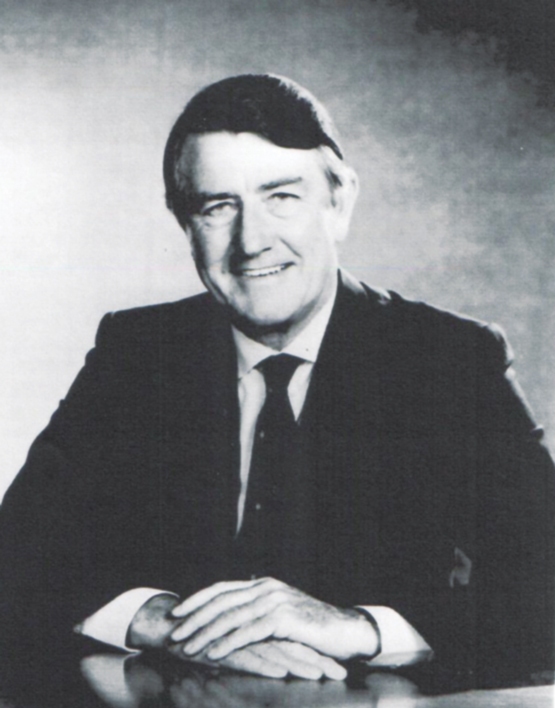
Neville Kenneth Wran was the colourful and charismatic Premier of New South Wales from 1976 to 1986. He was widely respected for his quick wit, engaging informality, and committed representation of blue collar voters. The youngest of eight siblings, he was born in 1926 and raised in the Sydney suburb of Balmain, then a working class stronghold of the Australian Labor Party1 (Box 1).
After receiving his law degree from the University of Sydney in 1948, Neville Wran was admitted as a solicitor in 1951, and became a Queen’s Counsel in 1968. Commencing his political career in 1970, he was elected leader of the NSW Australian Labor Party and then NSW Premier in 1976. Wran achieved some of the most convincing electoral victories in Australian political history, including landslide wins in 1978 (13-seat swing) and 1981 (a further 6-seat swing), each of which saw the then leaders of the opposition Liberal Party lose their own seats.
It was in 1980 that Wran developed his distinctively raspy voice, which became a political trademark throughout the latter part of his career.1 We clarified the clinical circumstances of its development during discussions with members of Mr Wran’s family and clinicians directly involved in his medical treatment.
Mr Wran was first noted to have a weak and breathy voice during a pre-operative anaesthetic workup for pending transurethral prostate surgery in early 1980. The assessing anaesthetist discussed his findings with the on-site otolaryngologist and the prostate procedure was postponed so that Wran’s dysphonia could be investigated. In-office indirect laryngoscopy revealed a lateralised left vocal cord with reduced mobility. At that point, his medical history was unremarkable apart from prostatic hypertrophy and occasional smoking. On further questioning, Wran reported that he had noticed that his voice had been weaker than normal over several years, requiring greater effort in conversations and during telephone calls. His voice was reported to have further deteriorated in the weeks before the laryngoscopy following a viral infection. As the cause of his vocal cord palsy was unknown, Wran was examined under anaesthetic, and this investigation excluded any sinister pathology in the larynx. Neck examination revealed a left thyroid nodule, correlated with a cold nodule on a radioactive iodine scan, raising the possibility of a thyroid malignancy. Fine needle aspiration biopsy was not routinely performed in the early 1980s, so the nodule was excised. During the procedure, the left recurrent laryngeal nerve was noted to be intact and unremarkable. Histopathology confirmed the presence of a benign thyroid adenoma; neck tomography and chest imaging failed to identify any other reason for his left vocal cord palsy. The final working diagnosis was that Mr Wran had a long standing idiopathic, partially compensated vocal cord palsy that may have been exacerbated by a recent upper respiratory tract infection.
Wran’s reduced vocal volume meant that he found himself unable to project his voice in parliamentary debates, which sources close to Wran at the time noted was distressing for him. He considered his voice a major political asset, and believed that this weakness might reduce his prospects for advancing to the Australian Prime Ministership. Concerned about the possible threat to his career, he discussed management options with his treating otolaryngologist.
Normal speech requires both vocal cords to adduct and to come into contact. Unilateral vocal cord palsy often results in the paralysed cord remaining in a lateral, abducted position, unable to adequately contact the opposing normal cord.2 This results in a significant loss of vocal volume and increased air escape during speech, producing a weak, hoarse, breathy voice.
Procedures to return the lateralised cord to a more medial position may restore relatively normal vocal function. Vocal fold injection or injection laryngoplasty, first described in 1911, involves the trans-oral or trans-cervical injection of an inert filler material lateral to the vocal cord, into the paraglottic space (immediately lateral to the thyro-arytenoid and lateral crico-arytenoid muscles), thereby medialising the affected cord.2,3
Filler materials used for vocal fold augmentation are categorised as either temporary or long lasting, and have historically included materials such as silicone, paraffin and Teflon (polytetrafluoroethylene resin, DuPont).4 In current practice, these materials have been replaced by alternatives with more predictable biomechanical properties and a lower risk of triggering foreign body reactions in the larynx. Alternative materials include autologous fat, hydroxyapatite, bovine gelatine, collagen, and hyaluronic acid.2-6 The development of new injectable materials and high definition endoscopic technology has significantly advanced the field of injection laryngoplasty.2
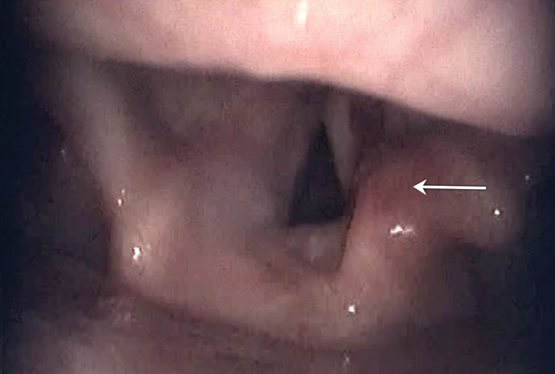
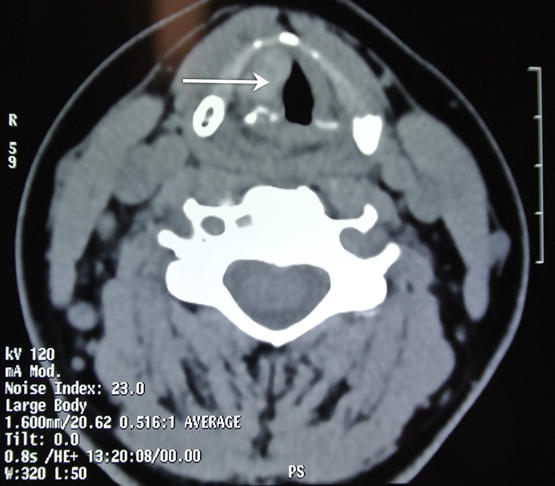
Until the early 1990s, Teflon was a popular choice as an injectable material for vocal fold augmentation because its texture and viscosity permitted easy injection, it was non-toxic, its results were long lasting, and it was thought to be inert. However, a number of early case reports and long term studies indicated that Teflon injections could elicit foreign body granulomatous reactions in some patients4-8 (Box 2). During the 1980s and 1990s, the incidence of Teflon granulomas increased, presenting on direct visualisation of the larynx as erythematous, submucosal swellings (Box 3) and as unilateral, well circumscribed masses on computerised tomography imaging (Box 4). Such granulomas compromise normal vocal cord function by preventing the propagation of a normal physiological waveform, resulting in a harsh, gravelly voice.8,9 Removing the injected Teflon and surrounding granulomas could be attempted with a trans-oral approach or with lateral laryngotomy. However, such procedures were technically challenging and could cause vocal cord scarring. As a result, Teflon fell out of favour in light of the newer, safer alternatives.8
At the time of Wran’s initial dysphonia (1980), vocal fold injection with Teflon was still widely employed to treat symptomatic vocal cord palsy with glottic insufficiency, and was accordingly recommended for his case. His paralysed left vocal fold was medialised during a routine procedure, but when he returned to the post-operative ward, an acute inflammatory response developed in his larynx. His airway remained patent and he was managed conservatively during his hospital stay. His breathing was stable and, apart from an obviously husky voice, he was otherwise well. After discharge, Wran noted that his voice had not returned to its original character, but he was pleased that he could maintain his speaking volume without fatigue. Over the following months, Wran’s voice became increasingly raspy, but his volume and power remained unaffected. Accordingly, he elected not to undergo any corrective procedures, wishing to avoid the risk of further injury.
The characteristic changes to Wran’s voice have been attributed to both an acute inflammatory response to the Teflon injection, together with Teflon-related granuloma secondary to a chronic foreign body reaction.
During his ensuing 6 years as Premier, Wran’s unique voice became a trademark feature that distinguished him from adversaries and colleagues alike. As news of the medical cause of his condition became known and his political fortunes advanced, he acquired the nickname of the “Teflon-coated Premier”.1
Wran resigned from Parliament in 1986, having realised an ambitious, if sometimes controversial agenda of infrastructure and public transport development, institutional reform, environmental protection (including the establishment of 20 new national parks), and social rights advancement (creating the Ethnic Affairs Commission, the Anti-Discrimination Board, the Women’s Advisory Council, and the Ministry of Aboriginal Affairs), as well as public health initiatives that included random breath testing of motorists to reduce drink-driving, lead-free petrol, and a ban on smoking on public transport.10 He died in 2014, aged 87.
Box 2 – Granulomatous multinucleated giant cell foreign body reaction to injected Teflon material (arrows: central areas of basophilia)
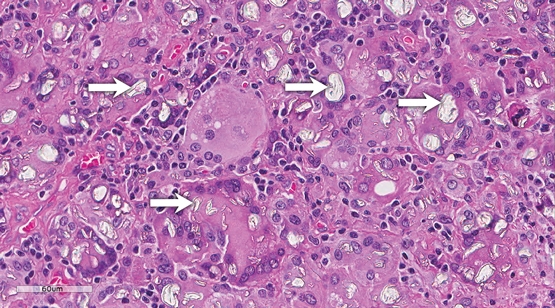
Haematoxylin–eosin staining, high power. Courtesy of Associate Professor Hedley Coleman.
Competing interests
No relevant disclosures.
References
- Steketee M, Cockburn M. Wran: an unauthorised biography. Sydney: Allen & Unwin, 1986.
- Mallur PS, Rosen CA. Vocal fold injection: review of indications, techniques, and materials for augmentation. Clin Exp Otorhinolaryngol 2010; 3: 177-182.
- Sanderson JD, Simpson CB. Laryngeal complications after lipoinjection for vocal fold augmentation. Laryngoscope 2009; 119: 1652-1657.
- Meslemani D, Benninger MS. Coblation removal of laryngeal Teflon granulomas. Laryngoscope 2010; 120: 2018-2021.
- Li L, Stiadle JM, Lau HK, et al. Tissue engineering-based therapeutic strategies for vocal fold repair and regeneration. Biomaterials 2016; 108: 91-110.
- Friedrich G, Dikkers FG, Arens C, et al. Vocal fold scars: current concepts and future directions. Consensus report of the Phonosurgery Committee of the European Laryngological Society. Eur Arch Otolraryngol 2013; 270: 2491-2507.
- Dailey SH, Ng K, Gunderson M, Petty B. Vocal fold reconstruction: a novel flap. Laryngoscope 2013; 123: 2793-2797.
- Pagedar NA, Listinsky CM, Tucker HM. An unusual presentation of Teflon granuloma: case report and discussion. Ear Nose Throat J 2009; 88: 746-747.
- Loehrl TA, Smith TL. Inflammatory and granulomatous lesions of the larynx and pharynx. Am J Med 2001; 111 Suppl 8A: 113s-117s.
- Bramston T. Wran’s plan a way back for NSW Labor. The Australian (Sydney). 4 June 2011. http://www.theaustralian.com.au/national-affairs/wrans-plan-a-way-back-for-nsw-labor/news-story/d434e7b75b1dd86d2b8da564b4d1d015 (accessed Sept 2017).
Provenance: Not commissioned; externally peer reviewed.
Non-Technical Errors Associated With Deaths in Surgical Care, Australia, 2012–2019, by Surgical Specialty (Australian and New Zealand Audit of Surgical Mortality)
Jesse Ey, Guy J. Maddern
Localised Herpes Simplex Following Midline Laparotomy
Jessica S. Bulluss, Paul Chee, Matthew J. Verheyden
Non‐technical errors associated with deaths in surgical care, Australia, 2012–2019, by surgical specialty (Australian and New Zealand Audit of Surgical Mortality): a retrospective cohort study
Jesse Ey, Victoria Kollias, Octavia Lee, Kelly Hou, Matheesha Herath, John B North, Ellie Treloar, Suzanne Edwards, Martin Bruening, Adam J Wells, Guy J Maddern
Changes in patient management after preoperative MRI for newly diagnosed breast cancer: a multicentre prospective observational study
Michael L Marinovich, Nehmat Houssami, Andrew Spillane, Gregory B Mann, Donna Taylor, Michelle Reintals, Nadine Phillips, Max K Bulsara, Patsy Siok Hwa Soon, Tracey Dickens, Christobel M Saunders
The first Australian evidence‐based guidelines on male infertility
Darren J Katz, Liza O’Donnell, Robert I McLachlan, Tim J Moss, Clare V Boothroyd, Veena Jayadev, Sarah R Catford
The first live term birth following uterus transplantation in Australia
Rebecca Deans, Brigitte Gerstl, Antonia W Shand, Sarah Lyons, Aaron Budden, Helen L Barrett, Grant Luxton, Mangalee Fernando, Kenneth Yong, Karen Keung, Kaushalya Arulpragasam, Henry Pleass, King Man Wan, Eva Kehag, Jana‐Emily Pittman, Mianna Lotz, Maria Fenn, Erin Nesbitt‐Hawes, Lily Byun, Katrina Tang, Mats Brannstrom, Jason Abbott