




Volume 206 - Issue 1
Overcoming cardiovascular disease in Indigenous Australians
Authors: Alex Brown and Leonard Kritharides
Med J Aust 2017; 206 (1): 10-12. || doi: 10.5694/mja16.00693
Published online: 16 January 2017
Published online: 16 January 2017
Despite the profound impact of cardiovascular disease in Indigenous Australians, much remains to be achieved
Despite the profound impact of cardiovascular disease on Indigenous Australians, much remains to be achieved
Cardiovascular disease (CVD), including heart disease and stroke, is the major cause of premature death experienced by Aboriginal and Torres Strait Islander Australians.1 Our understanding of CVD, its causes and treatment, has improved dramatically over the past 40 years, resulting in substantial reductions in age- and sex-adjusted mortality.2 Unfortunately, the disparities in cardiovascular health between the overall population and Aboriginal and Torres Strait Islander people have persisted. Perhaps the most concerning feature is the age at which CVD strikes among Aboriginal and Torres Strait Islander people — between 10 and 20 years younger than seen in other Australians.3 The emotional, societal and economic implications of premature CVD mortality and disability are devastating and, in many ways, impossible to measure and fully comprehend.
Effective preventive and therapeutic strategies for CVD are well established, save lives and reduce morbidity, but people who survive an acute event require ongoing and expensive therapy. For Indigenous Australians, profound inequalities exist in relation to access and appropriateness of long term care. Articulating deficits in the delivery of prevention and treatment programs, designing and delivering them, and monitoring improvement in the receipt and outcomes of care have all been accepted as national priorities.4-7 The methods, models of service delivery, systems of care and pharmacological and non-pharmacological interventions that will reverse ingrained inequalities for this population will provide important lessons for the health care system for all Australians. Solving problems in the prevention and treatment of CVD in Indigenous communities will have benefits for other marginalised communities, whether defined by ethnicity, geography or socio-economic status. What we fail to achieve for our most vulnerable citizens will have implications for our aspirations as a fair-minded civil society.
The major cardiovascular conditions affecting Aboriginal and Torres Strait Islander populations include coronary heart disease, congestive heart failure, rheumatic heart disease and cerebrovascular disease (or stroke).8 Actions targeting the prevention of these conditions can be grouped within broad categories of primordial prevention (eg, societal and cultural factors, enabling healthy lifestyle, high quality primary health care) and primary prevention (eg, risk factor detection and treatment of hypertension, hyperlipidaemia, smoking, diabetes, renal disease), as well as treatment of CVD involving an acute phase for medical emergencies such as heart attack or stroke, and a chronic phase of rehabilitation and secondary prevention. In the case of rheumatic heart disease, similar principles apply, with societal factors such as overcrowding and nutrition relevant to primordial prevention, screening with echocardiography for early disease detection, prevention of major disease recurrences with penicillin therapy, and medical management and surgical correction of patients with severely affected cardiac valves. The individual elements of effective health care delivery can be complex, all the more so when the provision of culturally sensitive services is required. The solutions require nuanced understanding of pressure points in health care delivery specific to Aboriginal and Torres Strait Islander populations.
Progress towards previously identified priorities
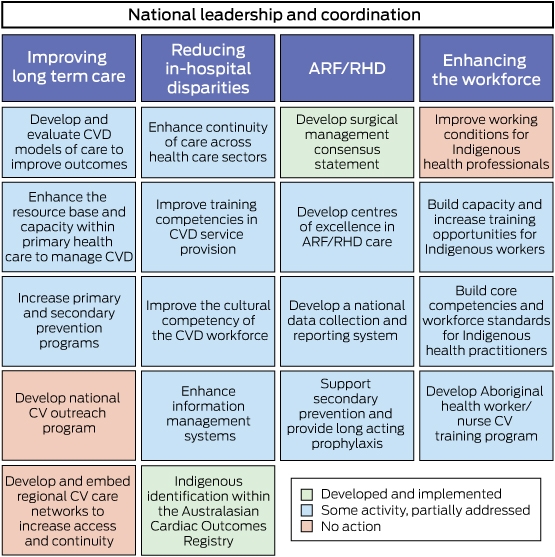
Despite longstanding awareness of the entrenched inequalities that exist, progress is frustratingly slow. Previous national conferences5,9 have identified clear priority areas for action (Box). These have included strategic advocacy, expanding an Aboriginal and Torres Strait Islander workforce across primary and tertiary care, and improving information systems to aid communication across multiple providers. Service development requires defining and overcoming barriers to specialist care in regional and remote settings and establishing specified Indigenous CVD coordinator positions in tertiary hospitals.5,9 Previous studies clearly identify that cultural barriers impede the provision of high quality care10 and that these can be overcome by providing culturally sensitive and integrated programs.11 For rheumatic heart disease, establishing national screening programs and centres of excellence in cardiac surgery have been identified as priorities.12
Careful consideration of what has been achieved gives a mixed scorecard. Progress has been made in the establishment and monitoring of a defined set of cardiovascular health care indicators, in establishing a national rheumatic heart disease strategic framework and program and in completing and publishing an Australian guideline for the surgical management of rheumatic valvular disease.13 The Lighthouse Project,14 a collaboration between the National Heart Foundation and the Australian Healthcare and Hospitals Association, has made important strides in improving acute hospital care and in enhancing relevant workforce training to better meet the needs of Aboriginal and Torres Strait Islander people experiencing CVD. The ESSENCE project (Essential Service Standards for Equitable National Cardiovascular Care for Aboriginal and Torres Strait Islander People)15 was established to define minimum service standards for the prevention, risk factor management, and acute and chronic care that can provide a framework for evaluating progress in overcoming CVD inequalities in Australia. The Australasian Cardiac Outcomes Registry (http://www.acor.net.au) established by the Cardiac Society of Australia and New Zealand, and the Australian and New Zealand Society of Cardiac and Thoracic Surgeons Cardiac Surgery Database (https://www.anzscts.org/national-database) have appropriately incorporated Aboriginal and Torres Strait Islander identifiers within demographic information collated within the databases. This will allow specific tracking of outcomes and service delivery for Aboriginal and Torres Strait Islander people into the future and identify priority areas for further action.
There remain many areas where seemingly little or no progress has been made. There have been no substantive increases in the number of Aboriginal health care workers or Aboriginal cardiovascular nurses, and no formal progress has been made with establishing a national training program for this critical workforce. Although state-based outreach programs exist across some parts of the country (http://www.healthinfonet.ecu.edu.au), we are no closer to establishing a national outreach program or agreed national models of regional cardiovascular care.
Priorities
Our priorities are identified based on the shortfalls in our progress indicated previously and on the potential impact of these areas to cardiovascular health.
Societal, cultural and lifestyle change
That all Australians can live in clean affordable housing, in a supportive social and cultural environment without racism, and have access to fresh, affordable, healthy food is a national responsibility, not an individual privilege. Social and physical environments can be critical to the primordial prevention of ill health for all populations.16
Primary care — prevention and chronic care
The barriers to access, defined broadly, include geography and out-of-pocket costs to patients (currently addressed by several national schemes, both universal and specific to Indigenous people).17 Overcoming the problems of remoteness can be minimised by expanding treatment and referral guidelines that support primary care in the delivery of acute care, and coordinating the efficient transfer of acutely ill patients from regional and remote centres to tertiary sites.18 In Texas, telemedicine improved access to acute health care for stroke and overcame ethnic and racial disparities in health care delivery.19
Providing affordable medications in a culturally sensitive manner is very important. Expanding the number of Aboriginal and Torres Strait Islander health care workers and developing a national training program that targets CVD treatment and prevention are also important. Primary care providers need to be able to work closely with rehabilitation facilities and tertiary centres so as to facilitate shared decision making, monitor long term therapies and control risk factors as advocated in National Health and Medical Research Council guidelines.20 It is unclear how globally or effectively such shared care has been established, but it is clear that the patient journey is improved by enhancing cultural awareness and support before, during and after episodic hospital care.21
Formal relationships between caregivers at tertiary and primary centres should be strengthened with formal memoranda of understanding and mutual obligation. Data measuring how well services are provided at a regional or community level will allow underserviced communities to be better targeted.
Tertiary care
There are few things as daunting to many Aboriginal and Torres Strait Islander people as finding themselves referred to a major teaching hospital in a large city where language and culture may be completely foreign. Self-discharge from hospitals is common among Aboriginal and Torres Strait Islander patients and, while multifactorial, health literacy and cultural factors play a part.22 Importantly, the rate of self-discharge was reduced by the engagement of Aboriginal and Torres Strait Islander hospital liaison officers.22
Mapping out a national outreach program that builds on existing services is important to monitor and improve the level of service delivery. Successful outreach services need to be maintained and strengthened. Areas that are inadequately served need clinical and administrative support.
Next steps
To make the most immediate impact on life expectancy for Indigenous Australians, we recommend:
the completion of a national audit of the delivery and quality of cardiovascular care provided to Aboriginal and Torres Strait Islanders according to agreed minimum service standards (the ESSENCE framework);15
the establishment of regional outreach networks of cardiovascular care;
significant investment in the number and expertise of an Aboriginal and Torres Strait Islander CVD workforce across all health professions; and
a concerted effort to improve the cultural competence of the existing cardiovascular care workforce.
References
- Australian Institute of Health and Welfare. Contribution of chronic disease to the gap in adult mortality between Aboriginal and Torres Strait Islander people and other Australians (AIHW Cat. No. IHW 48). Canberra: AIHW, 2011.
- Roth GA, Forouzanfar MH, Moran AE, et al. Demographic and epidemiologic drivers of global cardiovascular mortality. N Engl J Med 2015; 372: 1333-1341.
- Brown A. Addressing cardiovascular inequalities among indigenous Australians. Glob Cardiol Sci Pract 2012; 2.
- Brown A, Kritharides L. Cardiovascular disease. Heart Lung Circ 2010; 19: 263.
- Brown A, Kritharides L. Overview: the 2nd Indigenous Cardiovascular Health Conference of the Cardiac Society of Australia and New Zealand. Heart Lung Circ 2012; 21: 615-617.
- Brown A, O’Shea RL, Mott K, et al. Essential service standards for equitable national cardiovascular care for Aboriginal and Torres Strait Islander people. Heart Lung Circ 2015; 24: 126-141.
- Brown A, Tonkin A, White H, et al. The Cardiac Society Inaugural Cardiovascular Health Conference: conference findings and ways forward. Heart Lung Circ 2010; 19: 264-268.
- Gray C, Brown A, Thomson N. Review of cardiovascular health among Indigenous Australians. HealthInfoNet, 2012. http://www.healthinfonet.ecu.edu.au/chronic-conditions/cvd/reviews/heart_review (accessed Aug 2016).
- Kritharides L, Brown A, Brieger D, et al. Recommendations arising from the inaugural CSANZ Conference on Indigenous Cardiovascular Health. Heart Lung Circ 2010; 19: 269-272.
- Aspin C, Brown N, Jowsey T, et al. Strategic approaches to enhanced health service delivery for Aboriginal and Torres Strait Islander people with chronic illness: a qualitative study. BMC Health Serv Res 2012; 12: 143.
- Tibby D, Corpus R, Walters D. Establishment of an Innovative Specialist Cardiac Indigenous Outreach Service in Rural and Remote Queensland. Heart Lung Circ 2010; 19: 361-366.
- White H, Walsh W, Brown A, et al. Rheumatic heart disease in Indigenous populations. Heart Lung Circ 2010; 19: 273-281.
- Walsh W, Brown A, Carapetis J. The diagnosis and management of chronic rheumatic heart disease — an Australian guideline. Heart Lung Circ 2008; 17: 271-289.
- Australian Heatlhcare and Hospitals Association. News. Lighthouse project shines a light on best practice healthcare for Aboriginal and Torres Strait Islander patients. 10 Apr 2015. http://ahha.asn.au/news/lighthouse-project-shines-light-best-practice-healthcare-aboriginal-and-torres-strait-islander (accessed Sept 2016).
- Brown A, O’Shea RL, Mott K, et al. A strategy for translating evidence into policy and practice to close the gap — developing essential service standards for Aboriginal and Torres Strait Islander cardiovascular care. Heart Lung Circ 2015; 24: 119-125.
- Marmot M, Friel S, Bell R, et al. Closing the gap in a generation: health equity through action on the social determinants of health. Lancet 2008; 372: 1661-1669.
- Australian Institute of Health and Welfare. The health and welfare of Australia’s Aboriginal and Torres Strait Islander peoples: 2015 (AIHW Cat. No. IHW 147). Canberra: AIHW, 2015. http://www.aihw.gov.au/publication-detail/?id=60129550168 (accessed Sept 2016).
- Tideman P, Tirimacco R, Senior DP, et al. Impact of a regionalised clinical cardiac support network on mortality among rural patients with myocardial infarction. Med J Aust 2014: 200: 157-160.
- Lyerly MJ, Wu T-C, Mullen MT, et al. The effects of telemedicine on racial and ethnic disparities in access to acute stroke care. J Telemed Telecare 2016; 22: 114-120.
- National Health and Medical Research Council. Strengthening cardiac rehabilitation and secondary prevention for Aboriginal and Torres Strait Islander peoples. Canberra: Australian Government, 2005. https://www.nhmrc.gov.au/guidelines-publications/ind1-ind2 (accessed Sept 2016).
- Lawrence M, Dodd Z, Mohor S, et al. Improving the patient journey: achieving positive outcomes for remote Aboriginal cardiac patients. Darwin: Cooperative Research Centre for Aboriginal Health, 2009.
- Einsiedel LJ, van lersel E, McNamara R, et al. Self-discharge by adult Aboriginal patients at Alice Springs Hospital, Central Australia: insights from a prospective cohort study. Aust Health Rev 2013; 37: 239-245.
Fatty Liver Disease in Australia: A Narrative Review on the Epidemiology, Natural History, Prognostication and Management in People With Metabolic Dysfunction
Karl Vaz, Daniel Clayton-Chubb, William W. Kemp, Stuart K. Roberts, Ammar Majeed
Sex Differences in Management and Outcomes of People With ST-Elevation Myocardial Infarction, New South Wales, 2011–2020: A Retrospective Cohort Study
Adam C. Livori, Jedidiah I. Morton, Dianna J. Magliano, Jonathan E. Shaw
Rethinking Rheumatic Fever Diagnosis: Progress, Pitfalls and the Path Towards a Definitive Test
Anna P. Ralph, Rachel Webb, Tom Parks, Nicole J. Moreland, Asha C. Bowen, Benjamin Jones, Emma Ndagire, Andrea Z. Beaton
Sex Differences in Management and Outcomes of People With ST-Elevation Myocardial Infarction, New South Wales, 2011–2020: A Retrospective Cohort Study
Samia Kazi, Simone Marschner, Clara K. Chow
Distribution of Cardiovascular Disease Risk Based on the Updated 2023 Guideline-Recommended Australian Cardiovascular Disease Risk Algorithm and Comparison With the 2012 Algorithm: An Observational Study
Nina Lazarevic, Meghana Bhat, Grace Joshy, Danielle C. Butler, Mark Woodward, Anushka Patel, Rod T. Jackson, Garry Jennings, Rosemary Wyber, Ellie Paige, Emily Banks
They Brought the Hospital to Me
Hugh N. Burrill