




Volume 204 - Issue 4
Trends in drug use among adolescents admitted to residential treatment in Australia
Authors: Sally Nathan, Anna Bethmont, Patrick R Rawstorne, Mark Ferry and Andrew Hayen
Med J Aust 2016; 204 (4): 149-150. || doi: 10.5694/mja15.01018
Published online: 7 March 2016
Published online: 7 March 2016
Methamphetamine use among this adolescent population has increased substantially
In Australia, trends in drug use are primarily measured through two population surveys.1,2 These show alcohol, cannabis and tobacco to be the most commonly used drugs among adolescents. The National Drug Strategy Household Survey found that methamphetamine use has remained very low (2%) and stable among 14–19 year olds, with no rise in methamphetamine use overall in the population; however, there was a change in the main form, with crystal (“ice”) replacing powder.2
Population-level surveys are not sensitive to changes in use of drugs, which have a low prevalence in the general population by different age groups. Our report examines trends in reported current drug use and drug of greatest concern among an adolescent population admitted to four residential treatment sites across New South Wales and the Australian Capital Territory from 2009 to 2014. These young people are likely to be excluded from population surveys.3
The study sample included 865 adolescents, aged 14–18 years, admitted to residential treatment between 1 July 2009 and 31 December 2014, representing a large proportion of the adolescent residential treatment population in NSW and the ACT.4 Analyses included log-binomial regression for trends by admission year and multiple log-binomial regression to control for changes over time in sociodemographic characteristics.
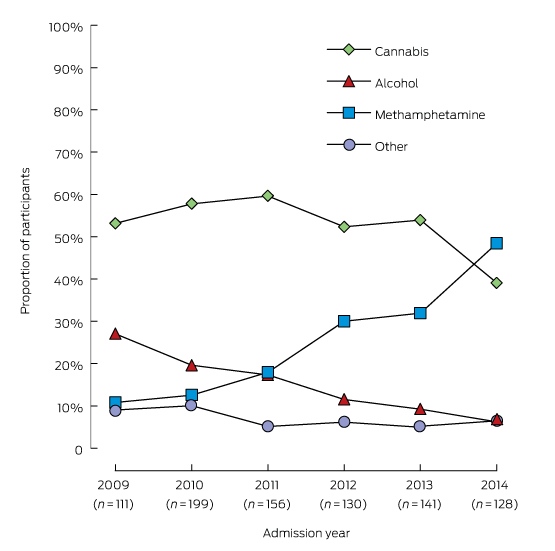
The mean age of the study population was 16.6 years and 72.6% were male (Box 1). Over a third (37.2%) were referred by juvenile justice staff or self-reported criminal activity. Methamphetamine was the only drug to show an upward trend in the reporting of drug of greatest concern (Box 2), from 10.8% in 2009 to 48.4% in 2014 (relative risk [RR] per year, 1.37; 95% CI, 1.27–1.47); and in current use of drug at admission, from 28.8% in 2009 to 59.4% in 2014 (RR per year, 1.15; 95% CI, 1.09–1.22). Trends in methamphetamine use remained significant after controlling for sociodemographic characteristics. Alcohol, cannabis and tobacco use remain high, with 64.1% of participants reporting currently using alcohol, 85.2% cannabis and 72.7% tobacco in 2014.
Among 321 participants reporting current methamphetamine use, those reporting inhaling smoke or vapour increased from 12.5% in 2009 to 85.5% in 2014 (RR per year, 1.21; 95% CI, 1.15–1.27). Different forms of methamphetamine were not recorded; however, ice is commonly inhaled, which suggests that the main form used by participants has changed. There were associations between methamphetamine use and number of places lived and enrolment in a special class at school, suggesting that young people who may have learning difficulties or unstable accommodation may be at a higher risk of methamphetamine use or that use may result in learning issues and unstable accommodation.
Although self-reporting is common in behavioural research, there may be some response bias. For example, recent media attention may have increased reporting of methamphetamine as the drug of greatest concern. Under-reporting of methamphetamine use may also have occurred due to stigma. However, we found similar trends on both measures. The questions used were drawn from scales in the Brief Treatment Outcome Measure, which was developed in six phases including testing psychometric properties with treatment clients, a 30-month clinical trial in selected rural and metropolitan health services and clinician feedback.5
In contrast to stable population-level trends, methamphetamine use among this adolescent population has increased substantially. To equitably address methamphetamine-related harms, population surveys and health campaigns should be supplemented by a targeted approach to monitoring, prevention and treatment of at-risk groups.
Box 1 – Sociodemographic characteristics of participants (n = 865)*
Characteristic |
No. of participants |
||||||||||||||
Mean age, years (SD) |
16.6 (1.0) |
||||||||||||||
Male |
628 (72.6%) |
||||||||||||||
Ever suspended or expelled from school |
725 (83.8%) |
||||||||||||||
Ever enrolled in special class at school |
340 (39.3%) |
||||||||||||||
Places lived in previous 6 months |
|||||||||||||||
1 |
287 (33.2%) |
||||||||||||||
2 |
235 (27.2%) |
||||||||||||||
3 |
160 (18.5%) |
||||||||||||||
≥ 4 |
183 (21.2%) |
||||||||||||||
Arrests in previous 3 months |
|||||||||||||||
0 |
279 (32.3%) |
||||||||||||||
1 |
241 (27.9%) |
||||||||||||||
2–3 |
233 (26.9%) |
||||||||||||||
≥ 4 |
112 (12.9%) |
||||||||||||||
* Data are number and proportion of participants unless otherwise indicated. | |||||||||||||||
Competing interests
No relevant disclosures.
References
- White V, Bariola E. Australian secondary school students’ use of tobacco, alcohol, and over-the- counter and illicit substances in 2011. Report prepared for Drug Strategy Branch, Australian Government Department of Health and Ageing. Melbourne: Centre for Behavioural Research in Cancer, Cancer Council Victoria, 2012. http://www.nationaldrugstrategy.gov.au/internet/drugstrategy/Publishing.nsf/content/BCBF6B2C638E1202CA257ACD0020E35C/$File/National%20Report_FINAL_ASSAD_7.12.pdf (accessed Jan 2016).
- Australian Institute of Health and Welfare. National Drug Strategy Household Survey detailed report 2013 (AIHW Cat. No. PHE 183; Drug Statistics Series No. 28) Canberra: AIHW, 2014. http://www.aihw.gov.au/alcohol-and-other-drugs/ndshs-2013 (accessed Jan 2016).
- Arcuri A, Howard J. PALM StatsPack 2001-2005. Sydney: Ted Noffs Foundation, 2006.
- Australian Institute of Health and Welfare. Alcohol and other drug treatment services in Australia 2012-13. (AIHW Cat. No. HSE 150; Drug Treatment Series No. 24) Canberra: AIHW, 2014. http://www.aihw.gov.au/publication-detail/?id=60129548206 (accessed Jan 2016).
- Lawrinson P, Copeland J, Indig D. The brief treatment outcome measure: opioid maintenance pharmacotherapy (BTOM) manual. NDARC Technical Report No. 156. Sydney: National Drug and Alcohol Research Centre, 2003. https://ndarc.med.unsw.edu.au/resource/brief-treatment-outcome-measure-opioid-maintenance-pharmacotherapy-btom-manual (accessed Jan 2016).
Linked content
-
MJA: “Ice” (crystal methamphetamine): concerns and responses
-
MJA: Trends in methamphetamine residues in wastewater in metropolitan and regional cities in south-east Queensland, 2009–2015
-
MJA: Estimating the number of regular and dependent methamphetamine users in Australia, 2002–2014
-
Podcast: Ice and the GP, with Professor Margaret Hamilton, AO
-
MJA InSight: Dealing with ice “a hard slog”
Medical Colleges Have an Obligation to Ensure Full Participation in Clinical Quality Registries
Thomas J. Hugh
Getting on the Same Page: Why Australia Needs a National Maternity Early Warning System (MEWS) Chart
Briony A. Cutts, Lucy Bowyer, Nisha Khot, Sandra Lowe, Stefan C. Kane
Data for Equity: Can Linked Administrative Data Inform Pathways to More Equitable Child Health?
Sarah Gray, Shuaijun Guo, Meredith O'Connor, Elodie O'Connor, Katrina Williams, Hannah Badland, Susan Woolfenden, Josie Dickerson, Gerry Redmond, Marnie Downes, Sharon R. Goldfeld
Specialty College Selection: Why Change is Critical to Support a Future Rural Workforce
Matthew R. McGrail, Jenny May AM, Katherine Logan
Differentiated and simplified oral HIV pre‐exposure prophylaxis (PrEP) models hold the key to virtually eliminating HIV transmission in Australia by 2030
Tyson Arapali, Sarah Warzywoda, Anthony K J Smith, Curtis Chan, Timothy R Broady, Erin Sullivan, Catherine MacPhail, Mohamed A Hammoud, Alexander Dowell‐Day, Benjamin R Bavinton
The number of cancer‐related deaths that could be attributable to spatial disparities in survival in Australia, 2010–2019: a retrospective population‐based cohort study
Charlotte K Bainomugisa, Jessica Cameron, Paramita Dasgupta, Peter Baade